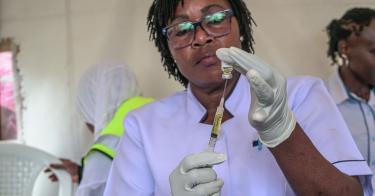
Last year saw the lowest number of people dying of AIDS around the world in over 30 years. This should be big news, given the millions the disease has killed and the billions the United States government has spent to combat it. Yet it isn’t. Why?
It’s not just the media’s natural aversion to reporting good news. The real problem is when that good news undercuts the foreign aid industry’s narrative that President Donald Trump’s dismantling of the U.S. foreign aid apparatus has been an unmitigated global catastrophe.
The U.S. Agency for International Development’s demise last year prompted severe criticism. For thousands of people that lost their jobs and careers it is understandable. But one should expect more calibrated responses from prominent foreign aid advocates.
It was the opposite. U2 frontman Bono cited an estimate suggesting that as many as 300,000 people may already have died as a result of the cuts, while acknowledging that the figure was unproven. Bill Gates warned that millions could die if cuts are not reversed. UNAIDS warned that the collapse of U.S.-supported HIV services could lead to around 4 million additional AIDS-related deaths between 2025 and 2029. A Lancet study projected that continued USAID defunding could result in more than 14 million additional deaths from all causes by 2030.
Missed amid the histrionics was that according to UNAIDS, 570,000 people died of AIDS worldwide in 2025, the lowest in years and a 73% decline from a peak of over 2.1 million in 2004. While still too high, the vast improvement is a testament to America’s unique and durable ability to mobilize massive resources—particularly through the U.S. President’s Emergency Plan for AIDS Relief, or PEPFAR, and taxpayer generosity—to respond to any global crisis anywhere. The predicted mass death did not happen last year, nor so far this year, and the industry looks unserious.
It is over 18 months since Trump ordered a review and suspension of U.S. foreign assistance, leading to USAID’s subsequent dismantling, and the reimagining of foreign aid as an unapologetic tool of national security. This was the basis for USAID’s establishment during the Cold War.
We can now better assess the impact. Emerging is a picture not of death and doom but, rather, a growing self-reliance from once aid-dependent countries where social services were regularly outsourced to foreign groups. They are now stepping up.
An accelerated journey to self-reliance
As the Democratic Republic of Congo struggles to contain its 17th Ebola outbreak—amid concerns about reduced U.S. assistance—in a region beset by armed conflict, neighboring Uganda was declared free of the Ebola virus by the World Health Organization in August.
Kenya, meanwhile, has mobilized testing, contact tracing, and surveillance after confirming its first imported Ebola case in October. As of Oct. 11, authorities had reported no additional infections.
Both prove Africa’s growing competence to handle serious epidemics.
Ghana responded to its aid funding gap by removing a cap on the National Health Insurance Fund, freeing up an estimated $300 million, to “take our destinies into our own hands.”
African leaders are mobilizing continentwide to develop new financial models not with donor agencies but with the private sector. They rightly see local manufacturing of medicines as “central to health sovereignty and long-term development.” Africa CDC estimates that the continent imports around 70%-90% of its medicines and medical devices and 99% of its vaccines.
Kenya’s President William Ruto, one of the continent’s vocal advocates of a shift away from dependence on foreign assistance, sums up Africa's reaction to U.S and Europewide foreign aid cuts: “Africa wants investment and equal partnership, not aid.”
Aid cuts are not just a MAGA obsession. European socialist and conservative governments alike are also reducing aid budgets amid fiscal pressures and changing priorities, and questions of aid effectiveness.
The new U.S. bilateral health agreements
In part, the African continent’s accelerated move to self-reliance springs from the U.S. administration’s restructuring of its global health programs. It has struck 36 government-to-government agreements. The administration says that countries will receive predictable multiyear financing and technical support to transition to full financial ownership of these lifesaving programs. I understand this is designed to cut out international NGOs, U.N. agencies, and contractors in favor of direct engagement with the private drug producers, and is this not what was needed?
Corruption and the legacy of foreign aid
For years, open-ended foreign aid subsidized African budgets that, in many cases, fostered a culture of corruption and rewarded bad economic policies. Meanwhile, aid diversion risks undercutting congressional and popular support for foreign aid.
>>> PEPFAR: From AIDS Relief to Leftwing Funding Apparatus
If the new approach creates stronger incentives for accountability and domestic ownership, that would be a welcome change.
Also, fears that placing America’s global disaster response capacity under the State Department proved misplaced, as shown by the U.S. response to Venezuela’s earthquakes.
Nevertheless, the sector’s condescending dismissal of foreign aid critics continues. The administration’s approach to foreign aid is based on working oneself out of a job by transitioning from traditional grants-based aid to what we all know creates wealth: foreign investment and trade.
This was the core of USAID’s Journey to Self-Reliance during the first Trump administration. Throughout the decades, foreign aid achieved much in advancing American interests and doing good, but it went on too long without a credible and sustainable pathway to self-reliance.
Still, much of the media coverage focuses on the disruption caused by the dismantling of USAID, covering views of former aid officials and defunded partners. Without an honest accounting of both the costs of the cuts and the results of the new approach, rebuilding bipartisan confidence in foreign aid will remain difficult.
This piece originally appeared in Devex