

In 2025, six states introduced legislation or a rule concerning illegal alien K–12 students in public schools. The measures range from collecting immigration status and reporting the data to state officials to charging tuition for such students attending public schools. This is an unsurprising and appropriate state response to the large numbers of inadmissible aliens resettled in their communities without their consent, agreement, or permission during the Biden Administration’s four-year open border operations. As of this writing, none of the legislation has been enacted.
By facilitating and enabling mass migration into and throughout the United States, the Biden Administration burdened states and localities with unsustainable costs, including public education.
In their pursuit to charge tuition for illegal alien students, six states sought to challenge the 1982 Plyler v. Doe Supreme Court decision, in which a five-to-four majority led by Justice William Brennan held that a Texas statute withholding state funds from local school districts for the education of illegal alien children violated the Equal Protection Clause of the 14th Amendment.REF
This Backgrounder summarizes the Supreme Court’s majority and dissenting opinions in Plyler and explains why it was wrongly decided. Second, this Backgrounder explains federal statutory changes enacted and changed circumstances in U.S. immigration that have developed since the 1982 Supreme Court decision. Third, this Backgrounder describes the current changes that states are considering in order to address the expensive burden of educating large numbers of children who came to the United States illegally. Finally, this Backgrounder provides model legislation that states could introduce and enact to address this decades-old problem.
Advocacy groups would inevitably sue state and local officials and claim that such a law is unconstitutional according to Plyler v. Doe. However, the issue deserves to be reconsidered in the courts. The Supreme Court should overturn Plyler because states have an interest in preventing illegal aliens from receiving free education paid by citizen and legal-resident taxpayers.
Legislative and Judicial History of Plyler
Following is a look at the legislative action and judicial rulings that culminated in the 1982 Plyler decision.
The Texas Statute that Led to Plyler v. Doe. In May 1975, the Texas legislature amended its education law to withhold from local school districts any state funds for the education of children who were not legally admitted into the United States. The revision also authorized local school districts to deny enrollment in their public school to children not legally admitted to the country.
Texas Education Code, Annotated, § 21.031, provided, in part:
(a) All children who are citizens of the United States or legally admitted aliens and who are over the age of five years and under the age of 21 years on the first day of September of any scholastic year shall be entitled to the benefits of the Available School Fund for that year.
(b) Every child in this state who is a citizen of the United States or a legally admitted alien and who is over the age of five years and not over the age of 21 years on the first day of September of the year in which admission is sought shall be permitted to attend the public free schools of the district in which he resides or in which his parent, guardian, or the person having lawful control of him resides at the time he applies for admission.
(c) The board of trustees of any public free school district of this state shall admit into the public free schools of the district free of tuition all persons who are either citizens of the United States or legally admitted aliens and who are over five and not over 21 years of age at the beginning of the scholastic year if such person or his parent, guardian, or person having lawful control resides within the school district.REF
Despite the enactment of this law in 1975, the Tyler Independent School District continued to enroll illegal alien students free of charge until July 1977, when the school district adopted a policy requiring the parents or guardians of illegal alien students to pay a “full tuition fee” to enroll.REF
In 1977, a class action suit on behalf of illegal alien school-aged children from Mexico was brought against the superintendent and members of the Board of Trustees of the Tyler Independent School District under the Equal Protection Clause of the 14th Amendment. The State of Texas intervened as a defendant.
Section 1 of the 14th Amendment states in part: “No State shall make or enforce any law which shall abridge the privileges or immunities of citizens of the United States; nor shall any State deprive any person of life, liberty, or property, without due process of law; nor deny to any person within its jurisdiction the equal protection of the laws.”REF
The Lower Courts. The U.S. District Court for the Eastern District of Texas enjoined the school district and state from enforcing the Texas school statute. The court found that the Texas statute did not have “either the purpose or effect of keeping illegal aliens out of the State of Texas.”REF Regarding the state’s claim that the statute was a financial measure designed to save costs, the court acknowledged that increased Mexican immigration to the United States had created problems for Texas public schools, which were exacerbated by the additional educational needs of Mexican children, such as learning English.REF The court noted, however, that the increased school enrollment was primarily due to the admission of children who were legal residents.
In 1977, the court for the Eastern District of Texas acknowledged that increased Mexican immigration to the United States had created problems for Texas public schools.
While the court acknowledged that exclusion of all illegal alien children from the Texas public schools would reach economies at some point, doing so would not necessarily improve the overall quality of education.REF The court found that the Texas statute affected “a very small subclass of illegal aliens, ‘entire families who have migrated illegally and—for all practical purposes—permanently to the United States.’”REF Finally, the district court held that “the illegal alien of today may well be the legal alien of tomorrow” and without an education, these “undocumented children,” “[a]lready disadvantaged as a result of poverty, lack of English speaking ability, and undeniable racial prejudices…will become permanently locked into the lowest socio-economic class.”REF
The District Court concluded that illegal aliens were entitled to protection under the Equal Protection Clause and that the Texas statute violated that clause. The court suggested that excluding illegal alien children from public schools “may well be the type of invidiously motivated state action for which the suspect classification doctrine was designed.”REF It avoided analyzing whether the Texas statute would survive strict scrutiny as unnecessary because “the discrimination embodied in the statute was not supported by a rational basis.”REF
The Court of Appeals for the Fifth Circuit upheld the District Court’s injunction, concluding that the Texas statute was “constitutionally infirm regardless of whether it was tested using the mere rational basis standard or some more stringent test.”REF
1982 Supreme Court Plyler v. Doe Decision
Following are descriptions of Plyler, from the majority opinion to the dissent, and the interests of the State of Texas.
The Brennan Majority Opinion. On appeal to the Supreme Court, Texas asserted that illegal aliens, due to their immigration status, are not “persons within the jurisdiction” of the State of Texas and, therefore, have no right to the equal protection of the law. Texas also argued that its school statute had three justifications. It would (1) prevent an influx of illegal aliens into Texas, (2) alleviate the burdens on the education system caused by educating illegal aliens, and (3) alleviate burdens created by educating children who are unlikely to remain in the state and contribute to it.
Brennan wrote the majority opinion for the Supreme Court, joined by Justices Thurgood Marshall, Harry Blackmun, Lewis Powell, and John Paul Stevens.
Brennan rejected the state’s argument that illegal aliens are not “persons within the jurisdiction” of the State of Texas and therefore have no right to the equal protection of the law.REF Brennan wrote:
Whatever his status under the immigration laws, an alien is surely a “person” in any ordinary sense of that term. Aliens, even aliens whose presence in this country is unlawful, have long been recognized as “persons” guaranteed due process of law by the Fifth and Fourteenth Amendments…. Indeed, we have clearly held that the Fifth Amendment protects aliens whose presence in this country is unlawful from invidious discrimination by the Federal Government.REF
The Brennan majority concluded that
the phrase “within its jurisdiction” thus does not detract from, but rather confirms, the understanding that the protection of the Fourteenth Amendment extends to anyone, citizen or stranger, who is subject to the laws of a State, and reaches into every corner of a State’s territory. That a person’s initial entry into a State, or into the United States, was unlawful, and that he may for that reason be expelled, cannot negate the simple fact of his presence within the State’s territorial perimeter. Given such presence, he is subject to the full range of obligations imposed by the State’s civil and criminal laws. And until he leaves the jurisdiction—either voluntarily, or involuntarily in accordance with the Constitution and laws of the United States—he is entitled to the equal protection of the laws that a State may choose to establish.REF
The Court then turned to the question whether the Equal Protection Clause was violated by the refusal of the State of Texas to reimburse local school boards for the education of children who cannot demonstrate lawful presence in the United States or by the imposition by those school boards of the burden of tuition on those children. The Brennan majority spent several pages considering and justifying which standard of review to use for the affected group and the right at issue. The Court explained the lowest standard of review, or rational basis test, stating:
A legislature must have substantial latitude to establish classifications that roughly approximate the nature of the problem perceived, that accommodate competing concerns both public and private, and that account for limitations on the practical ability of the State to remedy every ill. In applying the Equal Protection Clause to most forms of state action, we thus seek only the assurance that the classification at issue bears some fair relationship to a legitimate public purpose.REF (Emphasis added.)
The majority pivoted away from the lowest standard of review to the higher standard of review, by stating, “But we would not be faithful to our obligations under the Fourteenth Amendment if we applied so deferential a standard to every classification…. We have treated as presumptively invidious those classifications that disadvantage a ‘suspect class,’ or that impinge upon the exercise of a ‘fundamental right.’” For such classifications, the Court uses the strict scrutiny standard of review, which requires the State to demonstrate that its classification has been “precisely tailored to serve a compelling government interest.”REF (Emphasis added.)
Foreshadowing its decision, the Brennan majority then introduced a middle or intermediate standard of review, writing that
we have recognized that certain forms of legislative classification, while not facially invidious, nonetheless give rise to recurring constitutional difficulties; in these limited circumstances, we have sought the assurance that the classification reflects a reasoned judgment consistent with the ideal of equal protection by inquiring whether it may fairly be viewed as furthering a substantial interest of the State.REF (Emphasis added.)
To determine which standard of review to use in Plyler, the Court examined the classification (illegal aliens) and the public benefit at issue (free public education). Regarding the classified group in this case, the Court circuitously examined illegal immigration, “undocumented resident aliens,” and then children of illegal aliens before stating, “Of course, undocumented status is not irrelevant to any proper legislative goal. Nor is undocumented status an absolutely immutable characteristic, since it is the product of conscious, indeed unlawful, action.”REF
The Court then pivoted from the party responsible for their actions—the parents—to the children, stating that the Texas statute was “directed against children, and imposes its discriminatory burden on the basis of a legal characteristic over which children can have little control.”REF The majority concluded, “It is thus difficult to conceive of a rational justification for penalizing these children for their presence within the United States. Yet that appears to be precisely the effect of § 21.031.”REF
The majority acknowledged at the very beginning of its analysis that “[p]ublic education is not a ‘right’ granted to individuals by the Constitution.”REF But then the majority pivoted, stating, “[b]ut neither is it merely some governmental ‘benefit’ indistinguishable from other forms of social welfare legislation. Both the importance of education in maintaining our basic institutions and the lasting impact of its deprivation on the life of the child mark the distinction.”REF
Even the majority opinion in Plyler acknowledged: “Public education is not a ‘right’ granted to individuals by the Constitution.”
Brennan went on, elevating public education into a de facto fundamental right, stating that the Court has previously recognized “public schools as a most vital civic institution for the preservation of a democratic system of government…and as the primary vehicle for transmitting the values on which our society rests.”REF The majority added, “In sum, education has a fundamental role in maintaining the fabric of our society. We cannot ignore the significant social costs borne by our Nation when select groups are denied the means to absorb the values and skills upon which our social order rests.”REF
Quoting Brown v. Board of Education, the majority wrote that
education is perhaps the most important function of state and local governments…. Compulsory school attendance laws and the great expenditures for education both demonstrate our recognition of the importance of education to our democratic society…. [I]t is doubtful that any child may reasonably be expected to succeed in life if he is denied the opportunity of an education. Such an opportunity, where the state has undertaken to provide it, is a right which must be made available to all on equal terms.REF
In choosing the middle or intermediate standard of review, the majority concluded that the Texas statute imposed a
lifetime hardship on a discrete class of children not accountable for their disabling status. The stigma of illiteracy will mark them for the rest of their lives. By denying these children a basic education, we deny them the ability to live within the structure of our civic institutions, and foreclose any realistic possibility that they will contribute in even the smallest way to the progress of our Nation. In determining the rationality of § 21.031, we may appropriately take into account its costs to the Nation and to the innocent children who are its victims. In light of these countervailing costs, the discrimination contained in § 21.031 can hardly be considered rational unless it furthers some substantial goal of the State.REF
The Court then examined Texas’s argument that illegal alien status establishes a sufficient rational basis for denying benefits for illegal aliens that a state may choose to provide for other residents. The majority began by characterizing Texas’s decision to treat illegal alien students differently than other students as imposing upon them “special disabilities.”REF The majority wrote that it was “unable to find in the congressional immigration scheme any statement of policy that might weigh significantly” in an equal protection balance with the state’s authority “to deprive these children of an education.”REF
The majority acknowledged Congress’s numerous constitutional powers and “complex scheme governing admission to our Nation and status within our borders,” and stated: “The obvious need for delicate policy judgments has counseled the Judicial Branch to avoid intrusion into this field.”REF Yet, the majority rejected that counsel, writing, “But this traditional caution does not persuade us that unusual deference must be shown the classification” of illegal alien students. “The States enjoy no power with respect to the classification of aliens. This power is committed to the political branches of the Federal Government.… [O]nly rarely are such matters relevant to legislation by a State.”REF
The majority recognized that the states do have some authority to act with respect to illegal aliens “where such action mirrors federal objectives and furthers a legitimate state goal.” In contrasting a state’s policy reflected in Congress’s intention to bar unauthorized workers from employment, the Court wrote that “there is no indication that the disability imposed by [Texas’s] § 21.031 corresponds to any identifiable congressional policy.”REF Texas did “not claim that the conservation of state educational resources was ever a congressional concern in restricting immigration.”REF “More importantly,” Brennan wrote, the illegal alien classification in the Texas statute “does not operate harmoniously within the federal program.”REF
The majority in Plyler also recognized that the states do have some authority to act with respect to illegal aliens “where such action mirrors federal objectives and furthers a legitimate state goal.”
Justice Brennan then speculated that even though illegal alien children are deportable, “there is no assurance that a child subject to deportation will ever be deported.”REF He continued:
In light of the discretionary federal power to grant relief from deportation, a State cannot realistically determine that any particular undocumented child will in fact be deported until after deportation proceedings have been completed. It would of course be most difficult for the State to justify a denial of education to a child enjoying an inchoate federal permission to remain.REF
On this point, the majority concluded:
We are reluctant to impute to Congress the intention to withhold from these children, for so long as they are present in this country through no fault of their own, access to a basic education. In other contexts, undocumented status, coupled with some articulable federal policy, might enhance state authority with respect to the treatment of undocumented aliens. But in the area of special constitutional sensitivity presented by these cases, and in the absence of any contrary indication fairly discernible in the present legislative record, we perceive no national policy that supports the State in denying these children an elementary education.REF
Texas’s State Interests. Texas asserted that the illegal alien classification furthers the state’s interest in preserving the state’s limited resources for the education of its lawful residents. The Court responded: “Of course, a concern for the preservation of resources standing alone can hardly justify the classification used in allocating those resources. The State must do more than justify its classification with a concise expression of an intention to discriminate.”REF The Court considered three state interests put forth by Texas.
First, the majority wrote that Texas appeared to suggest that it can seek to protect itself from an influx of illegal aliens. The Court rejected this, writing:
While a State might have an interest in mitigating the potentially harsh economic effects of sudden shifts in population, § 21.031 hardly offers an effective method of dealing with an urgent demographic or economic problem. There is no evidence in the record suggesting that illegal entrants impose any significant burden on the State’s economy.REF
“To the contrary,” the Court continued,
the available evidence suggests that illegal aliens underutilize public services, while contributing their labor to the local economy and tax money to the state fisc. The dominant incentive for illegal entry into the State of Texas is the availability of employment; few if any illegal immigrants come to this country, or presumably to the State of Texas, in order to avail themselves of a free education. Thus, even making the doubtful assumption that the net impact of illegal aliens on the economy of the State is negative, we think it clear that charging tuition to undocumented children constitutes a ludicrously ineffectual attempt to stem the tide of illegal immigration, at least when compared with the alternative of prohibiting the employment of illegal aliens.REF
Second, the Court rejected the state’s interest in differentiating illegal alien students because of the “special burdens they impose on the State’s ability to provide high-quality public education.” Brennan wrote that “the record in no way supports the claim that exclusion of undocumented children is likely to improve the overall quality of education in the State.” Brennan added that
even if improvement in the quality of education were a likely result of barring some number of children from the schools of the State, the State must support its selection of this group as the appropriate target for exclusion. In terms of education cost and need, however, undocumented children are basically indistinguishable from legally resident alien children.REF
Third, Texas argued that it was appropriate to distinguish illegal alien children because they were less likely than other children to remain in Texas and put their education to productive social or political use within the state.REF The majority refuted this argument, writing:
The State has no assurance that any child, citizen or not, will employ the education provided by the State within the confines of the State’s borders…. The record is clear that many of the undocumented children disabled by this classification will remain in this country indefinitely, and that some will become lawful residents or citizens of the United States.REF
Brennan continued:
It is difficult to understand precisely what the State hopes to achieve by promoting the creation and perpetuation of a subclass of illiterates within our boundaries, surely adding to the problems and costs of unemployment, welfare, and crime. It is thus clear that whatever savings might be achieved by denying these children an education, they are wholly insubstantial in light of the costs involved to these children, the State, and the Nation.REF
In affirming the Court of Appeals, the majority concluded: “If the State is to deny a discrete group of innocent children the free public education that it offers to other children residing within its borders, that denial must be justified by a showing that it furthers some substantial state interest. No such showing was made here.”REF
Powell’s Concurring Opinion. In one of the concurring opinions, Justice Lewis Powell focused on the innocence of children brought here through no fault of their own by their parents. He wrote that the illegal alien children “can affect neither their parents’ conduct nor their own status.”REF “These children thus have been singled out for a lifelong penalty and stigma. A legislative classification that threatens the creation of an underclass of future citizens and residents cannot be reconciled with one of the fundamental purposes of the Fourteenth Amendment.”REF This point is an important one relevant to the changed circumstances today.
Dissenting Opinion. Chief Justice Warren Burger, joined by Justices Byron White, William Rehnquist, and Sandra Day O’Connor, wrote a blistering dissenting opinion that merits extensive consideration, starting with the first sentence: “Were it our business to set the Nation’s social policy, I would agree without hesitation that it is senseless for an enlightened society to deprive any children—including illegal aliens—of an elementary education.”REF “However,” the dissent continued,
the Constitution does not constitute us as “Platonic Guardians” nor does it vest in this Court the authority to strike down laws because they do not meet our standards of desirable social policy, “wisdom,” or “common sense.” We trespass on the assigned function of the political branches under our structure of limited and separated powers when we assume a policymaking role as the Court does today.
The Court makes no attempt to disguise that it is acting to make up for Congress’ lack of “effective leadership” in dealing with the serious national problems caused by the influx of uncountable millions of illegal aliens across our borders. The failure of enforcement of the immigration laws over more than a decade and the inherent difficulty and expense of sealing our vast borders have combined to create a grave socioeconomic dilemma. It is a dilemma that has not yet even been fully assessed, let alone addressed. However, it is not the function of the Judiciary to provide “effective leadership” simply because the political branches of government fail to do so.
The Court’s holding today manifests the justly criticized judicial tendency to attempt speedy and wholesale formulation of “remedies” for the failures—or simply the laggard pace—of the political processes of our system of government. The Court employs, and in my view abuses, the Fourteenth Amendment in an effort to become an omnipotent and omniscient problem solver. That the motives for doing so are noble and compassionate does not alter the fact that the Court distorts our constitutional function to make amends for the defaults of others.
In a sense, the Court’s opinion rests on such a unique confluence of theories and rationales that it will likely stand for little beyond the results in these particular cases. Yet the extent to which the Court departs from principled constitutional adjudication is nonetheless disturbing.REF
In turning to the specific issues the Court considered, the dissenting justices agreed with the majority’s conclusion that the Equal Protection Clause applies to illegal aliens who are physically within the jurisdiction of a state. However, the “Equal Protection Clause does not mandate identical treatment of different categories of persons.”REF Rather, Chief Justice Burger wrote:
The dispositive issue in these cases, simply put, is whether, for purposes of allocating its finite resources, a state has a legitimate reason to differentiate between persons who are lawfully within the state and those who are unlawfully there. The distinction the State of Texas has drawn—based not only upon its own legitimate interests but on classifications established by the Federal Government in its immigration laws and policies—is not unconstitutional.REF
Regarding which level of scrutiny to use for review, the dissent wrote:
[T]he Court expressly—and correctly—rejects any suggestion that illegal aliens are a suspect class or that education is a fundamental right. Yet by patching together bits and pieces of what might be termed quasi-suspect-class and quasi-fundamental-rights analysis, the Court spins out a theory custom-tailored to the facts of these cases.
In the end, we are told little more than that the level of scrutiny employed to strike down the Texas law applies only when illegal alien children are deprived of a public education. If ever a court was guilty of an unabashedly result-oriented approach, this case is a prime example.REF
In Plyler, the dissent stated: “If ever a court was guilty of an unabashedly result-oriented approach, this case is a prime example.”
In addressing the majority’s analysis of the classification of, and effects on, illegal alien children, the dissenting justices wrote:
Illegality of presence in the United States does not—and need not—depend on some amorphous concept of “guilt” or “innocence” concerning an alien’s entry. Similarly, a state’s use of federal immigration status as a basis for legislative classification is not necessarily rendered suspect for its failure to take such factors into account.
The Court’s analogy to cases involving discrimination against illegitimate children is grossly misleading. The State has not thrust any disabilities upon appellees due to their “status of birth.” Rather, appellees’ status is predicated upon the circumstances of their concededly illegal presence in this country, and is a direct result of Congress’ obviously valid exercise of its “broad constitutional powers” in this field of immigration and naturalization. This Court has recognized that in allocating governmental benefits to a given class of aliens, one “may take into account the character of the relationship between the alien and this country.” When that “relationship” is a federally prohibited one, there can, of course, be no presumption that a state has a constitutional duty to include illegal aliens among the recipients of its governmental benefits.REF
The dissent also strongly disagreed with the majority’s “opaque” analysis of whether public education is a fundamental right:
[W]e have held repeatedly that the importance of a governmental service does not elevate it to the status of a “fundamental right” for purposes of equal protection analysis…. Moreover, the Court points to no meaningful way to distinguish between education and other governmental benefits in this context. Is the Court suggesting that education is more “fundamental” than food, shelter, or medical care?
The Equal Protection Clause guarantees similar treatment of similarly situated persons, but it does not mandate a constitutional hierarchy of governmental services.REF
The dissent praised Justice Powell’s statement in his majority opinion in San Antonio Independent School Dist. v. Rodriguez:REF “[T]o the extent this Court raises or lowers the degree of ‘judicial scrutiny’ in equal protection cases according to a transient Court majority’s view of the societal importance of the interest affected, we ‘assum[e] a legislative role and one for which the Court lacks both authority and competence.’”REF Chief Justice Burger and the dissenting justices in Plyler stated: “Yet that is precisely what the Court does today.”REF
Unlike the majority opinion, the dissent addressed the Texas requirement of tuition from illegal aliens who attend the public schools:
I assume no Member of this Court would argue that prudent conservation of finite state revenues is per se an illegitimate goal. Indeed the numerous classifications this Court has sustained in social welfare legislation were invariably related to the limited amount of revenues available to spend on any given program or set of programs.… The significant question here is whether the requirement of tuition from illegal aliens who attend the public schools—as well as from residents of other states, for example—is a rational and reasonable means of furthering the State’s legitimate fiscal ends.REF
The dissent concluded that it was rational to distinguish between legal and illegal aliens when providing taxpayer benefits, stating that
it simply is not “irrational” for a state to conclude that it does not have the same responsibility to provide benefits for persons whose very presence in the state and this country is illegal as it does to provide for persons lawfully present. By definition, illegal aliens have no right whatever to be here, and the state may reasonably, and constitutionally, elect not to provide them with governmental services at the expense of those who are lawfully in the state.REF
Regarding school quality and enrollment, the dissent stated that
only recently this Court made clear that a State has a legitimate interest in protecting and preserving the quality of its schools and “the right of its own bona fide residents to attend such institutions on a preferential tuition basis.” The Court has failed to offer even a plausible explanation why illegality of residence in this country is not a factor that may legitimately bear upon the bona fides of state residence and entitlement to the benefits of lawful residence.REF (Emphasis in original.)
The dissent noted that the federal government’s exclusion of illegal aliens from federal benefits tended to support a state from doing the same:
It is significant that the Federal Government has seen fit to exclude illegal aliens from numerous social welfare programs, such as the food stamp program, the old-age assistance, aid to families with dependent children, aid to the blind, aid to the permanently and totally disabled, and supplemental security income programs, the Medicare hospital insurance benefits program, and the Medicaid hospital insurance benefits for the aged and disabled program…. [A]t the very least they tend to support the rationality of excluding illegal alien residents of a state from such programs so as to preserve the state’s finite revenues for the benefit of lawful residents.REF
Chief Justice Burger criticized the majority’s quality education improvement test. He wrote:
The Court maintains—as if this were the issue—that “barring undocumented children from local schools would not necessarily improve the quality of education provided in those schools.” However, the legitimacy of barring illegal aliens from programs such as Medicare or Medicaid does not depend on a showing that the barrier would “improve the quality” of medical care given to persons lawfully entitled to participate in such programs. Modern education, like medical care, is enormously expensive, and there can be no doubt that very large added costs will fall on the State or its local school districts as a result of the inclusion of illegal aliens in the tuition-free public schools. The State may, in its discretion, use any savings resulting from its tuition requirement to “improve the quality of education” in the public school system, or to enhance the funds available for other social programs, or to reduce the tax burden placed on its residents; each of these ends is “legitimate.” The State need not show, as the Court implies, that the incremental cost of educating illegal aliens will send it into bankruptcy, or have a “grave impact on the quality of education”; that is not dispositive under a “rational basis” scrutiny. In the absence of a constitutional imperative to provide for the education of illegal aliens, the State may “rationally” choose to take advantage of whatever savings will accrue from limiting access to the tuition-free public schools to its own lawful residents, excluding even citizens of neighboring States.REF
The dissenting justices concluded as they began—stating that the role of the Court is not to make policy decisions:
[T]he fact that there are sound policy arguments against the Texas Legislature’s choice does not render that choice an unconstitutional one. [Emphasis in original.]
The Constitution does not provide a cure for every social ill, nor does it vest judges with a mandate to try to remedy every social problem. Moreover, when this Court rushes in to remedy what it perceives to be the failings of the political processes, it deprives those processes of an opportunity to function. When the political institutions are not forced to exercise constitutionally allocated powers and responsibilities, those powers, like muscles not used, tend to atrophy. Today’s cases, I regret to say, present yet another example of unwarranted judicial action which in the long run tends to contribute to the weakening of our political processes….
Yet, instead of allowing the political processes to run their course—albeit with some delay—the Court seeks to do Congress’ job for it, compensating for congressional inaction. It is not unreasonable to think that this encourages the political branches to pass their problems to the Judiciary.
The solution to this seemingly intractable problem is to defer to the political processes, unpalatable as that may be to some.REF
Why the Brennan Majority Opinion Was Flawed
The five-to-four Brennan majority opinion was a clear example of justices making policy decisions as if they were legislators rather than applying the well-developed legal standard for Equal Protection claims. The majority centered its opinion, including using an intermediate standard of review instead of the lower “rational basis” standard, on the children rather than the parents’ illegal entry into the country and consequences for violating the law.
The five-to-four Brennan majority opinion was a clear example of justices making policy decisions as if they were legislators.
The Texas school district in this case charged tuition for illegal alien students to attend the school, as authorized by the Texas statute.REF Though the Texas statute also authorized school districts to bar enrollment of illegal alien children, the school district in Plyler did not prevent enrollment of illegal alien children. Paying tuition is a responsibility of the parents—not the children—and it is a rational consequence for their illegal crossing. However, the majority largely disregarded the parents and certainly ignored the ability of illegal alien students in the Tyler school district to attend school due to their parents paying tuition.
The majority’s emotional justification for its decision, focused on the children, can be seen here, for example:
Section 21.031 imposes a lifetime hardship on a discrete class of children not accountable for their disabling status. The stigma of illiteracy will mark them for the rest of their lives. By denying these children a basic education, we deny them the ability to live within the structure of our civic institutions, and foreclose any realistic possibility that they will contribute in even the smallest way to the progress of our Nation. In determining the rationality of § 21.031, we may appropriately take into account its costs to the Nation and to the innocent children who are its victims.REF
Unlawful presence is not a disability. Adults made the decision to enter the United States illegally and to bring their children with them—subjecting both themselves and their children to the consequences that flow from that decision. Other adults have chosen to follow U.S. law to come here legally and to benefit from that decision. The illegal alien parents of the children in this case made a decision, but the Brennan majority excused that decision and gave the same benefit to those families as the families who came to the United States lawfully. In fact, the majority erroneously claimed, “In terms of educational cost and need…undocumented children are ‘basically indistinguishable’ from legally resident alien children.”REF
Illegal immigration is not a victimless crime. It has clear and significant costs for a school district as well as teachers and students in the classroom. School districts cannot appropriately budget for unknown numbers of students who suddenly arrive in their school district following illegal entry into the country. This results in an inadequate number of teachers, teacher assistants, English as a Second Language teachers, translators, counselors, classrooms, and more.
This imposes added burdens on the teachers in the classroom and school staff, and other students’ education suffers from less teaching, less attention, and fewer resources. States, which are responsible for K–12 education, have a clear basis to, at a minimum, charge tuition for illegal alien students to recoup these costs, maintain a manageable teacher-to-student ratio in the classrooms so that students may receive a quality education, and collect the resources needed for the additional supplies and classroom facilities.
Adults made the decision to enter the United States illegally and to bring their children with them—subjecting both themselves and their children to the consequences that flow from that decision.
Furthermore, the majority made speculative statements that signaled that the Court was trying to get to the particular result of holding that the statute violated the Equal Protection Clause. For example, as Justice Brennan claimed: “There is no assurance that a child subject to deportation will ever be deported. An illegal entrant might be granted federal permission to continue to reside in this country, or even to become a citizen.”REF
The majority was obviously speculating that the executive branch would not do its job to enforce the law and deport illegal aliens. That is not the role of the Court. To state that an illegal alien might get amnesty from the legislative branch or to ponder the type of immigration benefit an alien may pursue is pure conjecture and is likewise not the role of the Court. The majority did this to change illegal immigration status into a quasi-lawful status to justify ruling in favor of the illegal aliens.
As noted, the majority had also claimed: “Few if any illegal immigrants come to this country, or presumably to the State of Texas, in order to avail themselves of a free education.”REF In fact, illegal aliens are able to continue residing in the U.S. illegally because of the many government benefits they receive; education is certainly one of those benefits. If illegal alien parents had to choose between a state or school district with free public education for their children and a state or district that charged tuition for their children’s education, it is reasonable to conclude that parents would choose the former over the latter. Regardless, that is a policy issue, not a judicial one.
The majority’s conclusion included this blatant policy decision, which warranted the dissent’s strong rebuke: “Thus, even making the doubtful assumption that the net impact of illegal aliens on the economy of the State is negative, we think it clear that charging tuition to undocumented children constitutes a ludicrously ineffectual attempt to stem the tide of illegal immigration.”REF
Not only was Plyler v. Doe wrongly decided in 1982 by the thinnest of margins, but a number of subsequently enacted federal laws and changed circumstances should yield a different result if the issue were challenged today.
Why the Supreme Court Should Overturn Plyler Now
There are many reasons why the Supreme Court should overturn Plyler v. Doe now.
Congress Has Since Legislated on Education and Immigration. The majority in Plyler stated that public education is not a right guaranteed to individuals by the Constitution.REF Yet, the majority then dedicated significant attention to the importance of education and elevated public education to be a de facto right. Brennan wrote: “[W]e are unable to find in the congressional immigration scheme any statement of policy that might weigh significantly in arriving at an equal protection balance concerning the State’s authority to deprive these children of an education.”REF He added, “we perceive no national policy that supports the State in denying these children an elementary education.”REF As noted, the Court mischaracterized the facts of the case since the Texas school district in the case did not prohibit illegal alien students from attending school and getting an education. Rather, the school district sought to prevent the district taxpayers from paying to educate that population of students who were not supposed to be in Texas or in the country.
Since the Plyler decision, Congress legislated on the matter of secondary education tuition and benefits for illegal aliens. In 1996, Congress legislated that an illegal alien shall not receive in-state tuition for postsecondary education unless such tuition benefit is likewise offered to U.S. citizens and legal residents from out of state.REF In other words, Congress does not believe that illegal alien college students should be treated better than U.S. citizens or lawful permanent residents in 49 other states.
Also in 1996, Congress legislated that an “alien who is not a qualified [legal] alien is not eligible for any public benefit.”REF In the Personal Responsibility and Work Opportunity Reconciliation Act (PRWORA), Congress stated that it “is a compelling government interest to remove the incentive for illegal immigration provided by the availability of public benefits.”REF In the definition of “Federal public benefit,” Congress included postsecondary education.REF Congress addressed the Plyler majority’s selection of the review standard for Equal Protection claims when Congress further stated:
With respect to the State authority to make determinations concerning the eligibility of qualified aliens for public benefits in this title, a State that chooses to follow the Federal classification in determining the eligibility of such aliens for public assistance shall be considered to have chosen the least restrictive means available for achieving the compelling governmental interest of assuring that aliens be self-reliant in accordance with national immigration policy.REF
Congress has greater jurisdiction over postsecondary education while states have primary jurisdiction over K–12 education. As such, Congress limited the inclusion of education to postsecondary education in the PRWORA definition of federal public benefit. Nonetheless, this congressional action subsequent to the Court’s Plyler decision lays the groundwork for states to again prohibit free public K–12 education for illegal aliens. In so doing, Congress addressed the Plyler majority claim that Congress had not acted on education policy for illegal aliens:
Faced with an equal protection challenge respecting the treatment of aliens, we agree that the courts must be attentive to congressional policy; the exercise of congressional power might well affect the State’s prerogatives to afford differential treatment to a particular class of aliens. But we are unable to find in the congressional immigration scheme any statement of policy that might weigh significantly in arriving at an equal protection balance concerning the State’s authority to deprive these children of an education.REF
In fact, the Plyler majority also stated that “undocumented status, coupled with some articulable federal policy, might enhance state authority with respect to the treatment of undocumented aliens.”REF Now that Congress has articulated a federal policy to preserve the public benefit of postsecondary education to only qualified aliens, a state has enhanced authority with respect to providing the public benefit of a free public education to only legal aliens.
Furthermore, this state authority only increased as the population of illegal aliens, by 2019, had grown to between 11 million and more than 22 million, which President Joe Biden’s open borders then increased to between 22 million and 32 million illegal aliens.REF Due to such large numbers, states have been spending billions of dollars annually on K–12 public education for illegal alien students.REF
It is therefore jarring to read the Plyler majority’s claim that “there is no evidence in the record suggesting that illegal entrants impose any significant burden on the State’s economy.”REF Besides creating the need for more teachers, classrooms, and facilities, illegal alien students often also need translation services, assistant teachers, English as a Second Language teachers, special counselors, and other services. Meanwhile, U.S. citizen and lawful alien children suffer from teachers’ diverted attention and resources. Their quality of education decreases and test scores follow.REF
These academic trends were further aggravated by the destructive government responses to COVID-19, which sent children home from schools to receive online instruction as children struggled with isolation and distraction from learning. Of note, the Plyler majority wrote about the effects of depriving children of education, stating that “the inestimable toll of that deprivation on the social, economic, intellectual, and psychological well-being of the individual,” poses an “obstacle to individual achievement.”REF
Illegal alien students create the need for more teachers and classrooms, and often need translation services, English as a Second Language teachers, and special counselors. U.S. citizen and legal alien children suffer from teachers’ diverted attention and resources.
This is exactly what American students have experienced, both during the pandemic lockdowns and in overcrowded classrooms with too little teaching and too little attention from teachers. Now, American students need to catch up academically. To do that, they need every available resource for quality instruction, not have resources diverted to illegal alien students without reimbursement by those responsible for that diversion—illegal alien parents.
Unaccompanied Children. The majority in Plyler acknowledged that illegal alien status is not an immutable characteristic “since it is the product of conscious, indeed unlawful, action.”REF The majority drew the line, however, at holding children responsible for their unlawful status. Brennan gave this point significant attention, writing that “the children who are plaintiffs in these cases can affect neither their parents’ conduct nor their own status…. [L]egislation directing the onus of a parent’s misconduct against his children does not comport with fundamental conceptions of justice.”REF
However, Powell raised an important point in his concurring opinion. He cited the Court’s finding in In Re Alien Children Education Litigation,REF that “undocumented children do not enter the United States unaccompanied by their parents.” He added, “A different case would be presented in the unlikely event that a minor, old enough to be responsible for illegal entry and yet still of school age, entered this country illegally on his own volition.”REF
Circumstances since this 1982 ruling have certainly changed—Powell’s claim that “undocumented children do not enter” the country without their parents is factually wrong. In 2008, the Democrat-majority House and Senate passed the Trafficking Victims Protection Reauthorization Act (TVPRA). In it, the Members of Congress added a set of immigration benefits for unaccompanied alien children (UACs), including a special immigrant juvenile visa and “refugee-like” protection.
It was entirely predictable that these statutory benefits would entice more unaccompanied child border crossings, and that is exactly what happened. As shown in Chart 1, the number of UAC border crossings rapidly increased, beginning soon after passage of the 2008 TVPRA until the numbers reached eye-popping, historic levels during the Biden Administration.REF
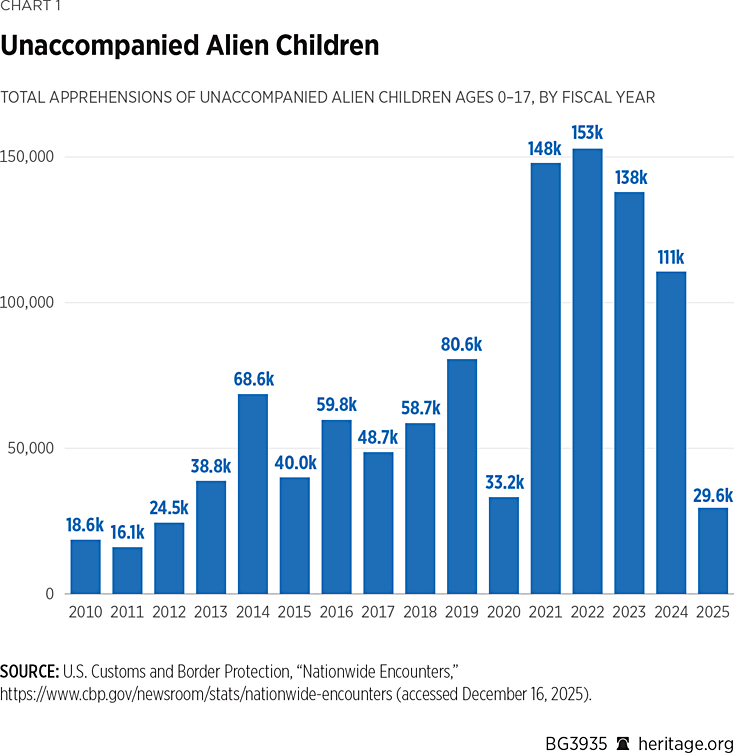
This phenomenon demonstrates that many minors do come to the U.S. without their parents and nullifies Brennan’s rationale in Plyler that children should receive a free public education because they cannot affect their own immigration status. The large population of UACs also makes Powell’s concurring comment, that a different case would be presented if a minor entered the U.S. illegally on his own volition, even more important in reconsidering this erroneous decision.
In 2012, the Obama Administration created another child entrant immigration benefit, Deferred Action for Childhood Arrivals (DACA). This unconstitutional program provided renewable amnesty and work authorization for more than 800,000 illegal aliens who entered the U.S. as minors—with or without their parents. Most UACs and DACA beneficiaries enter the U.S. as teenagers,REF not as infants or toddlers as supporters regularly claim to evoke emotional support for the illegal alien population and to generate opposition to their deportation.
With the unprecedented numbers of unaccompanied minors who have crossed the border illegally over the past two decades, advocates for illegal alien minors now have a difficult time arguing that states must provide them a free education because such minors are in the U.S. through no fault of their own. Furthermore, these populations add millions of dollars annually to states’ education costs.
For example, in fiscal year 2023, the Department of Health and Human Services (HHS) released 16,406 unaccompanied alien minors to sponsors (many of whom are also here illegally) in Texas.REF Texas spent $13,900 per pupil for K–12 public education.REF Accordingly, Texas spent an additional $228 million on this illegal alien student population in just one year. In New York, the HHS released 8,461 unaccompanied minors to sponsors. New York spent $28,261 per pupil, making the total additional cost to taxpayers close to $240 million for one year. These are substantial costs, giving states significant interest in maintaining their taxpayer funds for American students and lawful residents.
These changes in laws and circumstances and the high volume of alien minors and costs that flow from mass illegal immigration make a compelling case for states to—at the very least—charge tuition for illegal alien K–12 students to cover their education costs.
School Districts Bar Enrollment and Charge Tuition for Non-District Residents. Another problem exists where U.S. citizens are barred from attending, or are charged tuition to attend, a K–12 public school out of district when no bar or fees apply to illegal aliens who reside in such district in violation of federal law. This backwards situation flows directly from the erroneous five-to-four Plyler decision.
As of 2023, 33 states prohibit cross-district open enrollment.REF In other words, K–12 U.S. citizen students cannot enroll in a public school district if they do not reside in that district. In addition, 26 states allow school districts to charge tuition for out-of-district residents to attend public school.REF These tuition amounts can be significant. For example, in Virginia, the Falls Church City Public School District charged $20,900 in FY 2025 for a student who resides outside Falls Church City to attend the elementary school, $24,100 to attend the middle school, and $27,200 to attend the high school.REF
Just as in-state tuition breaks for illegal alien college students discriminates against out-of-state U.S. citizen and lawful permanent resident college students, free in-district schooling for illegal aliens who have no legal right to reside there discriminates against U.S. citizen and lawful permanent resident elementary and secondary students who happen to live out of district and are charged a tuition fee. As such, states and particularly the American and legal immigrant taxpayers in a state, have a significant interest in charging illegal aliens tuition to attend public elementary and secondary schools.
After suffering from the unannounced mass resettlement of illegal alien families in American communities during the Biden Administration and the resulting unbudgeted costs, states have started to try to prevent illegal aliens from receiving public benefits, including free K–12 public education.
States Are Revisiting Illegal Immigration and Public Education
In 2025, six states introduced legislation or approved administrative action regarding illegal alien students’ ability to receive taxpayer-funded K–12 schooling. None became law, however.
In Tennessee, state legislators introduced the following bills:
- Senate Bill 1044/House Bill 746 would require a parent or guardian to submit documentation showing U.S. citizenship or legal immigrant status, or to pay tuition equal to the per-pupil state and local funds required. The bill failed three to five in the Senate Education Committee in March 2025.REF
- House Bill 145/Senate Bill 268 would require the parent, guardian, or legal custodian of an illegal alien student to pay tuition. In March 2025, the bill received a two-to-two tie vote in the House Banking and Consumer Affairs Subcommittee and did not pass.REF
- Senate Bill 836/House Bill 746 would require documentation that a student is a U.S. citizen or lawful permanent or temporary visa holder. If such documentation could not be provided, the school district would be required to charge tuition. The bill passed the Senate by 19 to 13 and passed two committees in the House but did not receive a House floor vote.REF
In Texas, state legislators introduced the following bills:
- House Bill 371 would allow U.S. citizens, nationals, and lawfully present aliens to receive tuition-free public education but would authorize the state to seek federal reimbursement for the costs of educating unlawful alien students. The bill did not receive a vote.REF
- House Bill 5371 would require school districts to collect and report U.S. citizenship and immigration status data as part of student enrollment. School districts would have to report quarterly the number of students who are present illegally and the cost of educating such students, including costs associated with the need to hire additional classroom teachers or other employees, and whether a student requires additional services for a disability or status as educationally disadvantaged. A school official would commit a misdemeanor for providing a false statement or no response about a student’s U.S. citizenship or immigration status. The bill did not receive a vote.REF
In Oklahoma, the State Board of Education approved a rule that would require documentation to show U.S. citizenship or legal immigration status during public school enrollment to assess statewide and local educational needs.REF The rule would only require the total number of students enrolled for which a parent or legal guardian could not provide proof of citizenship or legal immigration status; it would not require personal identifiable information.REF A similar bill, House Bill 1165, was introduced in the state legislature but it was not considered.REF
In Idaho, the state legislature introduced House Bill 382. It would require public school districts to collect and record the immigration status of all enrolled students and publish aggregated data, including immigration status and nationality each year on the state department of education’s website.REF The bill was not considered.
In Indiana, House Bill 1394 would authorize a school district to deny enrollment if the district determines by a preponderance of the evidence that the alien student is illegally present in the United States. The bill would also require a school district to report the number of illegal alien students enrolled in the prior school year.REF The bill was not considered.
In New Jersey, Assembly Bill 5233 would require documentation establishing that a student is a U.S. citizen or holds legal immigrant or visa status.REF A student who cannot provide such documentation would be charged tuition, and the state board of education must report the number and percentage of students who pay tuition, as well as the amount of tuition collected each year on the board of education website and each school district’s website.
These state bills demonstrate that, after being burdened with unsustainable numbers of illegal aliens and associated costs, including public education, states have a convincing basis to restrict taxpayer-funded benefits to those lawfully present in the state. As such, states should collect U.S. citizenship and immigration documentation during student enrollment, charge tuition to cover the full costs of educating unlawful alien students, and publish the data and costs each year for transparency and to develop sound education and fiscal policies. (See the appendix for Heritage’s model state legislation to pursue this goal.)
If a state implements such legislation, open-border advocates would certainly sue the state and claim the law violates the Equal Protection Clause according to the Supreme Court’s decision in Plyler v. Doe. The states should, however, contest the rationale and legitimacy of that decision. The five-to-four majority opinion in Plyler was flawed in 1982, and since then, the U.S. Congress has legislated on public education and federal benefits for aliens; the volume and ages of illegal immigration has significantly changed; and more than half the states allow school districts to charge tuition for U.S. citizens residing outside the school district.
Conclusion
Illegal aliens should not be eligible for federal, state, or local government benefits, including through their children, because the receipt of such benefits facilitates longer unlawful residence in the United States and takes resources from American citizens and lawful immigrants. The role of elected officials is to prioritize finite resources among those seeking the resources. States have a convincing interest in preserving limited taxpayer dollars by prioritizing U.S. citizens and lawful immigrants to receive a tuition-free public education while charging full tuition for illegal alien students unless and until they are deported or obtain lawful status. Such a state law can well withstand judicial scrutiny, and the Supreme Court should overturn Plyler v. Doe.
Lora Ries is Director of the Border Security and Immigration Center at The Heritage Foundation.
Appendix: Model State Legislation
On December 17, 2025, The Heritage Foundation published model legislation for states titled the “Charging K–12 Public School Tuition for Illegal Alien Students Act.” The model legislation was revised and updated on February 17, 2026.
SECTION 1. DEFINITIONS.
For purposes of this Act:
“State education funding” means funds distributed under the state’s K–12 education funding formula, including both state and local entitlement components administered by the [state] education agency.
SECTION 2. ADMISSION AND ELIGIBILITY FOR TUITION-FREE PUBLIC EDUCATION.
A public school district shall, without charging tuition, enroll a school-age student who resides within the geographic boundaries of the public school district and provides valid documentation establishing that the student is:
(1) A citizen of the United States;
(2) A national of the United States;
(3) A lawful permanent resident of the United States;
(4) An individual granted refugee status by the U.S. Department of Homeland Security;
(5) An individual granted asylum status by the U.S. Department of Homeland Security; or
(6) An alien lawfully present in the United States as evidenced by a valid, unexpired visa issued by a federal agency with authority to verify such status.
SECTION 3. VERIFICATION OF DOCUMENTATION.
(a) A school district shall require reasonable evidence to determine a student’s eligibility under Section 2, including federal immigration documentation, passports, permanent resident cards, certificates of citizenship, vital records, documentation of refugee admission, asylum grant notices, or valid visa records.
(b) A U.S. birth certificate issued by a state, territory, or possession of the United States with authority to register vital records constitutes sufficient documentation to establish that a student is a citizen of the United States under Section 2. A district may not deny tuition-free enrollment to a U.S. citizen student on the ground that the student lacks federal immigration documents if a valid birth certificate is provided unless a decision has been issued by the U.S. Supreme Court establishing that birth in the United States alone is not sufficient to establish that an individual is a U.S. citizen.
(c) A district may not deny tuition-free enrollment to a student who is unable to provide documentation proving eligibility under Section 2, if at least one of the student’s parents provides documentation proving that parent is a U.S. citizen or U.S. national.
(d) A school district must verify all immigration documentation submitted under this section through the Systematic Alien Verification for Entitlements (SAVE) Program, or any successor program operated by the U.S. Department of Homeland Security, to confirm valid immigration status. A district may make additional reasonable inquiries to verify authenticity when required.
(e) Nothing in this section shall be construed to prohibit a district from requesting supplemental documentation when necessary to resolve discrepancies, verify authenticity, or determine eligibility for tuition-free enrollment.
SECTION 4. CONDITIONING OF STATE EDUCATION FUNDING.
(a) A student who cannot provide documentation establishing eligibility under Subsection 2 may be admitted by the school district; however, the district shall collect, either from the student, third parties, or local government funding sources, the standard nonresident tuition rate applied to all nonresident students who are admitted to the school. If the school does not require nonresidents to pay tuition, the school will collect tuition that is equal to the average of the sum of the local tax revenue per student generated by the[state’s K–12 education funding formula]and the state portion of[the funding formula]. Such tuition must be secured and collected by the school district in full prior to enrollment. A school district shall not allocate or reprogram any state funds, whatever the source, to pay for the tuition of any such student.
(b) A school district may not receive, retain, or claim state education funding for any student who does not meet the eligibility requirements for tuition-free enrollment under Section 2 during any period in which tuition has not been paid by such student or otherwise collected by the school district.
(c) The [state] education agency shall determine compliance using district reports and shall regularly audit records.
(d) If the agency determines that state funds were distributed in violation of this section, the agency shall:
(1) Withhold future payments in an amount sufficient to recover improperly distributed funds; or
(2) Require repayment pursuant to rules adopted under this Act.
(e) Nothing in this section requires a school district to deny enrollment to any student; however, state funding eligibility is conditioned on compliance with this Act.
SECTION 5. ANNUAL REPORTING REQUIREMENT.
(a) Each school district shall report annually to the [state] education agency, in a manner prescribed by the agency, the following information for the preceding school year:
(1) The number of students who were unable to provide documentation under Section 2;
(2) The amount of tuition assessed and collected for those students; and
(3) Any additional data necessary to determine the fiscal impact on the district and the state.
(b) The agency shall compile the information reported under this section and submit an annual statewide report to the governor, lieutenant governor, speaker of the state house of representatives, and the chairs of the state legislative education committees. The report must be publicly accessible on the [state] education agency website.
SECTION 6. RULEMAKING AUTHORITY.
The [state] education agency shall adopt rules necessary to implement this Act, including documentation standards, verification procedures, tuition calculation methods, uniform reporting requirements, and audit procedures. Rules adopted under this section may not alter or expand eligibility for state education funding beyond the conditions established in Section 4.
SECTION 7. APPLICABILITY.
This Act applies beginning with the 2026–2027 school year.



