

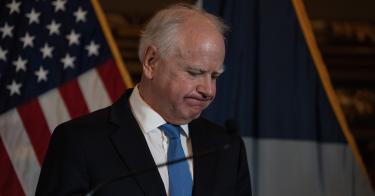
The saga of federal benefits fraud in Minnesota is still being told. Democrat Gov. Tim Walz dropping out of his bid for re-election to a third term is only the latest chapter.
Reports of fraud in childcare operations, and the connection to Twin Cities’ Somali immigrants, go back almost a decade. But state politicians and the legacy media initially ignored or downplayed the story, probably because most of the perpetrators were from a minority that carries “intersectional” clout in woke circles and electoral clout for Democrats.
In 2025, the magazine County Highway reported in depth on the scam, followed by the City Journal, and finally even The New York Times. Walz, who has been in power for nearly eight years, tried to shift blame away from himself and from Somalis on to President Donald Trump and conservatives for noticing. It didn’t work.
But there’s an underlying story that is no less important: the much larger cost of absorbing millions of low-skilled immigrants.
>>> Congress Should Prioritize American Graduates, Not Foreigners Who Promised to Go Home
Back in 2016, George Borjas of Harvard wrote that, “the higher cost of all the services provided to immigrants and the lower taxes they pay (because they have lower earnings) inevitably implies that on a year-to-year basis immigration creates a fiscal hole of at least $50 billion.”
Because most Somali immigrants came to the U.S. as refugees or on family reunification visas thereafter, they are an interesting subset to examine. At a press conference, Minnesota Democrat Rep. Ilhan Omar said of her Somali constituents that “we have … become nurses and doctors and engineers.”
Some, but not many. From 2019 to 2023, the median Somali household in Minnesota had an income of $43,600, compared to a national median of $78,538. That means that they will qualify for many federal benefits available to citizens and some immigrants.
In a 2024 report, Daniel Di Martino of the Manhattan Institute looked at the net lifetime fiscal impact of immigrants. Immigrants without a college education are a net fiscal burden of up to $400,000, DiMartino estimates, while “each immigrant under the age of 35 with a graduate degree reduces the budget deficit by over $1 million in net present value during his lifetime.”
Somali refugees fall more into the former category. According to a recent Center for Immigration Studies (CIS) report, 58% of them do not speak English well, and 39% have no high school diploma. That translates into a heavy use of welfare programs.
Of Somali immigrant households with children, CIS reports, 89% use some kind of welfare—86% of such families are on Medicaid, compared to only 28% of Minnesota households headed by a native-born citizen. More than one in five Somali men of working age are unemployed. More than half of children in Somali-immigrant households are below the poverty line, compared with only 7.6% of those in native-headed homes.
Studies in Europe have shown that, on average, immigrants from certain countries are net takers from the fiscal pot over their lifetime, while others are net givers.
In Denmark, the net fiscal contribution of the average native Dane over a lifetime is positive. In their working years, native Danes pay into the system more than they take. That’s the only way the fiscal equation can balance. But their average immigrant from the Middle East, North Africa, Turkey and Pakistan never pays more to the government than they take in benefits.
A Finnish study had similar results. On average, people from Somalia and many other places were net lifetime losses.
Mass migration was sold to Europeans as a solution to their plummeting fertility rate. To pay for wraparound socialist benefits, the thinking went, they needed to import millions of younger workers. Unfortunately, they weren’t getting the kinds of migrants who are net contributors.
The countries that produce the most economically desirable immigrants have low fertility and don’t export people. Meanwhile, emigrants from the countries whose populations are burgeoning and are on average a lifetime fiscal drain are the ones that do export people.
>>> The H-1B Visa Needs Drastic Reform to Put Americans First
Liberals love to quote a line from Emma Lazarus’ poem on the Statue of Liberty: “Give me your tired, your poor. Your huddled masses yearning to breathe free” This is a sentimental expression from a 19th century context very different from today. Notice she doesn’t say yearning to eat free, sleep free, educate your kids free and get free healthcare, legal aid and a raft of other benefits unavailable in 1890.
The Trump administration has lowered refugee numbers for fiscal year 2026 to 7,500. But a future president might choose to ramp up refugees and also open the spigots with other Biden-era tools to facilitate mass migration.
American voters need to understand that accepting refugees and low-skilled migrants means taxpayers write a check for hundreds of thousands of dollars to support them for life.
Their children? Some will succeed and help balance the budget. Others will not. It will take generations to find out the long-term results of America’s mass migration binge.
But in the short-term, our fiscal hole will get much deeper, and the politics of refilling it will be impossible. Accepting the fiction that all migrants are the same, and that mass migration is always a net benefit to the receiving population, will leave us with a staggering bill we may never be able to pay.
This piece originally appeared in Fox News



