[A]n important issue of our time [is] not merely what AI can do, but who we are becoming through the technologies we build.
[I]ntelligence—whether artificial or human—finds its fullest meaning in love, freedom and relationship with God.
[D]o not let the algorithm write your story! Be the authors yourselves; use technology wisely, but do not let technology use you.
[A]ccess to data—however extensive—must not be confused with intelligence, which necessarily involves the person’s openness to the ultimate questions of life and reflects an orientation toward the True and the Good.
—Pope Leo XIV[REF]
In his 1891 encyclical Rerum Novarum responding to the upheaval of the Industrial Revolution, Pope Leo XIII wrote that “[t]he elements of the conflict now raging are unmistakable, in the vast expansion of industrial pursuits and the marvelous discoveries of science.”[REF] One hundred and thirty-five years later, another “vast expansion” is once again before us. Many sense that we are entering the long-imagined future even if we remain in its early phases, casting our best guesses into the anticipated unknown.
Artificial intelligence (AI), in its many forms, could be one of history’s broadest, deepest, and most disruptive technologies. It already promises to be the most misunderstood. It inspires utopian visions of limitless wealth and immortality on one side and dystopian prophecies of sentient killer robots on the other.
Even without such omens, however, AI will clearly transform our world. It builds upon computers, the internet, mobile technology, and breakthroughs in machine learning but will be more transformational than all of these combined. It will suffuse every industry and organization. Biomedical breakthroughs, already advancing, will only accelerate further. AI is already empowering robots and autonomous vehicles, both of which will disrupt physical industries.[REF] The worlds of molecules and bits will become ever more entangled, as will debates about how man and machine are alike and how they are different.
We can discern the size and speed of this revolution with the simple measures of dollars and cents. Over three decades, between 1995 and 2025, the internet changed nearly everything. During that period, the U.S. invested “more than $2.2 trillion” in fiber optic networks, broadband links to homes and offices, mobile phone towers, and first-generation data centers.[REF]
In just the next five years, however, U.S. firms will invest more—perhaps far more. According to one recent estimate, $7.6 trillion will be invested in giant computing warehouses, AI data centers, and power in the next five years.[REF] AI will amplify and exceed the internet’s impact both in our economy and in our culture.
The internet delivered vast riches and unleashed historic creativity. It also warped our culture, twisted our politics, and distracted and sometimes deranged our children. AI will supercharge both the good and bad of the digital world.
Most worrisome are the threats to children. AI-driven algorithms can amplify addictive content, expose young users to pornography and toxic ideologies, and undermine the formation of healthy habits and relationships.[REF] A sane society strives to protect its young from harm while promoting innovation that serves human flourishing rather than undermining it.
We will need wise policies to align incentives and empower parents and families properly if we are to enjoy technology’s power to educate, connect, and enrich. Even as we anticipate technology’s many upsides, we have a solemn duty to protect the most vulnerable among us from its downsides. Healthy adaptation and enduring values need not be mutually exclusive. In many cases, if we are wise, they can bolster one another.
Likewise, biological breakthroughs based on the codes of life—DNA, RNA, protein folding, the epigenome, and all the other “omics”—could improve the health and lifespans of millions. Such miracles will also present unprecedented ethical dilemmas.
These technologies will dominate policy debates for the next several decades. Today, as the saying goes, every business is a technology business. Similarly, most policy issues are now at least partially technology issues.
AI will play an outsized role in the rate of economic growth and labor force dynamics. It may point the way to new scientific discoveries. It already looms large in military power and training. On it may hinge the political fate of our country and our world.
Given its thirst for electricity, AI has already changed energy debates. Our entire information environment will twist and turn as never before, challenging norms of free speech, privacy, property, and the principles of a free and virtuous society.
These technologies will raise questions beyond public policy, extending to philosophy and theology. Questions of human dignity and even what it means to be human will demand serious thought and prayer.
Many religious leaders have begun to reflect on the meaning of these new technologies. Pope Leo XIV, for instance, dedicated his first encyclical, Magnifica Humanitas, to AI and the human person, and it has been widely covered by international media. The former Cardinal Prevost reportedly took his name out of reverence for Leo XIII, who in the late 1800s penned Rerum Novarum (quoted above).[REF]
Leveraging AI and bioscience to improve human lives will require innovative thinking, discernment, and a recommitment to fundamental creeds and ideals. For policy analysts and policymakers, there is now an urgent temptation to propose something—anything—to address these concerns. Given the long history of well-meaning but misguided tech policies, however, we must resist the urge to act first and ask questions later, especially because cutting-edge information technology and its corresponding market are so complex and fast-changing.
Pope Leo XIV makes a similar point in Magnifica Humanitas. “[I]t is necessary to establish adequate regulatory tools capable of upholding justice and curbing the distorting effects of technological power,” he notes. “Nevertheless, the issue is not limited to regulation.”[REF] Indeed. And even where regulation makes sense in general, the details matter. Good regulation should align market incentives properly rather than distort them, and that will not be easy. The landscape ahead is wider and deeper than any single policy lever can navigate, and it changes almost daily.
That is the purpose of this paper: to describe the current landscape. Understanding that landscape will make it more likely that we land on the right policy responses.
A Policy Cornucopia
Technology is undoubtedly man’s ally. It facilitates his work, perfects, accelerates and augments it. It leads to an increase in the quantity of things produced by work, and in many cases improves their quality.
—Pope John Paul II[REF]
AI and related technologies present policy analysts with a fraught, fascinating, and confounding challenge. Meeting that challenge will require wisdom in areas as diverse as materials science, economics, information theory, national security, ethics, and metaphysics. Consider the following policy themes that will demand our attention in the next decade.
The Productivity Boom. AI and robotics may deliver a massive, possibly historic, boost in productivity across many if not all sectors. We know productivity growth is the key driver of wage, income, and overall economic growth. The technology on offer could allow Americans to spend less of their time in drudgery and more of their time on fulfilling work and in service to goods outside the market—such as family, true leisure, and spiritual life.
AI, Robots, and Jobs. Optimists envision an era of spectacular, widespread abundance. Many others fear that such a productivity boom could vastly widen the wealth gap and leave millions without jobs. Regardless of the macro effects, wrenching changes are likely ahead for many tasks, jobs, firms, and industries. How do we encourage dynamism and its benefits while mitigating concentrated harms to individuals, families, and communities?
The era of globalization generated vast wealth both in the U.S. and abroad, but it also hurt certain industries, workers, and communities far more than others.[REF] Conservatives did not do a great job of anticipating the challenges of globalization and designing thoughtful policies to avoid or soften its downsides. We can and should do better this time.
Admittedly, large segments of the U.S. economy are bloated and sterile. Take health care, which imposes huge burdens on families and businesses. AI could help to turn health care from economic anchor to innovator, but that also would mean disruptions for millions of Americans who work in the sector. How do we embrace productivity growth and creative destruction, accept that some jobs—that is, ways of working—will or even should disappear, while helping workers and families to adjust? Will rapid productivity growth even be allowed in certain politically powerful sectors?
A related concern is the nature of work itself. Some, including Elon Musk, predict a near-future utopia of vast wealth in which few people need to work and government provides the people with a universal basic income (UBI).[REF] Given the role of meaningful work in human happiness and fulfillment, however, such a work-free future would almost certainly be dystopian.
Others argue, more plausibly, that while work will change radically, it will not render us obsolete. It may even hold the promise of safer, more fulfilling and humane work.
Federal vs. State Regulation. The hype around AI, which would provoke far less angst if we had named it “stochastic statistical modeling,” has given rise to panicked overreactions. States are proposing hundreds of new laws to regulate a technology that changes far faster than any legislative cycle. We should be thankful that our federal system distributes government power. Nevertheless, a patchwork of conflicting and ill-considered state laws would grind America’s competitive edge to a halt. The debate resembles arguments over broadband and internet regulation during the past 30 years. AI is an even more general-purpose technology, so the legal playing field is far broader and deeper.
Chips and Infrastructure. Overreliance on Taiwanese semiconductors led to enactment of the CHIPS (Creating Helpful Incentives to Produce Semiconductors) Act, which sought to encourage domestic U.S. chip manufacturing.[REF] The goal was sound, but many questioned the vehicle of giant subsidies. For AI and robots, we will need a vast supply of batteries, minerals, and both high-tech and low-tech materials. How do we rebuild U.S. high-tech manufacturing and supply chains without depriving ourselves of the benefits of trade and without resorting to the type of industrial policy that does more harm than good?
Data Centers and Chip Fabs. Progress in AI technology will grind to a halt without new domestic data centers and chip fabrication plants.[REF] However, their construction has become controversial in many states and cities even when they provide new jobs. Do people fear these facilities because of AI anxiety? Does their fear reflect more generic and perennial NIMBYism,[REF] rising prices, or something else?
Energy. AI’s voracious thirst for electricity has already changed the energy discussion for the better. Climate doomism has been sidelined by the Trump Administration, and U.S. hydrocarbon policy is in a good place. But we still are not moving fast enough in other areas such as nuclear power.
Competition with China. China’s manufacturing might is staggering. We have known that for three decades. China is now a top-tier technology innovator. From electric cars to AI to robots, it either rivals or is a close second to the U.S. AI and robots are central to the coming economic, cyber, and military competitions. Domestic and global calls to “pause” AI or other technologies may strike a chord with some of the public, but such policies are at odds with the imperative to stay ahead of our global adversaries.
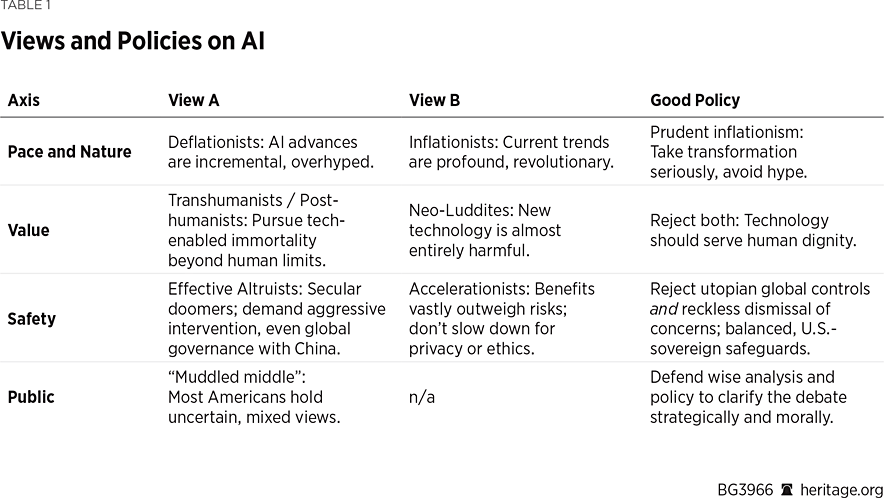
AI Safety. Worries about AI safety have been swirling for more than a decade. They nearly ground AI to a halt during the Biden Administration. But safety concerns are shared across the political spectrum. This is one sign of how complex the AI debate is for policy. There are multiple opinion axes in the AI and technology debate, and few of them track the familiar left-to-right axis of American politics.
One axis represents opinions about the nature and pace of current trends. On one end are what we might call deflationists, a term that does not refer to prices in the economy. Deflationists argue that recent developments in large language models, robotics, and the like are not all that profound or different from what has gone before. They look at the current frontier large language models (LLMs) and notice limits. Some think progress will soon grind to a halt. They also are far less sanguine about using language of agency and consciousness for AI.
On the other end are what we may call the inflationists, which also does not refer to prices. Inflationists see current and near-future trends as revolutionary. They are much more likely to believe that AI will soon upend everything we think we know about ourselves and the universe. Many believe that exponential trends over the next two years will transform civilization and that we could soon hit a “singularity” with the advent of “artificial superintelligence.”
Another axis represents how one judges these trends: Are they, on balance, good or bad? On one extreme are the transhumanists and post-humanists who imagine an immortal future in which we leave our mortal bodies behind and assume more durable hardware. Such a radical vision tends to inspire its opposite. It is therefore no surprise that Neo-Luddite critics see technology—and certainly new technology—as almost entirely bad even if very few wish to return to the Middle Ages, let alone the Stone Age.
This axis is close to but distinct from the axis representing opinions on safety, public discussion of which is dominated by two opposing camps. On one side are the effective altruists, who tend to be secular doomers and inflationists. That is, they fear that AI will cause existential harms: sentient killer robots, the Singularity,[REF] AIs self-generating ever more AIs, a dangerous superintelligence. In their view, companies, governments, and transnational entities such as the United Nations and European Union must intervene aggressively to prevent runaway smart machines. Some are even calling for global governance involving an alliance between the U.S. and Communist China.[REF]
In the other camp are the accelerationists, only some of whom are transhumanists. They acknowledge challenges but think humans can block runaway AI or combat dangerous AI with good AI. The benefits will so far outweigh the risks, they believe, that we should not waste time worrying too much about such things as data privacy and pornography.[REF] As with the other axes of opinions on AI, these two extremes do not bookend the traditional axis of American politics.
Not surprisingly, most Americans’ views land somewhere in the muddled middle. Still, the path of wise public policy is likely found in the Golden Mean between these extremes, and given both past and current trends, it is wise to trust that human ingenuity will continue in the future despite the rising chorus of doom.
Marc Andreessen, founder of the Andreessen Horowitz (a16z) venture capital firm, says the Biden Administration was close to quasi-nationalizing AI into just two or three highly regulated, government-approved providers.[REF] He and many in Silicon Valley were so alarmed that much of the famously liberal tech world shifted to Donald Trump in 2024.
The current Administration, until recently under the leadership of AI and cryptocurrency czar David Sacks, is pursuing an aggressive pro-AI policy on regulation, energy, and more. It does not propose a libertarian free-for-all, however, as the recent conflict between Anthropic and the U.S. Department of War (DOW) makes clear.
Under its signed contract with the DOW, Anthropic had stipulated two limitations on uses of its product: (1) mass domestic surveillance of American citizens and (2) fully autonomous weapons systems—that is, lethal targeting and engagement decisions made without meaningful human input. In the latter case, the company said it did not object in principle to autonomous weapons systems. Rather, Anthropic claimed that in its judgment, the technology was not yet reliable enough for such use.
The DOW, for its part, insisted that it should be free to pursue all lawful uses. In effect, the government sought to renegotiate a contract already in place. The department could have declined to work with Anthropic on any or all future projects, but it went further by treating the American company as a hostile supply chain risk.[REF] Few policy experts grasped the details of the dispute in real time, and it is now in the courts. Despite this case, the White House soon asked to make Anthropic’s most advanced LLM, Mythos, available to all federal agencies.[REF]
Children and Education. AI could be the best educational tool ever created. It is already transforming academic research. AI apps like NotebookLM can convert massive amounts of material, such as course textbooks, into memory aids that help students to study and digest material.[REF] A near-future AI app may even tutor children with seemingly infinite patience and personalization.
AI could also destroy education as we know it. If it replaces reading, writing, and thinking, we will have failed. If children do not read and analyze texts, write essays, or learn their multiplication and division tables, they will lack the very foundation they need to leverage the new AI tools. Parents need the power to help their children master AI instead of allowing AI to master them.
We must seek ways to prepare our children to deploy these powerful new tools while protecting them from the addictive pull of screens, the flood of toxic ideology, and the risk that constant algorithmic curation will erode their attention, imagination, and moral formation. We must empower wise parents and promote age-appropriate limits, a renewed emphasis on real-world relationships, and disciplined study even as we welcome AI’s capacity to personalize learning.
Social media promised to empower diverse voices, democratize speech, and thus limit government and other powerful authorities. But social media can also mesmerize, mislead, distract, pollute, and indoctrinate. Parents could mostly shield their children from old media, such as TV and movies. Social media often bypass the parental filter. AI will supercharge these effects.
Infowarp. Anyone who thought the past decade’s social media wars were scary should watch out: AI will amplify the anxieties, antipathies, and attacks. These technologies expand knowledge but also sow confusion. If we build tools and norms that reward truth, however, they could expand access to expertise, lower barriers to learning, and help everyday citizens to test claims against reliable sources.
In the past decade, diverse voices on the internet challenged established authorities as never before. Governments and gurus, jealous of their monopolies on truth, sensed existential threat. Collaborating with Big Tech social media firms, advertising networks, and nongovernmental organizations (NGOs), they squashed dissenters and inconvenient ideas. They claimed to be protecting us from “misinformation.” In truth, they orchestrated the broadest and deepest censorship effort in American history. Europe is still zealously censoring, and its Digital Services Act is a major thorn in the side of U.S. tech firms.[REF] AI will generate even more furious calls to censor and suppress.
Can we persuade policymakers and the public that despite reasonable fears, free speech is still a constitutional right and a much better way to stumble toward the truth? Can we develop technologies and institutions that promote sense-making and truth-telling amid the psychedelic swirl? Can conservative policy analysts keep up with a technology that seems to change with every news cycle? Can we honestly assess both the risks and rewards instead of lurching between obsequious cheerleading on the one hand and screeds against “Big Tech” on the other?
There’s more: Activists and political parties will try to manipulate AI platforms. In the case of Wikipedia, for example, what began as a terrific information source became infected with politics. There will be battles over AI in education, history, health care, government services, and other fields. Multiple, competitive AIs can help to avert the specter of a woke AI monopoly and make it easier to verify sources and determine the provenance of data, but we will need mechanisms and incentives to reward truthful AI and punish deceitful or self-serving AI.
Bioethics and Synthetic Biology. Modern medicines based on the codes of life—DNA, RNA, synthetic peptides, etc.—are already delivering longer and better lives for many people. At the same time, our experience during the COVID pandemic highlights new and old concerns about our reliance on pharmaceuticals in general and the unforeseen dangers of specific novel biologics. Many Americans now rightly insist on more rigorous proof of reward compared to risk. As more people ask more questions, however, many health authorities demand fewer questions, ever more medication, and even mandates.
The new technologies also raise unprecedented ethical dilemmas. The debate over in vitro fertilization (IVF) and the promise of restorative reproductive technology is the latest chapter in the decades-long pro-life debate. Unfortunately, even many pro-life Americans do not understand how IVF, as practiced in the U.S., involves the destruction of far more human embryos than ever result in a live birth.[REF] Gene editing and therapy are even murkier. In some forms, these techniques might save lives and cure diseases. They might also launch a eugenic arms race for perfect babies and post-human super soldiers. As with AI, so with synthetic biology: We must find a way to encourage life-enhancing innovation while discouraging an anti-human God complex.
Conclusion
These are simply examples. We could list a dozen more tech policy topics: satellites, drones and autonomous vehicles, copyright, space-based AI, exotic materials, artificial wombs, quantum computing, non-silicon-based semiconductors, blockchain, wireless spectrum, and the status and meaning of intellectual property in LLM training data. But this is surely enough to establish that AI will dominate not just tech policy, but many other policy domains in the coming years.
Policy organizations that care about the future of the American Republic must face this fact squarely and prepare accordingly.
Bret Swanson is Director of the Center for Technology and the Human Person at The Heritage Foundation. Jay W. Richards is Vice President of Social and Domestic Policy and William E. Simon Senior Research Fellow in American Principles and Public Policy at The Heritage Foundation.