
Emma Waters
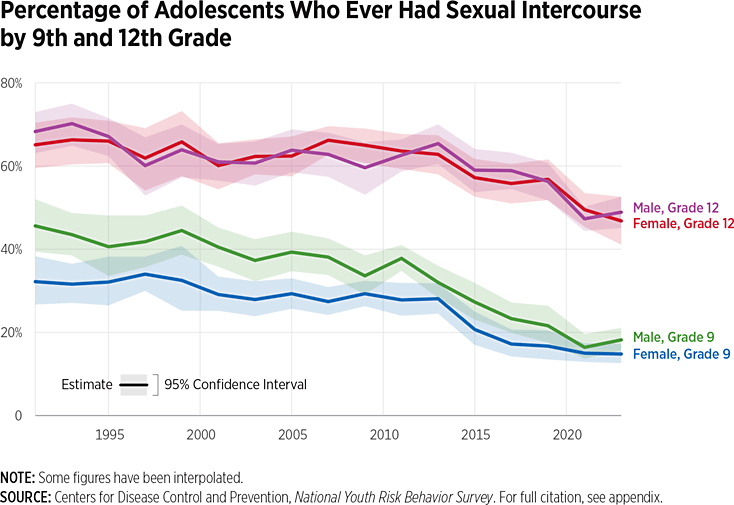
This chart from the Youth Risk Behavior Surveillance System (YRBSS) illustrates the declining trend in the percentage of adolescents who have ever had sexual intercourse, categorized by sex (male and female) and grade level (9th and 12th) from 1991 to 2023. Over the past three decades, the share of sexually experienced adolescents has steadily decreased, with the most notable declines occurring after 2017. While 12th graders (both male and female) historically reported higher rates than 9th graders, all groups have seen significant reductions, with 2023 figures showing fewer than 50 percent of 12th graders and under 20 percent of 9th graders who ever had sexual intercourse.
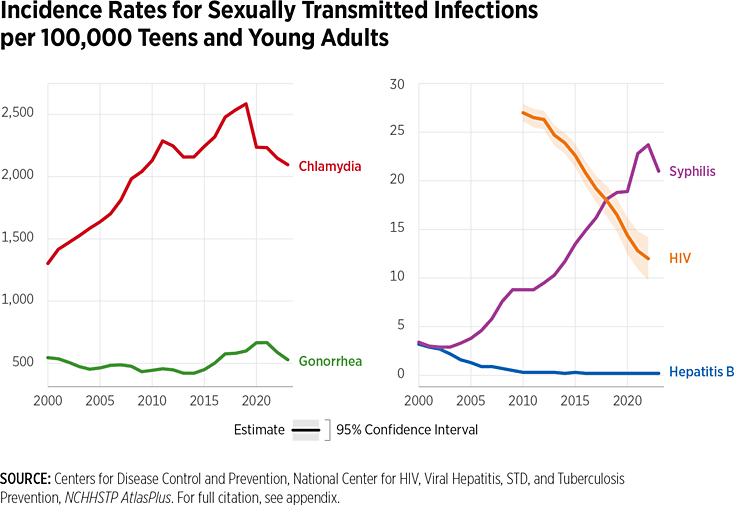
The declining rates of sexual activity among teenagers reflect a shift away from the hypersexualized youth culture of previous decades. On the surface, this would appear to be a positive development: fewer teen pregnancies, fewer abortions, fewer sexually transmitted diseases (STDs), and potentially stronger marriages in the future. This shift could reflect cultural and policy efforts that emphasize family values, access to contraception, and relational health. However, while the decline in sexual behavior is encouraging, the digitalization and isolation that characterize modern life may push teenagers to other behaviors that are equally unhealthy.
Teens today are not just abstaining from sex; they are disengaging from relationships altogether. Fewer young people are dating,[REF] and in-person social interactions have plummeted by as much as 45 percent.[REF] Instead, many teenagers are retreating into digital spaces, spending hours on social media,[REF] relying on sexting rather than real-life intimacy,[REF] dealing with pornography addictions,[REF] and even forming relationships with AI-driven “girlfriends” and “boyfriends.”[REF] Taking all these trends together, the decline in teen sexual activity, instead of being a sign of a healthier society, is symptomatic of a broader crisis in which genuine emotional vulnerability and in-person relationships are supplanted by artificial and dehumanizing options.
Moreover, other factors may be in play, including the widespread use of Selective Serotonin Reuptake Inhibitors (SSRIs) and hormonal birth control, which can reduce sexual desire and alter attraction patterns. As Dr. Sarah E. Hill explores in This Is Your Brain on Birth Control, the influence of these medications extends beyond a woman’s fertility or mood and influences her mental health, attraction, and stress response.[REF] While some may view this as a trivial side effect, this trend is not just about sex; it is about human flourishing through meaningful relationships and marriage. As birth rates continue to decline[REF] and more young adults report feelings of loneliness and isolation,[REF] we must recognize that the decline in teen sexual activity is a warning sign that, despite all of its undeniable benefits, modern technology is currently being used in ways that jeopardize future family formation.
The solution is not to return to a hypersexualized culture but to restore balance. Young people need real-life interactions, strong communities, and the ability to develop the social and emotional skills necessary for healthy relationships, marriage, and family life. The decline in teen sexual activity is “good” only if it reflects healthier choices—not if it signals a retreat from real relationships into a world of screens, pornography, and AI companions.
Endnotes
- Daniel A. Cox, “Gen Z’s Romance Gap: Why Nearly Half of Young Men Aren’t Dating,” American Institute for Boys and Men Commentary, February 8, 2024, https://aibm.org/commentary/gen-zs-romance-gap-why-nearly-half-of-young-men-arent-dating/ (accessed April 6, 2026). ↩
- Derek Thompson, “Why Americans Suddenly Stopped Hanging Out,” The Atlantic, February 14, 2024, https://www.theatlantic.com/ideas/archive/2024/02/america-decline-hanging-out/677451/ (accessed April 6, 2026). ↩
- Tori DeAngelis, “By the Numbers: Teens Are Spending Nearly 5 Hours Daily on Social Media. Here Are the Mental Health Outcomes,” Monitor on Psychology, Vol. 55, No. 3 (April/May 2024), https://www.apa.org/monitor/2024/04/teen-social-use-mental-health#:~:text=4.8%20hours,day%20on%20these%20three%20apps (accessed April 6, 2026). ↩
- Christine Lee and Jane Shawcroft, “Teen Sexting and Sexually Explicit Music,” Institute for Family Studies Blog, May 9, 2023, https://ifstudies.org/blog/teen-sexting-and-sexually-explicit-music (accessed April 6, 2026). ↩
- Grace B. Jhe et al., “Pornography Use Among Adolescents and the Role of Primary Care,” Family Medicine and Community Health, Vol. 11, No. 1 (January 2023), article no. e001776, https://www.proquest.com/docview/2766083680?sourcetype=Scholarly%20Journals (accessed April 6, 2026). ↩
- Wendy Wang and Michael Toscano, “Artificial Intelligence and Relationships: 1 in 4 Young Adults Believe AI Partners Could Replace Real-Life Romance,” Institute for Family Studies Research Brief, November 14, 2024, https://ifstudies.org/blog/artificial-intelligence-and-relationships-1-in-4-young-adults-believe-ai-partners-could-replace-real-life-romance (accessed April 6, 2026). ↩
- Sarah E. Hill, This Is Your Brain on Birth Control: The Surprising Science of Women, Hormones, and the Law of Unintended Consequences (New York: Avery Publishing Group, 2019). ↩
- Joyce A. Martin et al., “Births in the United States, 2023,” U.S. Department of Health and Human Services, Centers for Disease Control and Prevention, National Center for Health Statistics Data Brief No. 507, August 2024, https://www.cdc.gov/nchs/products/databriefs/db507.htm (accessed April 6, 2026). ↩
- Richard Weissbourd et al., “Loneliness in America: How the Pandemic Has Deepened an Epidemic of Loneliness and What We Can Do About It,” Harvard Graduate School of Education, Making Caring Common Project, February 2021, https://static1.squarespace.com/static/5b7c56e255b02c683659fe43/t/6021776bdd04957c4557c212/1612805995893/Loneliness+in+America+2021_02_08_FINAL.pdf (accessed April 6, 2026). ↩
Sources
- U.S. Department of Health and Human Services, Youth Risk Behavior Surveillance System (YRBSS), “National YRBSS Datasets and Documentation by Year,” 1991–2023, https://www.cdc.gov/yrbs/data/national-yrbs-datasets-documentation.html (accessed May 10, 2026).
- U.S. Department of Health and Human Services, National Center for HIV, Viral Hepatitis, STD, and Tuberculosis Prevention, NCHHSTP AtlasPlus, https://gis.cdc.gov/grasp/nchhstpatlas/tables.html (accessed May 10, 2026).
