Christos A. Makridis, PhD
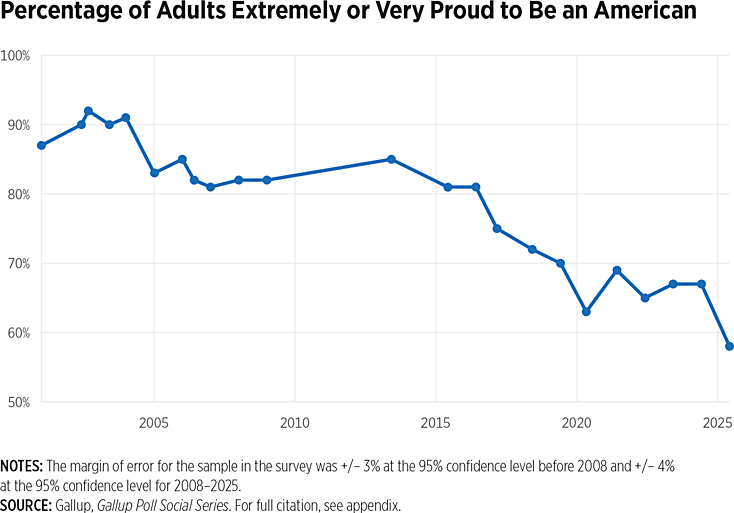
In the early 2000s, American patriotism was nearly universal: In January 2001, 87 percent of U.S. adults surveyed by Gallup said they were “extremely” or “very” proud to be American; “[a]fter the 9/11 terrorist attacks, the figure increased to 90%, and it held at that level or higher between 2002 and 2004.”[REF] By 2017, however, the share of respondents who said they were proud to be American had fallen to 75 percent, and it deteriorated further amid political and social turmoil. In June 2025, Gallup recorded a new low of just 58 percent of Americans expressing high pride in their nationality. This downward trajectory has been especially steep since the mid-2010s and reflects a significant shift in Americans’ collective self-perception.
Today, national pride varies widely across demographic and political groups. What was once a near consensus has splintered along partisan lines: In 2025, only 36 percent of Democrats expressed pride in their country, whereas about 92 percent of Republicans still profess being extremely or very proud. A similar pattern is exhibited by younger generations when compared to their elders: On average, from 2021–2025, only 41 percent of Generation Z adults said they were extremely or very proud to be American, compared with 58 percent of Millennials and more than 70 percent of Baby Boomers.
All age cohorts have seen some decline in pride since the early 2000s, but these declines have been most pronounced since 2015–2016, especially among younger Americans and those on the political Left. What was once a unifying sentiment has weakened with differences by age and party that were far less evident a generation ago.
One explanation for the drop in patriotic sentiment is the rise in political polarization and partisan distrust. The increasing politicization of American life has had profound implications for social harmony and national unity. Bitter partisanship has made shared symbols and national identity into battlegrounds. Surveys document growing ideological divides and intense partisan rancor in recent years. Even in the workplace, some survey evidence suggests that 42 percent of employees have withheld their opinions to protect their professional futures, and the Equal Employment Opportunity Commission has reported a 73 percent rise in religiously based discrimination charges between 1992 and 2020.[REF]
Many Americans now view their political opponents with deep suspicion or even as threats to the country’s values. In such an environment, expressions of patriotism can become politicized—seen as a marker of one faction or another rather than as a unifying civic bond. The collapse of a broadly shared civic narrative and its replacement by hyperpartisan identity have likely dampened Americans’ willingness to feel proud of their nation across party lines.
The long-term decline in patriotism has coincided with a collapse of public trust in institutions, from government and media to churches and corporations, that traditionally undergird national identity. Confidence in major U.S. institutions remains at or near historic lows after a steady decades-long decline. As of 2023, the average share of Americans expressing even a “fair amount” of confidence in 14 core institutions was just 26 percent, roughly half the level of the late 1970s.[REF] Scandals, political dysfunction, and perceived failures by leaders have fed a cynicism that blunts pride in the nation’s direction. Social trust among Americans has also eroded.
Another structural force behind waning patriotism is the fragmentation of American society, which weakens social ties and civic engagement and leaves individuals less connected to any common national project. Sociological research has long documented a decline in “social capital” in the United States. Robert Putnam famously observed that for most of the 20th century, Americans were drawn into ever-deeper community engagement,[REF] but that trend reversed in the 1970s, and in the ensuing decades, community activities that once fostered local pride and belonging, from club memberships to shared cultural rituals, became less common as civic participation and networks quietly unraveled. By many measures—political involvement, religious participation, neighborhood groups, even trust in neighbors—social capital has eroded steadily over the past two generations.[REF]
Endnotes
- Jeffrey M. Jones, “American Pride Slips to New Low,” Gallup, June 30, 2025, https://news.gallup.com/poll/692150/american-pride-slips-new-low.aspx (accessed April 1, 2026). ↩
- Rachel C. Schneider et al., “How Religious Discrimination Is Perceived in the Workplace: Expanding the View,” Socius: Sociological Research for a Dynamic World, Vol. 8 (2022), https://journals.sagepub.com/doi/full/10.1177/23780231211070920 (accessed April 5, 2026). ↩
- Lydia Saad, “Historically Low Faith in U.S. Institutions Continues,” Gallup, July 6, 2023, https://news.gallup.com/poll/508169/historically-low-faith-institutions-continues.aspx (accessed April 5, 2026). ↩
- See Robert D. Putnam, Bowling Alone: The Collapse and Revival of American Community (New York: Simon & Schuster, 2000). ↩
- Knight Foundation and Gallup, American Views 2022: Part 2, Trust, Media and Democracy, January 2023, passim, https://legacy.knightfoundation.org/wp-content/uploads/2023/02/American-Views-2022-Pt-2-Trust-Media-and-Democracy.pdf (accessed April 5, 2026). ↩
Sources
- Gallup, Gallup Poll Social Series, “American Pride Slips to New Low,” June 30, 2025, https://news.gallup.com/poll/692150/american-pride-slips-new-low.aspx (accessed May 11, 2026).
