
Emma Waters
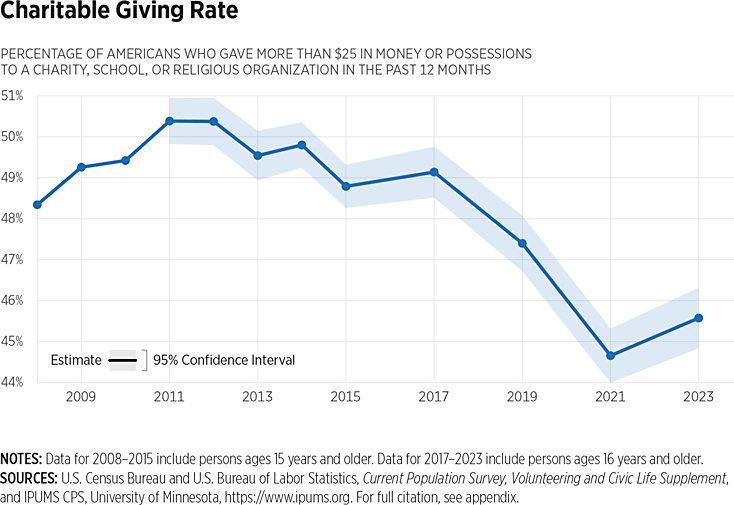
This chart depicts the share of Americans ages 15 and older who have donated $25 or more in money, assets, or property to a charitable or religious organization in the past year, covering a period from 2008 to 2021. The trend indicates that charitable giving has remained generally stable over this period of time, hovering around 50 percent. From 2009 to 2013, charitable giving saw a slight increase. In 2017, it declined by approximately 5 percent before slowly increasing since then, returning to 2008 levels.
Charitable giving has long been a defining characteristic of American civic life. Although philanthropy is often associated with the wealthy, the data consistently show that individual generosity—particularly among religiously affiliated Americans—drives the bulk of charitable donations.[REF] The correlation between attendance at religious services and charitable behavior is strong and underscores how faith communities encourage care for “the least of these.”[REF]
Between 2008 and 2021, the proportion of Americans aged 15 and older who donated at least $25 to charity remained remarkably stable at approximately 50 percent. This period included the aftermath of the 2007 stock market crash and the COVID-19 pandemic, underscoring America’s ongoing commitment to generosity. The role of marriage is also notable. Married individuals were the most likely to donate, with 54 percent contributing compared to 29 percent of those who had never married.[REF] Moreover, married couples without children donated slightly more (56 percent) than those with children under 18 (54 percent), suggesting that fewer financial responsibilities may enable couples to donate or tithe more.[REF]
Beyond marriage and family, religious affiliation is one of the strongest predictors of charitable giving.[REF] Americans who regularly attend religious services are more likely to donate to their place of worship and other charities.[REF] This generosity is part of a broader cultural trend: Americans donate at per capita rates that are significantly higher than those of Europeans and even Canadians, partly because of a national tradition of aid and a sense of personal responsibility to support their communities instead of relying solely on state or federal help.[REF]
Large foundations and corporations play a significant role in philanthropy, but individual giving remains the backbone of charitable donations in the United States. In 2023, total giving reached $557.16 billion with the majority coming from individuals.[REF] Weekly tithing and a culture of financial discipline encourage many Americans to prioritize charitable giving as part of their monthly budget. Giving patterns in America also reflect a cultural belief that small donations can have a major impact.[REF]
Endnotes
- Philanthropy Roundtable, “Statistics on U.S. Generosity,” https://www.philanthropyroundtable.org/almanac/statistics-on-u-s-generosity/ (accessed April 4, 2026). ↩
- Giving USA Foundation, Giving USA Special Report: Giving to Religion, Fall 2017. ↩
- Heritage Foundation Calculations based on “Charitable Giving by Marital Status,” Current Population Survey Data, Volunteer Supplement, IPUMS, 2021. ↩
- Ibid. ↩
- Karl Zinsmeister, “Less God, Less Giving?” Philanthropy Magazine, Winter 2019, https://www.philanthropyroundtable.org/magazine/less-god-less-giving/#:~:text=Philanthropic%20studies%20show%20that%20people,compare%20demographic%20apples%20to%20apples (accessed April 4, 2026). ↩
- Arthur C. Brooks, “Religious Faith and Charitable Giving,” Hoover Institution, October 1, 2003, https://www.hoover.org/research/religious-faith-and-charitable-giving (accessed April 4, 2026). ↩
- John J. Miller and Karl Zinsmeister, “DoNation: Which Americans Give Most to Charity?” Philanthropy Magazine, Summer 2013, https://www.philanthropyroundtable.org/magazine/summer-2013-donation/ (accessed April 4, 2026). ↩
- Giving USA Foundation, “Giving USA: U.S. Charitable Giving Totaled $557.16 Billion in 2023,” posted June 25, 2024, https://givingusa.org/giving-usa-u-s-charitable-giving-totaled-557-16-billion-in-2023/#:~:text=DIVING%20DEEPER,even%20when%20adjusting%20for%20inflation (accessed April 4, 2026). ↩
- Editorial, “Americans Feeling Charitable,” Orange County Register, January 26, 2016, https://www.ocregister.com/2016/01/26/americans-feeling-charitable/ (accessed April 4, 2026). ↩
Sources
- U.S. Department of Commerce, Census Bureau, and U.S. Department of Labor, Bureau of Labor Statistics, Current Population Survey, Volunteering and Civic Life Supplement, 2011–2023 [data and nonresponse replicate weights], page last revised November 12, 2024, https://www.census.gov/data/datasets/time-series/demo/cps/cps-supp_cps-repwgt/cps-volunteer.html (accessed May 11, 2026).
- U.S. Department of Commerce, Census Bureau, and U.S. Department of Labor, Bureau of Labor Statistics, Current Population Survey, Civic Engagement and Volunteering Supplement, as distributed by Sarah Flood, Miriam King, Renae Rodgers, Steven Ruggles, J. Robert Warren, Daniel Backman, Etienne Breton, Grace Cooper, Julia A. Rivera Drew, Stephanie Richards, David Van Riper, and Kari C.W. Williams, IPUMS CPS: Version 13.0 [dataset], Minneapolis, MN: IPUMS, 2025, https://doi.org/10.18128/D030.V13.0 (accessed May 11, 2026).
