Jonathan Abbamonte
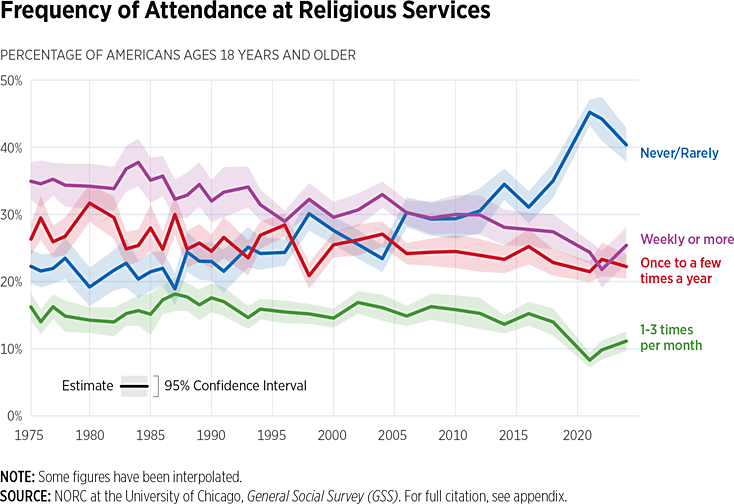
Attendance at religious services across the United States has long been in a state of gradual decline. The chart above shows the percentage of Americans over time who attended religious services weekly or more, one to three times a month, one to a few times a year, or rarely or never. Between 1975 and 2024, the percentage of Americans who attend religious services at least once a week fell from 35 percent to 25 percent. The percentage of Americans who attend one to three times per month has dropped from 16 percent to 11 percent. Meanwhile, the share of Americans who rarely or never attend has nearly doubled from 22 percent to 40 percent.
Nor is attendance at religious services declining only in the aggregate. Attendance rates have fallen for both men and women, for both married and never-married adults, and among African Americans, Caucasians, and Hispanics.[REF] Moreover, despite the publicity that declining attendance at religious services among young adults receives both in the media and from the pulpit, attendance has been declining among all age groups, including those who are 60 years of age and older.[REF]
These trends are alarming. Faith is the bedrock of culture and the foundation of the principles and values that govern society. Without religious adherence and commitment, secular ideologies will inevitably fill the void.
In addition to the spiritual benefits of religious observances and the fulfillment of filial duty to the Creator, there are countless temporal benefits that individuals, families, and society at large derive from frequent (weekly or more) attendance at religious services. People who attend religious services frequently, for example, are more likely to live longer,[REF] have lower mortality rates,[REF] have better mental health,[REF] and have a greater sense of purpose and meaning in life.[REF] They also are happier in their marriages[REF] and give more of their time and wealth to those who are in need.[REF] Adolescents who attend religious services frequently are less likely to commit a crime,[REF] engage in illicit drug use, and have sex at an early age[REF] and more likely to have higher standardized test scores and higher educational aspirations.[REF]
The reasons for the decline in attendance at religious services are complex and multifaceted. For one, seismic shifts in culture have moved toward values and behavioral norms that are antagonistic to religious values and teachings. Many have fallen away from organized religion because their secular values and life choices conflict with religious values. Many have fallen away from religious practices because of doubts or skepticism about religious teachings.[REF] Many others have fallen away because they have become choked by the busyness of work, home, and family life; and as American culture has increasingly placed importance on money,[REF] status, achievements, and childrearing,[REF] religious observances have often been pushed down the list of priorities. Others have turned away as a result of the rise in scandals among religious leaders or negative interactions with religious adherents.[REF]
Moreover, contemporary society—from the public education system to our universities to the workplace—enforces a rigid secularism, making it difficult for people of faith to live out their faith in the public square and “sanitizing” society of religious practices and beliefs. When people as a society do not practice religion, its importance diminishes. Also, perhaps many have become too comfortable in their lives and financial security to turn to their faith. Countries with higher life expectancy and greater per capita wealth often have lower rates of weekly attendance at religious services.[REF]
Whatever the cause or mix of causes, the importance that Americans place on religion is declining[REF] as are, along with it, the observance of religious practices like prayer[REF] and attendance at religious services. Society has much to lose when religious observance diminishes. Let us hope that more Americans can once again recognize the importance that frequent attendance at religious services has for themselves, for their families, and for our nation.
Endnotes
- Jonathan Abbamonte, “The Great Falling Away: The Decline in Religious Services Attendance in the United States Over the Past 50 Years,” Heritage Foundation Backgrounder No. 3916, July 17, 2025, https://www.heritage.org/sites/default/files/2025-07/BG3916_0.pdf. ↩
- Ibid. ↩
- Terrence D. Hill et al., “Dimensions of Religious Involvement and Leukocyte Telomere Length,” Social Science & Medicine, Vol. 163 (August 2016), pp. 168–175. ↩
- Michael E. McCullough et al., “Religious Involvement and Mortality: A Meta-Analytic Review,” Health Psychology, Vol. 19, No. 3 (2000), pp. 211–222, https://www.apa.org/pubs/journals/releases/hea193211.pdf (accessed April 4, 2026); Li Shanshan et al., “Association of Religious Service Attendance with Mortality Among Women,” JAMA Internal Medicine, Vol. 176, No. 6 (2016), pp. 777–785, https://jamanetwork.com/journals/jamainternalmedicine/fullarticle/2521827 (accessed April 4, 2026); Tyler J. VanderWeele et al., “Attendance at Religious Services, Prayer, Religious Coping, and Religious/Spiritual Identity as Predictors of All-cause Mortality in the Black Women’s Health Study,” American Journal of Epidemiology, Vol. 185, No. 7 (2017), pp. 515–522, https://www.researchgate.net/publication/315654757_Attendance_at_Religious_Services_Prayer_Religious_Coping_and_ReligiousSpiritual_Identity_as_Predictors_of_All-Cause_Mortality_in_the_Black_Women’s_Health_Study (accessed April 4, 2026). ↩
- Sukkyung You, Ji Eun Yoo, and Yunsung Koh, “Religious Practices and Mental Health Outcomes Among Korean Adults,” Personality and Individual Differences, Vol. 142 (2019), pp. 7–12; Arjan W. Braam and Harold G. Koenig, “Religion, Spirituality and Depression in Prospective Studies: A Systematic Review,” Journal of Affective Disorders, Vol. 257 (2019), pp. 428–438. ↩
- You, Yoo, and Koh, “Religious Practices and Mental Health Outcomes Among Korean Adults.” ↩
- Marriage and Religion Research Institute, “Religion and Marital Satisfaction,” https://downloads.frc.org/EF/EF15A76.pdf (accessed April 4, 2026). ↩
- Arthur C. Brooks, “Religious Faith and Charitable Giving,” Hoover Institution, October 1, 2003, https://www.hoover.org/research/religious-faith-and-charitable-giving (accessed April 4, 2026). ↩
- Christian Smith and Robert Faris, Religion and American Adolescent Delinquency, Risk Behaviors and Constructive Social Activities: A Research Report of the National Study of Youth and Religion, No. 1, University of North Carolina at Chapel Hill, National Study of Youth and Religion, 2002, https://youthandreligion.nd.edu/assets/102504/religion_and_american_adolescent_delinquency_risk_behaviors_and_constructive_social_activities.pdf (accessed April 4, 2026). ↩
- Jennifer S. Manlove et al., “The Role of Parent Religiosity in Teens’ Transitions to Sex and Contraception,” Journal of Adolescent Health, Vol. 39, No. 4 (2006), pp. 578–587. ↩
- Mark D. Regnerus, “Shaping Schooling Success: Religious Socialization and Educational Outcomes in Metropolitan Public Schools,” Journal for the Scientific Study of Religion, Vol. 39, No. 3 (2000), pp. 363–370. ↩
- Gregory A. Smith et al., Religious “Nones” in America: Who They Are and What They Believe, Pew Research Center, January 2024, https://www.pewresearch.org/wp-content/uploads/sites/20/2024/01/PR_2024.01.24_religious-nones_REPORT.pdf (accessed April 4, 2026). ↩
- Frank Newport, “Measuring Trends in Americans’ Personal Values,” Gallup News (November 23, 2023), https://news.gallup.com/opinion/polling-matters/544508/measuring-trends-americans-personal-values.aspx (accessed April 4, 2026). ↩
- Esteban Ortiz-Ospina, “Are Parents Spending Less Time with Their Kids?” World Economic Forum, January 6, 2021, https://www.weforum.org/stories/2021/01/parents-children-parenting-time-spent-work-family-life-balance/ (accessed April 4, 2026). ↩
- Smith et al., Religious “Nones” in America: Who They Are and What They Believe. ↩
- Abbamonte, “The Great Falling Away: The Decline in Religious Services Attendance in the United States Over the Past 50 Years”; Pew Research Center, The Age Gap in Religion Around the World, June 13, 2018, https://www.pewresearch.org/wp-content/uploads/sites/20/2018/06/ReligiousCommitment-FULL-WEB.pdf (accessed April 4, 2026). ↩
- Newport, “Measuring Trends in Americans’ Personal Values;” Gregory A. Smith, “About Three-in-Ten U.S. Adults Are Now Religiously Unaffiliated,” Pew Research Center, December 14, 2021, https://www.pewresearch.org/wp-content/uploads/sites/20/2021/12/PF_12.14.21_update_on_religion_trends_report.pdf (accessed April 4, 2026). ↩
- Smith, “About Three-in-Ten U.S. Adults Are Now Religiously Unaffiliated.” ↩
Sources
- Michael Davern et al., General Social Survey 1972–2024, machine-readable data file sponsored by National Science Foundation, produced and distributed by NORC at the University of Chicago, https://gssdataexplorer.norc.org (accessed May 11, 2026).
