
Rachel Sheffield
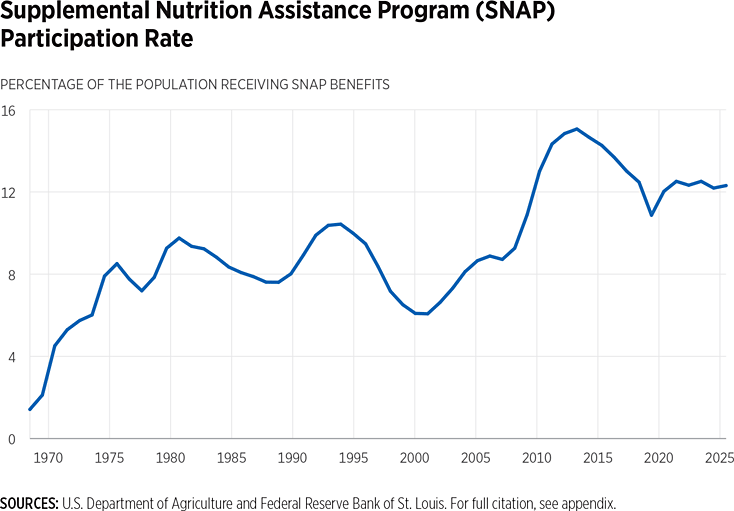
The Supplemental Nutrition Assistance Program (SNAP), more commonly known as the food stamps program, is one of the largest of the federal government’s approximately 90 means-tested welfare programs. As of 2023, almost 42.2 million people—13 percent of the U.S. population—were receiving SNAP benefits.[REF]
As can be seen in the chart above, SNAP has grown substantially through the years, typically surging during a recession but then rarely returning to pre-recession levels. Most recently, program participation grew during the COVID-19 pandemic, and spending soared.[REF] The cost of the food stamps program is projected to remain well above pre-pandemic levels for at least the next 10 years as a result of massive benefit increases made by the Biden Administration.[REF] This executive overreach under Biden led to an increase of 23 percent—the single largest benefit increase in the program’s history.[REF]
SNAP has been ripe for reform for years. As is the case with most government welfare programs, SNAP undermines work by providing benefits without a work requirement. The vast majority of able-bodied adults receiving SNAP benefits are not required to work, participate in job training, or even look for work as a condition for receiving benefits. Although SNAP has a limited work requirement for childless, non-elderly adults, states are often able to take advantage of loopholes in the law to waive even that limited requirement.[REF] (Elderly is defined as more than 55 years old as of 2023 and before 2023 was defined as more than 49 years old.)
Moreover, SNAP is just one part of the government’s welfare system, which, as noted, is comprised of approximately 90 means-tested programs that provide cash, food, housing, medical care, and social services to poor and lower-income Americans.[REF] This web of programs costs more than $1 trillion annually.[REF]
Helping people to free themselves from poverty should be the goal of welfare. Unfortunately, SNAP and nearly all other means-tested assistance programs stand in the way of upward mobility. Reforming SNAP to promote work should be among policymakers’ highest priorities as they work to reform anti-poverty programs.
Endnotes
- Table, “Supplemental Nutrition Assistance Program Participation and Costs,” in U.S. Department of Agriculture, Food and Nutrition Service, “SNAP Data Tables: National Level Annual Summary,” https://www.fns.usda.gov/pd/supplemental-nutrition-assistance-program-snap (accessed April 3, 2026). ↩
- Ibid. ↩
- Congressional Budget Office, “Baseline Projections: Supplemental Nutrition Assistance Program,” June 2024, https://www.cbo.gov/system/files/2024-06/51312-2024-06-snap.pdf (accessed April 3, 2026); Nina Owcharenko Schaefer, Leslie Ford, and Lindsey Burke, “Biden’s Executive Actions on Food Stamps, Obamacare, Student Loans Will Balloon Deficit, CBO Says,” The Daily Signal, June 30, 2022, https://www.dailysignal.com/2022/06/30/bidens-executive-actions-on-food-stamps-obamacare-student-loans-will-hike-deficit-cbo-says/. ↩
- Ibid. ↩
- Jamie Bryan Hall, “Geographic-Area Waivers Undermine Food Stamp Work Requirements,” Heritage Foundation Backgrounder No. 3332, July 19, 2018, https://www.heritage.org/sites/default/files/2018-07/BG3332.pdf. ↩
- Rector and Menon, “Understanding the Hidden $1.1 Trillion Welfare System and How to Reform It.” ↩
- Ibid. ↩
Sources
- U.S. Department of Agriculture, Food and Nutrition Service, “SNAP Data Tables: National Level Annual Summary,” https://www.fns.usda.gov/pd/supplemental-nutrition-assistance-program-snap (accessed May 11, 2026).
- Federal Reserve Bank of St. Louis, “Total Population: All Ages Including Armed Forces Overseas,” https://fred.stlouisfed.org/series/POP#0 (accessed May 11, 2026).
