
Rachel Greszler
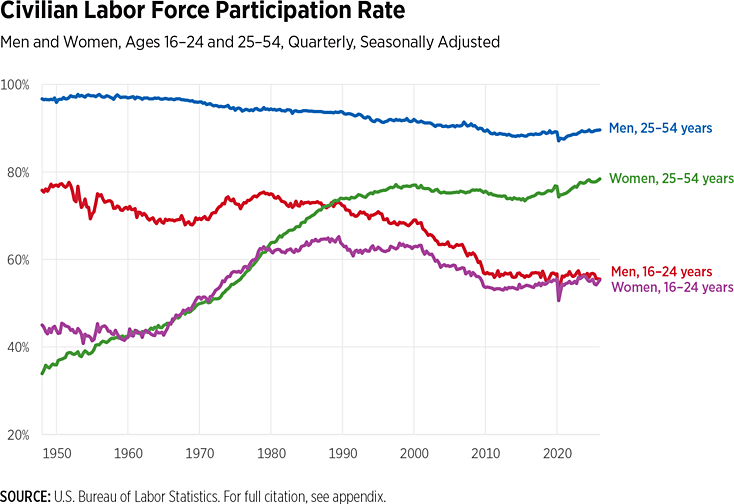
Along with faith, family, and friends, work is a primary source of personal contentment and meaning and a necessary component of human flourishing. Yet labor force participation is declining, and it is particularly troubling that this decline has occurred primarily among young men.[REF] A lack of work not only causes lower incomes, but also contributes to fewer marriages and less family formation.[REF]
The entry of more women into the workforce caused labor force participation to rise from the 1960s up until a peak in 2000. The prime-age labor force participation rate of individuals 25 to 54 years old is only 1.0 percentage point below its peak in 2000.[REF] This includes a 0.9 percentage point increase in the labor force participation rate of prime-age women and a 3.9 percentage point decline among prime-age men.[REF]
Younger Americans’ (ages 16–24) labor force participation rate, on the other hand, is 9.7 percentage points lower than its peak in 2000.[REF] This includes a 7.9 percentage point decline in labor force participation among young women and an 11.5 percentage point decline among young men.[REF] These declines are beyond what can be explained by educational enrollment, which has also declined. Working at younger ages provides valuable experience and builds a work ethic that can contribute to higher future earnings, more stable work, and increased family formation.
Compared to peak employment in 2000, there were 4.9 million fewer people under age 55 working in 2024 than would have been the case if the employment-to-population ratio had held steady.[REF] Most of that decline—4.1 million—was among individuals under age 35, and 3.2 million was among men under age 35.[REF] While cultural changes such as a decline in religion and family formation are almost certainly contributing to the decline in labor force participation among younger Americans, a massive expansion in welfare without work has made it easier for younger people to get by with little or no work. This decline in labor force participation has a predictably negative effect on individual potential and societal flourishing.
Endnotes
- Rachel Greszler, “What Is Happening in This Unprecedented U.S. Labor Market? April 2024 Update,” Heritage Foundation Backgrounder No. 3827, April 30, 2024, https://www.heritage.org/sites/default/files/2024-05/BG3827.pdf. ↩
- Lindsey M. Burke, Rachel Greszler, and Brad Wilcox, “Education Freedom and Work Opportunities as Catalysts for Increasing the Birth Rate Among Married Couples,” Heritage Foundation Backgrounder No. 3769, May 22, 2023, https://www.heritage.org/sites/default/files/2023-05/BG3769.pdf. ↩
- Data from tables in U.S. Department of Labor, Bureau of Labor Statistics, “Employment: Labor Force Statistics from the Current Population Survey: Annual Averages,” last modified February 20, 2026, https://www.bls.gov/data/home.htm (accessed April 3, 2026). ↩
- Ibid. ↩
- Ibid. ↩
- Ibid. ↩
- Ibid. ↩
- Ibid. ↩
Sources
- U.S. Department of Labor, Bureau of Labor Statistics, “Labor Force Statistics from the Current Population Survey, (Seas) Labor Force Participation Rate—25–54 Yrs., Men,” Series ID LNS11300061Q, https://data.bls.gov/timeseries/LNS11300061Q (accessed May 14, 2026).
- U.S. Department of Labor, Bureau of Labor Statistics, “Labor Force Statistics from the Current Population Survey, (Seas) Labor Force Participation Rate—25–54 Yrs., Women,” Series ID LNS11300062Q, https://data.bls.gov/timeseries/LNS11300062Q (accessed May 14, 2026).
- U.S. Department of Labor, Bureau of Labor Statistics, “Labor Force Statistics from the Current Population Survey, (Seas) Labor Force Participation Rate—16–24 Yrs., Men,” Series ID LNS11324885Q, https://data.bls.gov/timeseries/LNS11324885Q (accessed May 14, 2026).
- U.S. Department of Labor, Bureau of Labor Statistics, “Labor Force Statistics from the Current Population Survey, (Seas) Labor Force Participation Rate—16–24 Yrs., Women,” Series ID LNS11324886Q, https://data.bls.gov/timeseries/LNS11324886Q (accessed May 14, 2026).
