
Jennifer Galardi
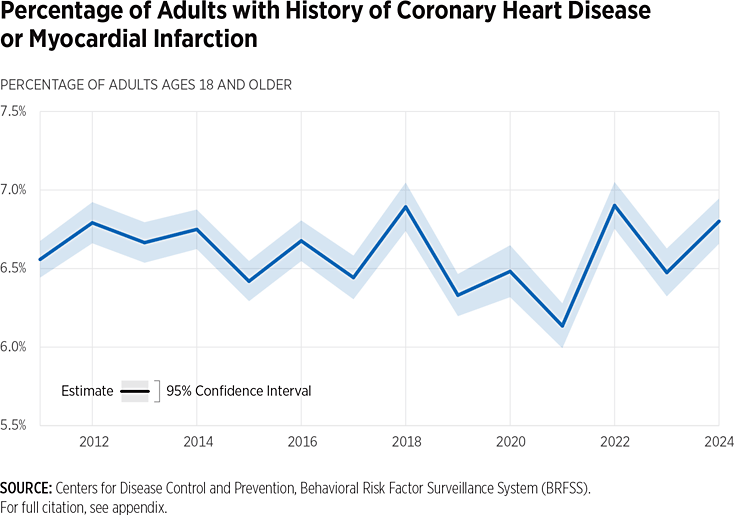
Coronary heart disease or myocardial infarction has been dubbed “the epidemic of the 20th century,”[REF] but the percentage of Americans suffering from a heart-related disease has declined significantly since the mid-1900s when it was at its peak and has hovered between 6 percent and 7 percent over the past decade. This would seem to be good news if it were not for the fact that the incidence of heart disease is projected to rise significantly over the next decade.
Heart disease was uncommon before the mid-1900s, but by mid-century, the number of cases had exploded. Most associated this new chronic disease with such dietary and lifestyle changes as increased smoking rates and an uptick in cholesterol serum levels. That seems to be partly true, but while smoking undoubtedly contributes to heart disease, more recent studies indicate that dietary cholesterol and saturated fats are not responsible for heart attacks and other heart failures. The theory, often referred to as the “lipid hypothesis,”[REF] was promoted by Ancel Keys in the latter half of the 20th century and has remained the dogma for over half a century. Keys pointed to his Seven Countries Study (1958–1999) as evidence that regions whose diets were based on fresh fruit and vegetables, bread, pasta, and olive oil, such as the Mediterranean, suffered fewer heart attacks and had lower cholesterol levels.[REF]
This position has come under strong scrutiny over the past decade.[REF] Many credible doctors and nutritionists have exposed both what they see as flaws in the study[REF] and the monetary incentives to promote corn, soybean, and cotton, the most heavily subsidized agricultural commodities in the U.S. today.[REF] Current research shows that animal products, which contain higher levels of cholesterol than plant-derived fats, have been demonized unnecessarily and are vital components of a nourishing diet. They provide essential nutrients like fat-soluble vitamins A, D, E, and K, which are crucial for the production of hormones[REF] and also increase satiety and can be an effective tool in weight management.
Moreover, while heart attacks and all coronary heart disease have diminished drastically thanks to pharmaceutical interventions (specifically, statins), this has not been without cost. Drug intervention is prescribed to millions of Americans to the tune of billions of dollars per year. In 2022, Medicaid spent $314.3 million (before rebates) on 28.6 million pharmacy prescription claims for statin medications, and the use of statins reportedly increased approximately fortyfold between 1991 and 2022.[REF] According to the American Heart Association, the direct and indirect costs of cardiovascular disease currently total $555 billion with a projected expenditure of $1.1 trillion by 2035.[REF] The benefit of statins has even been called into question.[REF]
In dealing with coronary heart disease and proper nutrition, good science is essential because it dictates all federal and state-level nutritional regulations and provides the model for healthy eating for all Americans. Ensuring accurate guidance is imperative not only for heart health, but also for our waistlines and wallets.
Endnotes
- James E. Dalen et al., “The Epidemic of the 20th Century: Coronary Heart Disease,” The American Journal of Medicine, Vol. 127, No. 9 (September 2014), pp. 807–812, https://doi.org/10.1016/j.amjmed.2014.04.015 (accessed April 29, 2026). ↩
- Jason Andrade et al., “Ancel Keys and the Lipid Hypothesis: From Early Breakthroughs to Current Management of Dyslipidemia,” British Columbia Medical Journal, Vol. 51, No. 2 (March 2009), pp. 66–72, https://bcmj.org/articles/ancel-keys-and-lipid-hypothesis-early-breakthroughs-current-management-dyslipidemia (accessed April 8, 2026). ↩
- See “Seven Countries Study,” https://www.sevencountriesstudy.com (accessed April 8, 2026). ↩
- Uffe Ravnskov, “The Fallacies of the Lipid Hypothesis,” Scandinavian Cardiovascular Journal, Vol. 42, No. 4 (2009), pp. 236–239, https://www.tandfonline.com/doi/pdf/10.1080/14017430801983082 (accessed April 8, 2026). ↩
- Diabetes.co.uk, “Fat and Politics—Nina Teicholz on How the Seven Countries Study Influenced Dietary Policy,” https://www.diabetes.co.uk/in-depth/fat-politics-nina-teicholz-seven-countries-study-dietary-policy/ (accessed April 8, 2026). ↩
- USAFacts, “Federal Farm Subsidies: What the Data Says,” updated June 23, 2025, https://usafacts.org/articles/federal-farm-subsidies-what-data-says/ (accessed April 8, 2026). ↩
- Jie Hu et al., “Cellular Cholesterol Delivery, Intracellular Processing and Utilization for Biosynthesis of Steroid Hormones,” Nutrition & Metabolism, Vol. 7 (2010), article no. 47, https://doi.org/10.1186/1743-7075-7-47 (accessed April 8, 2026). ↩
- Yiyu Chen et al., “A Retrospective Trend Analysis of Utilization, Spending, and Prices for Generic Statins in the US Medicaid Population, 1991–2022,” American Health & Drug Benefits, Vol. 17 (February 2024), last modified April 25, 2025, https://www.ahdbonline.com/web-exclusives/a-retrospective-trend-analysis-of-utilization-spending-and-prices-for-generic-statins-in-the-us-medicaid-population-1991-2022 (accessed April 8, 2026). ↩
- See American Heart Association, “Cardiovascular Disease: A Costly Burden for America, Projections Through 2035,” https://www.heart.org/en/-/media/Files/Get-Involved/Advocacy/Burden-Report-Consumer-Report.pdf (accessed April 8, 2026), and Projections of Cardiovascular Disease Prevalence and Costs: 2014–2035: Technical Report, prepared for Sue Nelson and Laurie Whitsell, American Heart Association, by Olga Khavjou, Diana Phelps, and Alyssa Leib, RTI [Research Triangle Institute] International, November 2016, https://www.heart.org/en/-/media/Files/Get-Involved/Advocacy/Burden-Report-Technical-Report.pdf?sc_lang=en (accessed April 8, 2026). ↩
- Andrew Thompson and Norman J. Temple, “The Case for Statins: Has It Really Been Made?” Journal of the Royal Society of Medicine, Vol. 97, No. 10 (October 2004), pp. 461–464, https://journals.sagepub.com/doi/epdf/10.1177/0141076809701002 (accessed April 8, 2026). ↩
Sources
- U.S. Department of Health and Human Services, Centers for Disease Control and Prevention, Behavioral Risk Factor Surveillance System, “Annual Survey Data,” 2011–2024, https://www.cdc.gov/brfss/annual_data/annual_data.htm (accessed May 10, 2026).
