
Jennifer Galardi
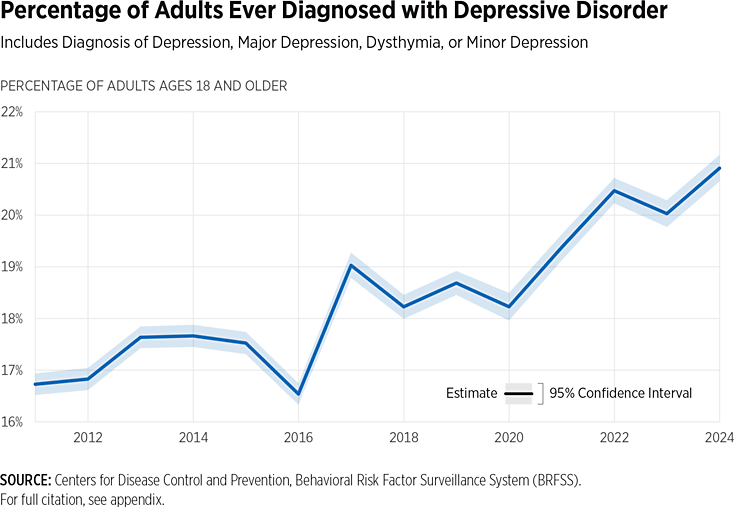
Concern about the decline in the mental health of many Americans is a principal focus of many researchers and influencers. Everyone from renowned authors such as Jonathan Haidt to popular podcasters like Joe Rogan are talking about the alarming rates of (and potential remedies for) the depressive disorders that seem to afflict Americans today. The chart above demonstrates the stark reality of this problem.
There have been two noticeable spikes in the incidences of diagnosis of depression, major depression, dysthymia, or minor depression in adults above the age of 18. In the first, the rate soared from around 16.5 percent in 2016 to just over 19 percent in 2017. Some have attributed this to Donald Trump’s election as President and have even gone so far as to call it “Trump depression.”[REF] Reports circulated that many liberals felt deep despair over the direction of the country. In fact, many studies have shown that those who self-identify as politically liberal often report lower levels of happiness and psychological well-being than their conservative counterparts report.[REF] This suggests that perception determines reality and that some worldviews lend themselves to despair.
The sharp increase between 2020 and 2022 is no mystery. The lockdowns during the COVID-19 pandemic wreaked havoc on almost everyone’s socio-emotional well-being. There were documented increases in alcohol use,[REF] drugs, domestic violence,[REF] and marital strain.[REF] Social isolation along with persistent fearmongering in the media led even the most optimistic to despair. The World Health Organization reported that the pandemic triggered a 25 percent increase in the prevalence of anxiety and depression worldwide.[REF]
Since its high of 21 percent, the rate of depression-related disorders for adults seems to be on the decline, but it is nowhere near its all-time low at the beginning of 2016.
It is important to note that these data are collected by the U.S. Centers for Disease Control and Prevention’s Behavioral Risk Factor Surveillance System (BRFSS),[REF] which collects state data on U.S. residents’ health-related risk behaviors, chronic health conditions, and use of preventive services. This means that diagnosis is self-established and self-reported.
Because emotions and feelings are subjective, complex, and nuanced, pinpointing the causes of mental health issues is difficult. However, many experts point to a decline in social cohesion,[REF] fracturing of the nuclear family,[REF] a rise in ideological education at institutions of higher learning, economic strains,[REF] and a decrease in religious participation.[REF]
The rates for youth in this category are even higher and correspond with the introduction of handheld computers and intense use of social media. This does not bode well for the future of America, which will require today’s younger generations to develop into sound, stable, and responsible leaders.
Endnotes
- Brandon W. Yan et al., “Changes in Mental Health Following the 2016 Presidential Election,” Journal of General Internal Medicine, Vol. 36, No. 1 (January 2021), pp. 170–177, https://pmc.ncbi.nlm.nih.gov/articles/PMC7602772/pdf/11606_2020_Article_6328.pdf (accessed April 8, 2026). ↩
- David J. Craig, “Why Depression Rates Are Higher Among Liberals,” Columbia Magazine, Spring/Summer 2023, https://magazine.columbia.edu/article/why-depression-rates-are-higher-among-liberals (accessed April 8, 2026). ↩
- Fact Sheet, “America’s Most Common Drug Problem? Unhealthy Alcohol Use,” Pew Charitable Trusts, December 13, 2024, https://www.pewtrusts.org/en/research-and-analysis/fact-sheets/2024/12/americas-most-common-drug-problem-unhealthy-alcohol-use (accessed April 8, 2026). ↩
- News release, “New Analysis Shows 8% Increase in U.S. Domestic Violence Incidents Following Pandemic Stay-at-Home Orders,” Council on Criminal Justice, February 24, 2021, https://counciloncj.org/new-analysis-shows-8-increase-in-u-s-domestic-violence-incidents-following-pandemic-stay-at-home-orders/ (accessed April 8, 2026). See also Alex R. Piquero et al., “Domestic Violence During COVID-19: Evidence from a Systematic Review and Meta-Analysis,” Council on Criminal Justice, February 2021, https://counciloncj.org/wp-content/uploads/2024/06/Domestic-Violence-During-COVID-19-February-2021.pdf (accessed April 8, 2026). ↩
- Jason K.S. Porter, “COVID-19 Causes the US Divorce Rate to Skyrocket (& Why),” Law Offices of Jason K.S. Porter Blog, October 5, 2020, https://www.pickporter.com/blog/2020/october/covid-19-causes-the-us-divorce-rate-to-skyrocket/ (accessed April 8, 2026). ↩
- News release, “COVID-19 Pandemic Triggers 25% Increase in Prevalence of Anxiety and Depression Worldwide,” World Health Organization, March 2, 2022, https://www.who.int/news/item/02-03-2022-covid-19-pandemic-triggers-25-increase-in-prevalence-of-anxiety-and-depression-worldwide (accessed April 8, 2026). ↩
- U.S. Department of Health and Human Services, Centers for Disease Control and Prevention, “Behavioral Risk Factor Surveillance System,” last reviewed February 4, 2026, https://www.cdc.gov/brfss/index.html (accessed April 8, 2026). ↩
- Eunice Y. Park et al., “Sense of Community and Mental Health: A Cross-Sectional Analysis from a Household Survey in Wisconsin,” Family Medicine and Community Health, Vol. 11, No. 2 (June 2023), article no. e001971, https://fmch.bmj.com/content/fmch/11/2/e001971.full.pdf (accessed April 8, 2026). ↩
- Linda A. Liang, Ursula Berger, and Christian Brand, “Psychosocial Factors Associated with Symptoms of Depression, Anxiety and Stress among Single Mothers with Young Children: A Population-Based Study,” Journal of Affective Disorders, Vol. 242 (January 2019), pp. 255–264, https://doi.org/10.1016/j.jad.2018.08.013 (accessed April 8, 2026). ↩
- Vikram Patel et al., “Income Inequality and Depression: A Systematic Review and Meta-Analysis of the Association and a Scoping Review of Mechanisms,” World Psychiatry, Vol. 17, No. 1 (February 2018), pp. 76–89, https://doi.org/10.1002/wps.20492 (accessed April 8, 2026). ↩
- Corina R. Ronneberg et al., “The Protective Effects of Religiosity on Depression: A 2-Year Prospective Study,” The Gerontologist, Vol. 56, No. 3 (June 2016), pp. 421–431, https://www.researchgate.net/publication/264248938_The_Protective_Effects_of_Religiosity_on_Depression_A_2-Year_Prospective_Study (accessed April 8, 2026). ↩
Sources
- U.S. Department of Health and Human Services, Centers for Disease Control and Prevention, Behavioral Risk Factor Surveillance System, “Annual Survey Data,” 2011–2024, https://www.cdc.gov/brfss/annual_data/annual_data.htm (accessed May 10, 2026).
