
Parker Sheppard
Stable prices are the foundation of a strong economy. A sound currency maintains the link between past and present, preserving the value of work and savings across generations. Rapidly rising prices undermine that connection by eroding people’s hard-earned wealth and making it more difficult for families to leave a meaningful inheritance to their children.
Inflation also creates arbitrary redistributions of wealth by transferring purchasing power from lenders to borrowers. Those who live paycheck to paycheck, especially households in the bottom 40 percent, suffer the most because they primarily hold liquid assets that lose value rapidly.[REF] Predictable prices are essential for long-term financial planning—whether saving for retirement, buying a home, or launching a business.
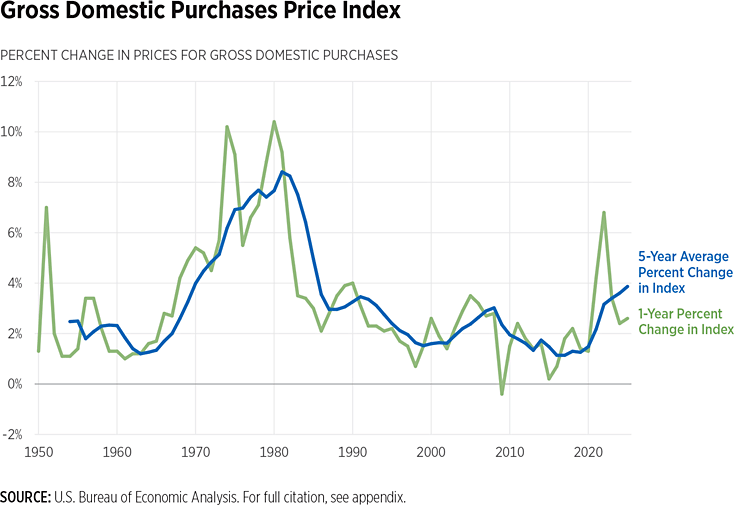
High inflation typically follows unchecked government spending. During the COVID pandemic period, Congress authorized more than $4 trillion in new outlays without offsetting cuts. Consequently, the Gross Domestic Purchases Price Index grew by 4.2 percent in 2021 and 6.9 percent in 2022. (See chart above.) The post-pandemic inflation is a breakout from the otherwise low and stable inflation that has prevailed since the 1990s.
The government does not have a revenue problem that can be solved by raising tax rates: Federal receipts as a share of GDP are already on par with historical highs, including periods when the top marginal tax rate exceeded 90 percent.[REF] Rather, responsible budgeting and disciplined spending are critical to avoid imposing the hidden tax of inflation on hardworking families.
Endnotes
- Edward N. Wolff, “Is There Really an Inflation Tax? Not for the Middle Class and the Ultra-Wealthy,” National Bureau of Economic Research Working Paper No. 31775, October 2023, https://www.nber.org/system/files/working_papers/w31775/w31775.pdf (accessed March 31, 2026). ↩
- Graph, “Federal Receipts as Percent of Gross Domestic Product (FYFRGDA188S),” U.S. Office of Management and Budget and Federal Reserve Bank of St. Louis, updated March 13, 2026, https://fred.stlouisfed.org/series/FYFRGDA188S (accessed March 31, 2026). ↩
Sources
- U.S. Department of Commerce, Bureau of Economic Analysis, National Income and Product Accounts, “Table 1.6.7. Percent Change from Preceding Period in Prices for Gross Domestic Purchases,” last revised March 13, 2026, https://www.bea.gov/.
