
Parker Sheppard
Starting and running a business in America is not just about hard work. More and more, success in business requires navigating the complexities of an ever-growing rulebook of federal regulations. From labor rules and environmental requirements to finance and consumer protection statutes, these regulations define what companies can and cannot do. Although each rule is intended to advance some public goal, the cumulative burden on businesses can be substantial, especially for small firms that lack the resources to hire dedicated compliance staff or specialized legal counsel.
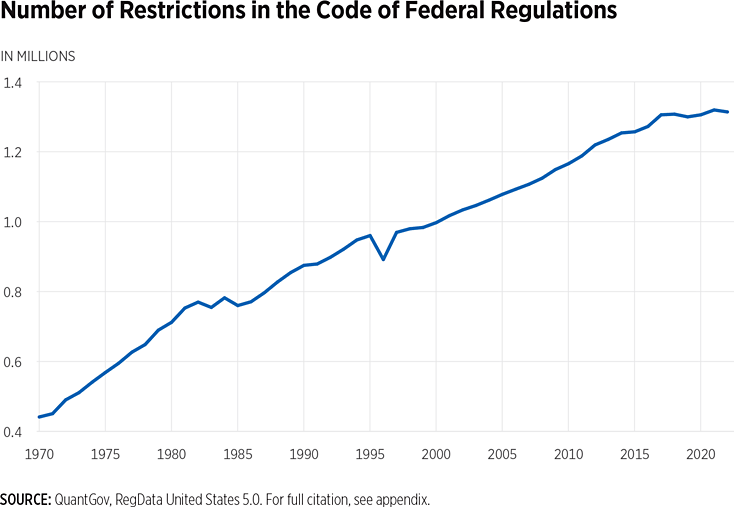
Over time, the volume of these federal rules has grown at a remarkable pace. According to the Mercatus Center at George Mason University’s RegData—a data set that counts the restrictions published in the Code of Federal Regulations—the number of explicit restrictions has grown 7.75 percent over the past 10 years of data. (See chart above.) The first Trump Administration was able to slow the growth but was unable to reverse the trend to any meaningful extent.
This continued growth in regulations signals a steady expansion of the government’s reach into how enterprises operate. Each new rule adds requirements for paperwork, training, and administration, raising costs and complexity for existing businesses, and that complexity can function as a barrier that protects incumbents and potentially discourages new businesses from entering the market and driving down prices.
Simultaneously, measures of business dynamism have declined.[REF] As the burden of federal regulation has risen, the rates at which new establishments and jobs are created have declined. Scholars and policymakers increasingly highlight the relationship between regulatory overhead and stifled entrepreneurship. When regulatory compliance costs are large, smaller or younger firms are often less able to absorb the compliance burden, and this in turn makes it harder for them to compete with larger, established players.[REF]
A healthy entrepreneurial society is one in which new ideas, products, and services can flourish. That type of environment demands a degree of regulatory clarity and flexibility that allows businesses to innovate and grow without disproportionate barriers. In many respects, the current surge in rules and restrictions challenges that principle, creating a climate in which caution supersedes risk-taking and growth is tempered by concerns over compliance rather than buoyed by the promise of invention.
Endnotes
- Parker Sheppard, “Reversing the Decline in Entrepreneurship So That More Americans Can Build Wealth,” Heritage Foundation Issue Brief No. 5356, July 11, 2024, https://www.heritage.org/sites/default/files/2024-07/IB5356_0.pdf. ↩
- J.R. Clark and Todd Nesbit, “Regulatory Burden and Business Dynamics: A Preliminary Analysis,” Journal of Entrepreneurship and Public Policy, Vol. 7, No. 1 (August 2018), pp. 279–289. ↩
Sources
- QuantGov, “RegData United States 5.0,” https://www.quantgov.org/csv-download (accessed May 11, 2026).
