
Parker Sheppard
Time is the bottleneck that holds back production. Population and the capital stock have grown throughout history, but there still are only 24 hours in a day and 365 days in a year. Thus, rising prosperity in the United States depends on Americans being able to produce more and more valuable goods and services in the time available to them.
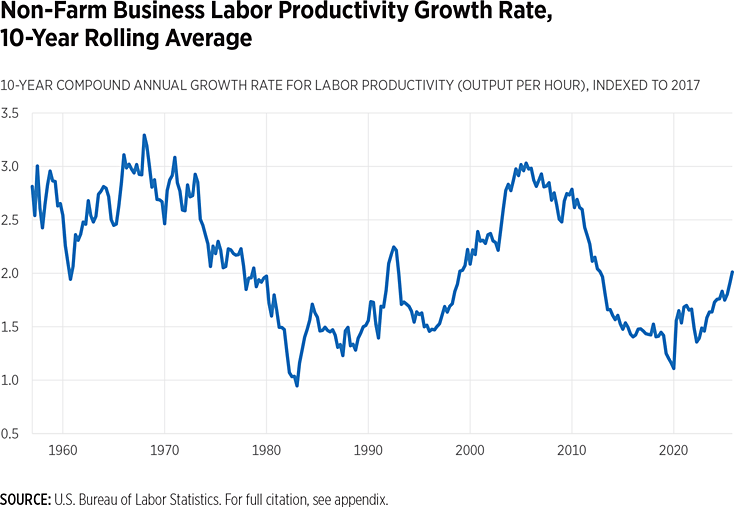
Labor productivity measures the growth in output relative to the number of hours worked. The chart above shows 10-year average growth rates in labor productivity for the nonfarm business sector, a broad measure of the trend in productivity growth.
The average annual growth rate in the whole series is 2.2 percent per year, and the 10-year trends alternate between long periods of growth above and below this average. Productivity growth was high in the 1950s and 1960s, languished in the 1970s and 1980s, and resumed in the 1990s with the information revolution before bottoming out again in the wake of the global financial crisis. Changes stemming from the COVID-19 pandemic encouraged a brief increase in productivity growth, but the trend is still below the average.
There is a massive difference between the benefits derived from sustained productivity growth of 1 percent and the benefits yielded by sustained productivity growth of 2 percent or 3 percent. Over 30 years, 1 percent growth will raise output by a total of 34 percent; 2 percent growth, by a total of 81 percent; and 3 percent growth, by 142 percent. In other words, the next generation could enjoy a standard of living that is more than twice as high as today’s if the economy can sustain productivity growth of 3 percent or nearly 3 percent.
The key drivers of productivity growth are new research and new technology. Emerging technologies like artificial intelligence and remote work could herald a return to above-average productivity growth—if policymakers can stay out of the way and let the development of new technologies flourish.
Sources
- Calculated from U.S. Department of Labor, Bureau of Labor Statistics, “Databases, Tables & Calculators by Subject: Major Sector Productivity and Costs: Labor Productivity (Output per Hour), Index (2017=100),” Seasonally Adjusted, Series ID PRS85006093, https://data.bls.gov/timeseries/PRS85006093 (accessed May 9, 2026).
