
Delano Squires
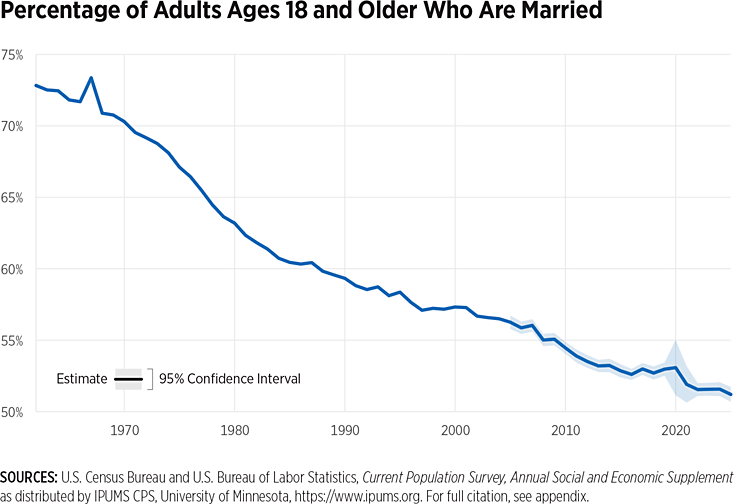
American family life has changed significantly in recent decades, largely because men and women are delaying marriage or no longer marrying at all. The chart above shows that roughly half of American adults are married, down from more than 70 percent in 1960. This is one reason why the percentage of American households composed of married couples has decreased from 74 percent in 1960 to 47 percent today.[REF] A Pew Research Center study released in November 2019 found that more adults ages 18 to 44 had cohabited (59 percent) than had been married (50 percent).[REF]
One reason why fewer married couples are living with their children is that adults are waiting longer to marry. The median age at first marriage in 1970 was 23 for men and 21 for women.[REF] Today, it is 30 for men and 29 for women.[REF]
Men and women in previous generations married young, and their relationship was the foundation of a life built together. This is what social scientists often call the “cornerstone” model of marriage.[REF] The age of first marriage has increased in recent decades because men and women often delay marriage until they achieve several personal and professional goals, including advanced degrees and home ownership. This approach is known as the “capstone” model of marriage.[REF]
Changes in marriage rates and family formation norms also affect children. Roughly 40 percent of American children are born to unmarried parents.[REF] Additionally, the United States leads the world in the percentage of children who live with a single parent (23 percent).[REF] While these statistics often prompt policymakers to extol the importance of involved fathers, the truth is that there is no way to promote pro-family policy without addressing the decline in marriage.
The family is the foundation of civil society, and the cornerstone of the family is marriage—the union of one man and one woman. A nation that rejects the importance of stable marriages and strong families weakens its ability to pass on the blessings of prosperity to future generations. This is the reality that Americans face today, and the response to the decline in marriage will determine the health and survival of the American Republic.
Endnotes
- Table HH-1, “Households by Type: 1940 to Present,” in U.S. Department of Commerce, Census Bureau, “Historical Households Tables,” December 2025, https://www.census.gov/data/tables/time-series/demo/families/households.html (accessed April 1, 2026). ↩
- Chart, “Amid Changes in Marriage and Cohabitation, Wide Acceptance of Cohabitation, Even as Many Americans See Societal Benefits in Marriage,” in Juliana Horowitz, Nikki Graf, and Gretchen Livingston, Marriage and Cohabitation in the U.S., Pew Research Center, November 2019, p. 4, https://www.pewresearch.org/wp-content/uploads/sites/20/2019/11/PSDT_11.06.19_marriage_cohabitation_FULL.final_.pdf (accessed April 1, 2026). ↩
- Table MS-2, “Estimated Median Age at First Marriage, by Sex: 1890 to Present,” in U.S. Department of Commerce, Census Bureau, “Historical Marital Status Tables,” December 2025, https://www.census.gov/data/tables/time-series/demo/families/marital.html (accessed April 1, 2026). ↩
- Ibid. ↩
- Alan J. Hawkins, Brad Wilcox, and Jason S. Carroll, “Capstones vs. Cornerstones: Is Marrying Later Always Better?” Institute for Family Studies Blog, February 9, 2022, https://ifstudies.org/blog/capstones-vs-cornerstones-is-marrying-later-always-better (accessed April 1, 2026). ↩
- Ibid. ↩
- Table 11, “Selected Demographic Characteristics by Births, by Race and Hispanic Origin of Mother: United States, 2021,” in Michelle J.K. Osterman et al., “Births: Final Data for 2021,” U.S. Department of Health and Human Services, Centers for Disease Control and Prevention, National Center for Health Statistics, National Vital Statistics System, National Vital Statistics Reports, Vol. 72, No. 1 (January 31, 2023), p. 29, https://www.cdc.gov/nchs/data/nvsr/nvsr72/nvsr72-01.pdf (accessed April 1, 2026). ↩
- Stephanie Kramer, “U.S. Has World’s Highest Rate of Children Living in Single-Parent Households,” Pew Research Center, December 12, 2019, https://www.pewresearch.org/short-reads/2019/12/12/u-s-children-more-likely-than-children-in-other-countries-to-live-with-just-one-parent/ (accessed April 1, 2026). ↩
Sources
- U.S. Department of Commerce, Census Bureau, and U.S. Department of Labor, Bureau of Labor Statistics, Current Population Survey, Annual Social and Economic Supplement, as distributed by Sarah Flood, Miriam King, Renae Rodgers, Steven Ruggles, J. Robert Warren, Daniel Backman, Etienne Breton, Grace Cooper, Julia A. Rivera Drew, Stephanie Richards, David Van Riper, and Kari C.W. Williams, IPUMS CPS: Version 13.0 [dataset], Minneapolis, MN: IPUMS, 2025, https://doi.org/10.18128/D030.V13.0 (accessed May 11, 2026).
