Delano Squires
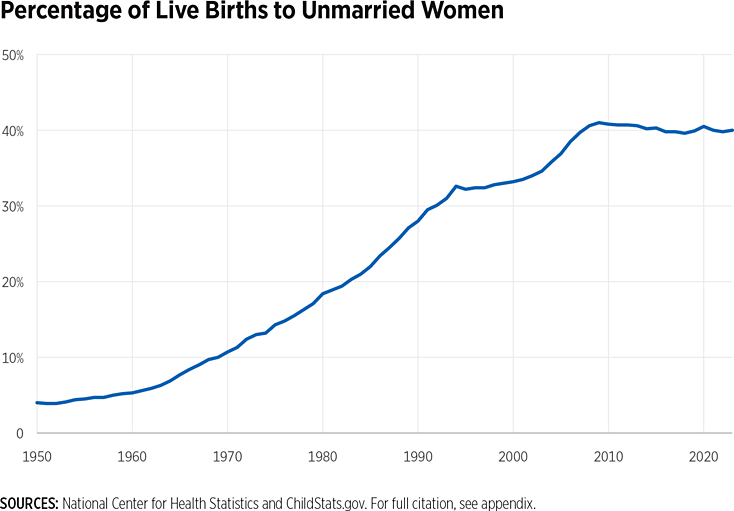
Since the 1960s, policy debates about the rise in out-of-wedlock births have focused largely on teenage mothers and low-income women in large cities. That is no longer the case. The chart above shows that 40 percent of all American children are born to unmarried parents—a significant increase from 5 percent in 1960.[REF]
Although unwed childbearing is common across all racial groups, 53 percent of Hispanic children and 70 percent of black children are born outside marriage compared to 13 percent of Asian children and 28 percent of white children.[REF] The disparities across education levels are even greater. Approximately 90 percent of births to highly educated women are within marriage,[REF] and most children born to women without a high level of education are born to unwed mothers. Specifically, two-thirds of births to mothers with low levels of education are outside marriage, and 53 percent of births to women with moderate levels of education are outside marriage.[REF]
Another reason for the increase in non-marital births is the steep decline in “shotgun marriages,” the post-conception unions that occurred after a couple became pregnant but before the baby was born. According to research from the U.S. Congress’s Joint Economic Committee, 43 percent of births in the early 1960s that began from nonmarital pregnancies occurred to women who married shortly before the birth took place. By the early 2000s, the “shotgun marriage rate” had dropped all the way to 9 percent.[REF]
The increase in nonmarital births, coupled with a decrease in marriage, has also led to more people having children with multiple partners (“multi-partner fertility”). According to a 2021 U.S. Census Bureau report, 18 percent of American parents have a child with more than one partner.[REF] About one in four parents that have more than two children have multi-partner fertility.[REF]
The family formation sequence that served as a cultural norm for decades can be summed up by the popular nursery rhyme, “first comes love, then comes marriage, then comes baby in a baby carriage!” Regrettably, because of shifting social norms around sex, relationships, and family, that is no longer the case. It is clear that for an increasing number of couples today, babies are welcome, but marriage is optional.
Endnotes
- Table 11, “Selected Demographic Characteristics by Births, by Race and Hispanic Origin of Mother: United States, 2021,” supra note 7; Table 4, “Percent of Births to Unmarried Women by Age, Race, and Hispanic Origin of Mother: United States, 1940 and 1950–99,” in Stephanie Ventura and Christine A. Bachrach, “Nonmarital Childbearing in the United States, 1940–99,” U.S. Department of Health and Human Services, Centers for Disease Control and Prevention, National Center for Health Statistics, National Vital Statistics System, National Vital Statistics Reports, Vol. 48, No. 16 (October 18, 2000), pp. 28–31, https://www.cdc.gov/nchs/data/nvsr/nvsr48/nvs48_16.pdf (accessed April 1, 2026). ↩
- Table 11, “Selected Demographic Characteristics by Births, by Race and Hispanic Origin of Mother: United States, 2021,” supra note 7. ↩
- Rachel Sheffield and Delano Squires, “Crossroads: American Family Life at the Intersection of Tradition and Modernity,” Heritage Foundation Special Report No. 310, March 4, 2025, p. 17, https://www.heritage.org/sites/default/files/2025-03/SR310.pdf. ↩
- Ibid. ↩
- Figure 13, “Shotgun Marriage Rate, 1950–54 to 2005–09,” in SCP Report No. 4-17, Love, Marriage, and the Baby Carriage: The Rise in Unwed Childbearing, U.S. Congress, Joint Economic Committee—Republicans, Social Capital Project, December 2017, p. 16, https://www.jec.senate.gov/public/_cache/files/bc6c3b18-b268-4178-b65f-56fec2b26002/4-17-love-marriage-and-the-baby-carriage.pdf (accessed April 1, 2026). ↩
- Table 2, “Prevalence of Multiple Partner Fertility Among Coresidential Couples,” in Brittany King and Tayelor Valerio, “Multiple Partner Fertility Research Brief: 2021,” U.S. Department of Commerce, Census Bureau, Current Population Reports P70BR-182, May 2023, p. 3, https://www.census.gov/content/dam/Census/library/publications/2023/demo/p70br-182.pdf (accessed April 1, 2026). ↩
- Figure 2, “Prevalence of Multiple Partner Fertility (MPF),” in ibid. ↩
Sources
- Stephanie J. Ventura and Christine A. Bachrach, “Nonmarital Childbearing in the United States, 1940–99,” U.S. Department of Health and Human Services, National Center for Health Statistics, National Vital Statistics Reports, Vol. 48, No. 16 (October 18, 2000), https://www.cdc.gov/nchs/data/nvsr/nvsr48/nvs48_16.pdf (accessed May 9, 2026).
- Table FAM2.B, “Births to Unmarried Women: Percentage of All Births That Are to Unmarried Women by Age of Mother, 1980–2021,” ChildStats Forum on Child and Family Statistics, https://www.childstats.gov/americaschildren23/tables/fam2b.asp (accessed May 11, 2026).
- Joyce A. Martin et al., “Births: Final Data for 2015,” U.S. Department of Health and Human Services, National Center for Health Statistics, National Vital Statistics Reports, Vol. 66, No. 1 (January 5, 2017), https://www.cdc.gov/nchs/data/nvsr/nvsr66/nvsr66_01.pdf (accessed May 9, 2026).
- Joyce A. Martin et al., “Births: Final Data for 2016,” U.S. Department of Health and Human Services, National Center for Health Statistics, National Vital Statistics Reports, Vol. 67, No. 1 (January 31, 2018), https://www.cdc.gov/nchs/data/nvsr/nvsr67/nvsr67_01.pdf (accessed May 9, 2026).
- Joyce A. Martin et al., “Births: Final Data for 2017,” U.S. Department of Health and Human Services, National Center for Health Statistics, National Vital Statistics Reports, Vol. 67, No. 8 (November 7, 2018), https://www.cdc.gov/nchs/data/nvsr/nvsr67/nvsr67_08-508.pdf (accessed May 9, 2026).
- Joyce A. Martin et al., “Births: Final Data for 2018,” U.S. Department of Health and Human Services, National Center for Health Statistics, National Vital Statistics Reports, Vol. 68, No. 13 (November 27, 2019), https://www.cdc.gov/nchs/data/nvsr/nvsr68/nvsr68_13-508.pdf (accessed May 9, 2026).
- Joyce A. Martin et al., “Births: Final Data for 2019,” U.S. Department of Health and Human Services, National Center for Health Statistics, National Vital Statistics Reports, Vol. 70, No. 2 (March 23, 2021), https://www.cdc.gov/nchs/data/nvsr/nvsr70/nvsr70-02-508.pdf (accessed May 9, 2026).
- Michelle J.K. Osterman, “Births: Final Data for 2020,” U.S. Department of Health and Human Services, National Center for Health Statistics, National Vital Statistics Reports, Vol. 70, No. 17 (February 7, 2022), https://www.cdc.gov/nchs/data/nvsr/nvsr70/nvsr70-17.pdf (accessed May 9, 2026).
- Michelle J.K. Osterman, “Births: Final Data for 2021,” U.S. Department of Health and Human Services, National Center for Health Statistics, National Vital Statistics Reports, Vol. 72, No. 1 (January 31, 2023), https://www.cdc.gov/nchs/data/nvsr/nvsr72/nvsr72-01.pdf (accessed May 9, 2026).
- Michelle J.K. Osterman et al., “Births: Final Data for 2022,” U.S. Department of Health and Human Services, National Center for Health Statistics, National Vital Statistics Reports, Vol. 73, No. 2 (April 4, 2024), https://www.cdc.gov/nchs/data/nvsr/nvsr73/nvsr73-02.pdf (accessed May 9, 2026).
- Michelle J.K. Osterman et al., “Births: Final Data for 2023,” U.S. Department of Health and Human Services, National Center for Health Statistics, National Vital Statistics System, National Vital Statistics Reports, Vol. 74, No. 1 (March 18, 2025), https://www.cdc.gov/nchs/data/nvsr/nvsr74/nvsr74-1.pdf (accessed May 9, 2026).
