
Jonathan Abbamonte
The United States is on an unsustainable demographic path. For decades, fertility in the U.S. has been below replacement, defined as the level of fertility that is theoretically necessary for a generation to replace itself. If fertility in the U.S. remains below replacement and immigration levels are insufficient to bridge the gap, the population of the United States will begin to shrink.[REF]
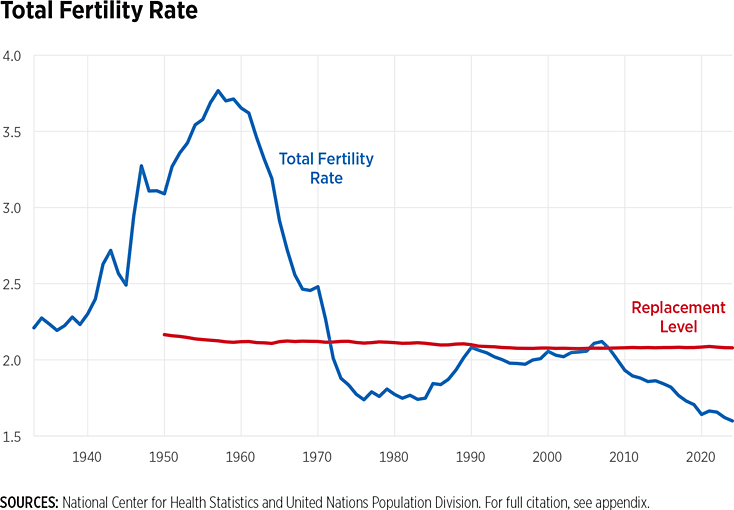
The chart above shows how America’s total fertility rate has changed over time. The red line shows the estimated replacement fertility rate. The total fertility rate is defined as the number of children that women on average are on pace to have by the end of their childbearing years if current age-specific fertility rates remain fixed over time. Because age-specific fertility rates have changed dramatically over the past several decades, the total fertility rate does not necessarily reflect the actual average number of children women end up having during their reproductive years. Nevertheless, it is a useful measure of fertility insofar as it helps us to gauge prevailing age-specific fertility rates in the aggregate.
Fertility rates in the United States fell precipitously after the Baby Boom and have never recovered. The total fertility rate peaked in 1957 at 3.77 children per woman, but by 1972, it had fallen below replacement. Since 1972, the total fertility rate has peaked above replacement only once, from 2006–2007. Since the start of the Great Recession in 2007, the total fertility rate has fallen every year except in 2014 and 2021. In 2023, it fell to the lowest level on record: 1.62 children per woman.
The total U.S. fertility rate has declined because women have been postponing births. Over the past few decades, fertility has declined significantly for women under 30 and has increased substantially for women over 30.[REF] There are many reasons why women are postponing fertility. For many, the reasons are financial.[REF] Others are related to not having found the right person to marry, to a desire to delay marriage, or to massive shifts in the culture that have changed what Americans value and how they spend their time.
Young adults, especially women, are spending more years in education to remain competitive in an increasingly specialized and technical skills-based market.[REF] Young adults also face mounting student debt, rising rent and housing costs, and diminished wealth on average compared to prior generations[REF] and increasingly tend to prioritize becoming established in a career before getting married and having children. Many of today’s young adults experienced the divorce of their parents while growing up, and this has made them more wary of entering into and committing to marriage.[REF]
Massive shifts in cultural values have also made Americans more accepting of premarital sex and cohabitation. The increasing prevalence of cohabitation and longer time spent dating are leading young people to delay marriage to later in life, and many are forgoing marriage entirely. Research has shown that, on average, Americans who cohabit are spending longer in cohabitation and are less likely to transition to marriage than they were several decades ago.[REF] Moreover, because fertility rates in the U.S. are higher for married women than for unmarried women,[REF] longer time spent unmarried translates to fewer births.
Although the total fertility rate has continued to plummet since the Great Recession, the desire for children surprisingly has not. After the Baby Boom, Americans’ ideal number of children fell with the fertility rate, but since 1980, the ideal number of children has remained more or less unchanged at around or just above 2.5 children.[REF] The sizeable and growing gap between Americans’ ideal number of children and the total fertility rate is an indication that Americans want to have more children than they are on pace for having. Today’s adults are having fewer children not necessarily because they do not want them, but rather because they cannot attain them with the priorities they have chosen and the financial difficulties they face.
Endnotes
- Jonathan Abbamonte, “Fertility in the United States Is Below Replacement,” Heritage Foundation Backgrounder No. 3884, March 4, 2025, https://www.heritage.org/sites/default/files/2025-03/BG3884_0.pdf. ↩
- Jonathan Abbamonte, “U.S. Fertility Is Declining Due to Delayed Marriage and Childbearing,” Heritage Foundation Backgrounder No. 3883, March 4, 2025, https://www.heritage.org/sites/default/files/2025-03/BG3883_0.pdf. ↩
- Ibid., and Claire Cain Miller, “Americans Are Having Fewer Babies. They Told Us Why,” The New York Times, July 5, 2018, https://www.nytimes.com/2018/07/05/upshot/americans-are-having-fewer-babies-they-told-us-why.html (accessed April 10, 2026). ↩
- Chart, “Average Years of Schooling Among Women,” Our World in Data, last updated May 7, 2025, https://ourworldindata.org/grapher/mean-years-of-schooling-female?tab=chart&country=~USA (accessed April 10, 2026); Figure 6, “Percent of Population 25 Years and Over, and 25 to 29 Years Old, with Bachelor’s Degree or Higher by Sex: 1947–2021,” in U.S. Department of Commerce, Census Bureau, “CPS [Current Population Survey] Historical Time Series Visualizations,” February 24, 2022, page last revised February 26, 2025, https://www.census.gov/library/visualizations/time-series/demo/cps-historical-time-series.html (accessed April 10, 2026). ↩
- Rob J. Gruijters, Zachary Van Winkle, and Anette E. Fasang, “Life Course Trajectories and Wealth Accumulation in the United States: Comparing Late Baby Boomers and Early Millennials,” American Journal of Sociology, Vol. 129, No. 2 (September 2023), pp. 530–569, https://hal.science/hal-04278042v1/file/Life%20Course%20Trajectories%20and%20Wealth%20Accumulation%20in%20the%20United%20States_AJS_final-1-1.pdf (accessed April 10, 2026). ↩
- Sarah W. Whitton et al., “Effects of Parental Divorce on Marital Commitment and Confidence,” Journal of Family Psychology, Vol. 22, No. 5 (2008), pp. 789–793, https://www.researchgate.net/publication/23317350_Effects_of_Parental_Divorce_on_Marital_Commitment_and_Confidence (accessed April 10, 2026). ↩
- Esther O. Lamidi, Wendy D. Manning, and Susan L. Brown, “Change in the Stability of First Premarital Cohabitation Among Women in the United States, 1983–2013,” Demography, Vol. 56, No. 2 (April 2019), pp. 427–450. ↩
- Abbamonte, “U.S. Fertility Is Declining Due to Delayed Marriage and Childbearing.” ↩
- Jonathan Abbamonte, “Americans Have Not Been Able to Have the Number of Children They Want,” Heritage Foundation Backgrounder No. 3886, March 4, 2025, https://www.heritage.org/sites/default/files/2025-03/BG3886_0.pdf. ↩
Sources
- Joyce A. Martin et al., “Births: Final Data for 2015,” U.S. Department of Health and Human Services, National Center for Health Statistics, National Vital Statistics Reports, Vol. 66, No. 1 (January 5, 2017), https://www.cdc.gov/nchs/data/nvsr/nvsr66/nvsr66_01.pdf (accessed May 10, 2026).
- Michelle J.K. Osterman et al., “Births: Final Data for 2023,” U.S. Department of Health and Human Services, National Center for Health Statistics, National Vital Statistics Reports, Vol. 74, No. 1 (March 18, 2025), https://www.cdc.gov/nchs/data/nvsr/nvsr74/nvsr74-1.pdf (accessed May 10, 2026).
- United Nations, Department of Economic and Social Affairs, Population Division, World Population Prospects 2024, https://population.un.org/wpp/ (accessed May 10, 2026).
