
Colombia, America's best friend in the Caribbean-Andean region, faces the hostile regimes of Ecuador and Venezuela on its borders, and other unfriendly neighbors are nearby in Cuba, Nicaragua, Argentina, and Bolivia. The main reasons for their animosity are that the Colombian government is solidly committed to its partnership with the United States and is following the same path toward market-based democracy that made the United States the most prosperous nation in world history.
Regrettably, on April 10, 2008, the leadership of the U.S. Congress forced a vote along party lines that has delayed consideration of the U.S.-Colombia Free Trade Agreement (FTA) indefinitely. With this ex post facto change in the "fast track" ground rules that have been a bedrock principle of U.S. trade negotiation policy for the past 35 years, Congress reneged on its pledge that trade agreements would receive a straight up-or-down vote within 90 days of submission.[1] Congress also sent an alarming message to America's trading partners around the world that Congress puts short-term political expediency above the long-term interests of the U.S. and its allies.
Colombians deserve the support of all Americans and better treatment from Congress. Congress should promptly reverse itself and approve the U.S.-Colombia FTA (also called the U.S.- Colombia Trade Promotion Agreement or TPA) to seal the alliance with this great ally and friend of the United States.
Colombia Today
In 2008, Colombia is bustling with people who are excited to see their homeland growing more prosperous and, at last, more peaceful. The vast majority of Colombians are focused on enhancing their peace and prosperity, which will accelerate Colombia's entry into the globalizing economy. The situation is a far cry from the Colombia of a decade ago--a nation wracked by violence and seized with fear, where drug kingpins, narcoterrorist communist guerrillas, far-right paramilitaries, and an assortment of other gangsters ruled with impunity while government, military, and law enforcement officials cowered in their offices.
In the intervening years, many things have changed, but they can be summarized in a few words: Plan Colombia, President Álvaro Uribe, and a new spirit among the Colombian people. Plan Colombia is a bold, multiyear program begun in 1999 by President Bill Clinton and President Andres Pastrana, Uribe's predecessor. Through this plan, the two countries began to rebuild the Colombian state. Plan Colombia has helped the Colombian government to regain control of territory and extend security to the towns and the countryside. Progress has been especially dramatic since 2002, when President Uribe and his center-right, pro-U.S. administration took office.
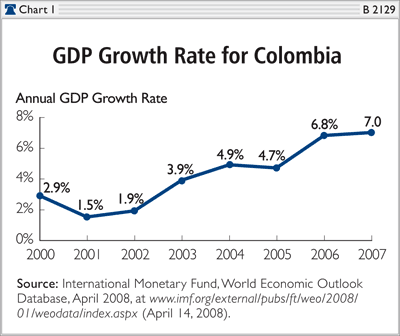
The restoration of order and civilian authority has allowed President Uribe's free-market policies to bear fruit, and economic growth in Colombia has taken off. The gross domestic product (GDP) has been growing at an increasing rate since Uribe took office, reaching an estimated 7 percent in 2007.[2] Meanwhile, the people enjoy the freedom of safely walking Colombia's once-mean streets for the first time in memory. Uribe's popularity has soared along with the economy, while the favorable rating of the Revolutionary Armed Forces of Colombia (FARC), the violent narcoterrorist guerrilla group and long-time enemy of Colombian democracy, has plummeted to almost zero.[3]
A Rough Neighborhood
Meanwhile, next door in Venezuela, the other big Caribbean-Andean power, populist President Hugo Chávez has taken his people in precisely the opposite direction since 1999--toward chaos, violence, and growing reliance on an ever more powerful, would-be totalitarian socialist police state. Notwithstanding the hundreds of billions of dollars in oil revenues that have flowed into Venezuela since he took office and his oft-stated claims to the contrary, Chávez has succeeded in keeping his Venezuelan supporters poor and dependent on his regime's ever-expanding and brutal command-and-control machinery. Now he wants to undermine and impoverish his next-door neighbor, Colombia.
Hugo Chávez is on an arms-buying spree. Chávez has already bought $3.4 billion worth of Russian weapons,[4] including "100,000 AK-103s and AK-104 assault rifles…a munitions factory, 53 helicopters--including a dozen Mi-17 military helicopters--and 24 SU-30MK fighter jets."[5] Venezuela is negotiating a multibillion-dollar, multiyear contract to purchase from Russia "five Project 636 Kilo-class diesel submarines and four state-of-the-art Project 677 Amur submarines" and "advanced Tor-M1 air defense missile complexes."[6] A Chávez military adviser boasts that the Russian submarines will "make Venezuela's navy the strongest in the region,"[7] potentially putting the U.S. Navy in harm's way at some point in the future. Some observers worry that Chávez intends to have a devastating first-strike capability against Colombia, especially with the Sukhoi fighter jets.[8]
Evidence from three FARC laptop computers captured during a raid by the Colombian military just inside Ecuador's border in March 2008 has revealed that the FARC depends on substantial financial support from Chávez.[9] The FARC also looks to Chávez to pressure European governments to drop the FARC's terrorism designation in order to give the FARC the political legitimacy that it craves.
Despite the FARC's brutal terrorist acts and inhumane exploitation of hostage situations, its strategists are convinced that they have earned the right to shoot their way into the democratic game in the 2010 Colombian elections. Chávez makes no secret of his desire to use the FARC to topple Uribe and democracy in Colombia so that he can dominate the entire Andean region and fulfill his dream to mimic (falsely) his hero Simón Bolívar.
President Uribe and President George W. Bush want to avert this possibility. One of the main weapons in their "arsenal" of democracy and economic freedom is the U.S.-Colombia FTA that the two governments signed in November 2006.
The U.S.-Colombia FTA is much more than just a simple trade agreement. It would help the United States to complete a contiguous free trade zone along the Pacific Rim from Canada to Chile and to increase U.S. exports to Colombia. More important in the short term, it would also seal a deep partnership between two nations that are long-time friends and great defenders of market-based democracy. The FTA would fortify a bulwark against the rising tide of Chávism that nearly surrounds Colombia and threatens to undermine U.S. hemispheric interests.
Leftist Opposition to the FTA
Big protectionist U.S. labor unions and far-left anti-globalization groups have joined the far-left allies of Hugo Chávez--the Castro brothers in Cuba, Daniel Ortega in Nicaragua, Rafael Correa in Ecuador, Nestor and Cristina Kirchner in Argentina, and Evo Morales in Bolivia--in doing all that they can to block the FTA. They are leading a campaign against its approval by the U.S. Congress.
On the surface at least, their main argument against the FTA is that Colombia's history of violence against trade unions and the government's alleged toleration or even sanctioning of the violence should disqualify Colombia from further consideration for an FTA with the United States. However, these opponents conspicuously ignore the considerable progress that the Uribe government has made in ending that violence.
This paper examines in detail the current situation in Colombia to demonstrate that the left's arguments against the FTA are based either on faulty or outdated assumptions about the reality on the ground in Colombia today or on a destructive and fiercely partisan socialist ideology that would diminish economic freedom for everyone. It also details the many reasons why the FTA is in the best long-term interests of the United States, Colombia, and all of the other democracies in the Western Hemisphere.
Big Labor's Opposition. The AFL-CIO opposed the U.S.-Colombia FTA from the minute negotiations began in 2004. Their opposition reflects the left's overall campaign against all U.S. free trade agreements during the 2008 U.S. election year, despite ample evidence that the North American Free Trade Agreement (NAFTA) and other FTAs have brought huge benefits to all parties.[10]
Numerous press releases and studies have echoed Big Labor's core argument against the FTA:
The AFL-CIO believes that Colombia's atrocious human right[s] record sets it apart from Peru and Panama, and that no renegotiation of the U.S.-Colombia FTA would adequately address the violence confronting trade unionists in that country or the impunity for perpetrators of that violence.[11]
To counter the Bush Administration's push for a floor vote on the FTA before the August 2008 recess, AFL-CIO executive Linda Chávez-Thompson led a "fact-finding" mission to Colombia in mid-February, accompanied by Communications Workers of America President Larry Cohen and United Steelworkers counsel Dan Kovalik, to "gather information to inform the debate over the proposed trade agreement."[12]
Although the AFL-CIO leaders met with government officials in Colombia, including President Alvaro Uribe and some anti-FTA union leaders, they went out of their way to avoid any encounters with the heads of the numerous trade unions that represent many of the hundreds of thousands of Colombians who work in export industries (e.g., cut flowers, mining, petroleum products, coffee, textiles, sugar, and bananas) or who would otherwise benefit from those exports. These unions fervently favor the FTA and the new investments and jobs that it would bring.[13] Apparently, the Big Labor visitors did not want to risk hearing any inconvenient facts from pro-FTA Colombian labor leaders that might contradict their preordained conclusions.
One pro-FTA Colombian union leader's courageous advocacy of the U.S.-Colombia trade agreement apparently cost him his life. Jairo Giraldo Rey was murdered in his hometown of Cali in November 2007, just before he was to travel to
A History of Violence. Colombia's tragic history of violence goes back to at least 1948 in Bogotá, when a ruthless young Fidel Castro joined others in leading several days of extremely violent rioting by various leftist groups to overthrow the 150-year-old democratic government of Colombia. Many of the rioters, like Castro, were attending an event funded by Argentinean strongman Juan Peron to protest the multilateral meeting then being held in Bogotá, which led to the creation of the Organization of American States. The revolutionaries were also protesting the recent assassination of Jorge Eliecer Gaitan, a lawyer and somewhat populist leftist politician who was running for president against the conservative oligarchy then in power.[15]
Thousands perished in the Bogatazo, as the riots came to be known, including Colombian soldiers, revolutionaries, and innocent bystanders. Colombia's major political parties were unable to put a stop to the extreme levels of violence (La Violencia) triggered by the Bogatazo until a decade later in 1958 after more than 200,000 Colombians had been killed. The 1980s and 1990s saw the rise of leftist guerrilla warfare groups such as the Marxist-oriented FARC and the Colombian Liberation Army (ELN). During this insurgency by the FARC and ELN, the Cali and Medellin Cartels dramatically increased cocaine production and smuggling. By the late 1980s, Pablo Escobar, the notorious leader of the Medellin Cartel, had become the world's seventh-richest man and most feared terrorist. His power was such that he threatened "to usurp the Colombian state."[16]
Long isolated in the Colombian jungles, FARC leaders are out of touch with the 21st century. They reject market-based democracy, individual freedoms, urban life, and modernity in general. Their visions of Colombia's future would follow in the footsteps of the apostles of revolutionary violence from Mao Zedong to Che Guevara. Colombian government officials say that negotiations with the FARC are very difficult, since there is little the government can offer them. Extended negotiations ended in 2002 after the FARC turned a safe haven twice the size of El Salvador into a laboratory for violence, misrule, drug trafficking, and kidnapping.[17]
Colombians' historical penchant for resolving disputes through violence has been analyzed by many sociologists, but that is not the principal theme of this paper. This phenomenon has many root causes, including the long-standing existence of criminal and violent narcoterrorist/trafficking gangs; the Colombian government's historical lack of effective control over much of its vast territory (the combined size of California and Texas); the fiercely independent and stubborn nature of the average hardscrabble Colombian, who must carve out a living from often rough and inhospitable terrain; and the long history of class warfare that has been stoked, organized, and funded by Castro and his ilk for the past 60 years.
Many "Union Killings" for Other Reasons. Anti-FTA opponents in big U.S. labor unions place heavy emphasis on the tragic history of violence against Colombian labor leaders and the alleged impunity of their government assailants. All of Colombian society, including union members, has clearly suffered from the horrifically high murder rate of the past few decades. However, more than half of all union members are in the Colombian public sector, with teachers comprising the largest union in the public sector. Given the nature of their work and the lack of any direct connection to paramilitaries sponsored by large landowners, most killings of teachers were likely the result of "normal" motives (e.g., robbery and crimes of passion).
Over the years, certain labor union members and leaders were undeniably targeted for assassination by paramilitaries and others in Colombia. Yet while the AFL-CIO reports the overall toll of violence against teachers and other union members, it fails to note that the vast majority of the "2,500 murders of trade unionists since 1986"[18] occurred prior to 2001. According to statistics from the Embassy of Colombia, the number of murders of union members in Colombia has dropped drastically since 2001, one year before Colombian President Álvaro Uribe was sworn into office. In 2001 and 2007, union killings totaled roughly 200 killings annually. The number fell by half in 2003 and has declined since then.[19] (See Chart 2.)
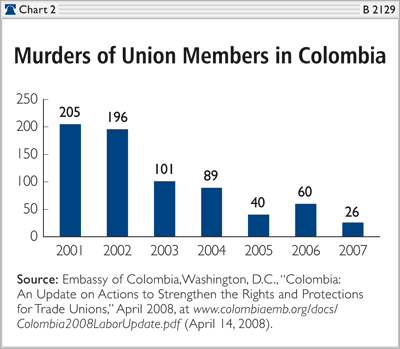
By the time President Uribe took office in 2002, almost 29,000 Colombians had been murdered. Many politicians from Uribe's political party were among the dead. While a few teachers were certainly killed because of their leftist ideology, a large number of the killings should not be included in the AFL-CIO's "union killings" figures. Many of the murders involved persons in union members' households, not the union members themselves. A high percentage of them occurred for reasons unrelated to union affiliation. As The Washington Post recently noted:
There were 17,198 murders in 2007. Of the dead, only 39 (0.226 percent) were even members of trade unions, let alone leaders or activists, according to the Colombian labor movement. (Union members make up just under 2 percent of the Colombian population.)[20]
Nevertheless, the leftists categorize all of the killings as “anti-union violence” to further their anti-globalization, protectionist agenda.
Plan
The FARC continued to pursue the overthrow of the Colombian government during the 1990s, but more worldly FARC members also turned to the lucrative and fast-growing businesses of drug trafficking, kidnapping, and extortion. The resulting violence led some far-right landowners in
The best-known of the paramilitary groups was the United Self-Defense Forces of Colombia (AUC),[21] which waged war against the left and the government in the general chaos generated by the armed left and the drug trade. AUC members engaged in a vicious guerrilla campaign against the FARC, the ELN, drug traffickers, and the Colombian army. Some AUC members were also corrupted by the temptation of easy money from narcotrafficking, and a significant number of large landowners in
In 1999, cooperation between President Pastrana and President Clinton led to the rollout of Plan
The Office of the U.S. Trade Representative reports that more than 30,000 paramilitaries have been demobilized since 2005, when the Colombian government implemented the Justice and Peace Law, which set the rules for the demobilization process.[22] As the Center for Strategic and International Studies recently noted, the FARC and other drug traffickers are on the run, and violence is down significantly. The government has “a legitimate state presence in all of
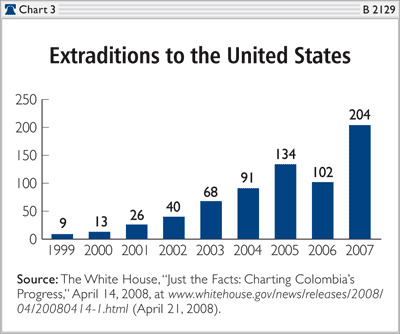
Another indicator of the success of Plan Colombia—and a development also very helpful to U.S. law enforcement efforts in the war against drugs—is the dramatic increase in the number of significant narcotics traffickers extradited to face prosecution in the United States since President Uribe took office. (See Chart 3.)
Despite the progress of Plan
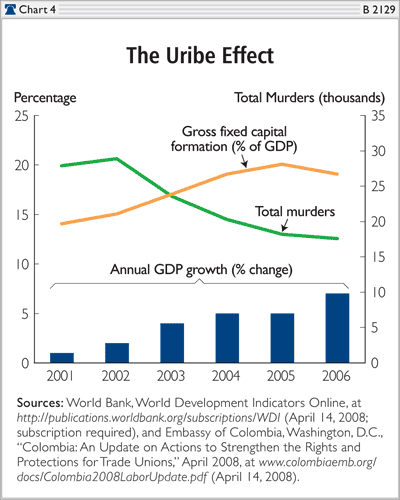
Dropping Murder Rate. When President Uribe assumed power, violence was ripping the very fabric of the Colombian nation. However, the overall murder rate has dropped by 40 percent, kidnappings are down 83 percent, and terrorist attacks are down 76 percent.[24] Plan
The streets of
Sustained Economic Growth. Along with the Uribe government’s success in reducing violence came the happy consequence of improved economic performance. As the U.S. State Department reported in March 2008:
The Uribe administration seeks to maintain prudent fiscal policies and has pursued tough economic reforms including tax, pension and budget reforms. A U.S. Agency for International Development (USAID) study shows that Colombian tax rates (both personal and corporate) are among the highest in
Latin America. The unemployment rate in November 2007 was 9.4%, down from 15.1% in December 2002. The sustained growth of the Colombian economy can be attributed to an increase in domestic security, the policies of keeping inflation low and maintaining a stable currency (the Colombian peso), petroleum price increases and an increase in exports to neighboring countries and the
United States as a result of trade liberalization. The Andean Trade Preference Act, which was extended through December 2008, also plays a pivotal role in Colombia’s economic growth.[29]
As a result of successful efforts to reduce crime and boost economic growth, President Uribe’s approval rating is above 80 percent according to a Gallup Colombia poll cited in El Tiempo.[30]
More Economic Freedom. The 2008 Index of Economic Freedom, published by The Heritage Foundation and The Wall Street Journal, scored Colombia’s economy at 61.9 out of a possible 100 (with 0 equaling “repressed” and 100 indicating “free”), making it the world’s 67th freest economy, up from 79th freest in 2007.[31]
Meanwhile, Uribe’s next-door nemesis Hugo Chávez has practically destroyed the Venezuelan economy, which now cannot provide sustainable jobs or prosperity for anyone not connected to the regime.
Dramatic Drop in Extrajudicial Killings. A constant refrain heard from
While extrajudicial killings are still occurring, they have been greatly reduced. President Uribe made it clear from the day he took office that his government would not tolerate paramilitary activity and would prosecute criminals in the AUC and other far-right groups. In fact, nearly all of the paramilitaries have been demobilized and disbanded under the Uribe administration.
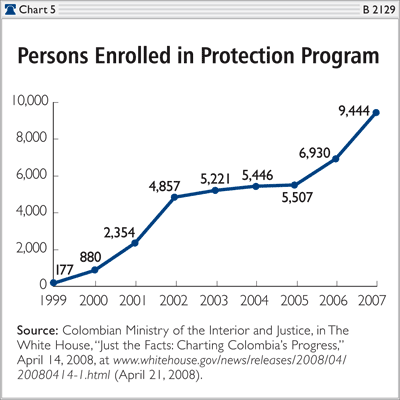
Furthermore, “[t]he Colombian government has tripled spending on protection for unionists, human rights activists, and other at-risk individuals and [has] established a special unit to prosecute crimes against trade unionists.”[34] In 2007, the Colombian government spent $39.5 million on this security program to protect at-risk individuals. Of the roughly 9,400 individuals benefiting from individual protection schemes—which range from bodyguards and armored vehicles to cell phone networks (see Chart 5)—1,959 are unionists, which is an increase from 2006, when unionists accounted for 1,504 of the 6,097 individuals being protected.[35]
The Prosecutor General’s office has led the charge in dealing with past killings, resolving 73 cases of union-member murder and convicting 156 individuals since 2001. A special labor subunit created in November 2006 to focus on labor union killings has resolved 40 cases and convicted 67 people.[36] The unit has 13 prosecutors and more than 70 judicial police investigators, and more will be hired in 2008.[37]
Opponents are also willfully blind to the many successes stemming from a wide variety of substantial USAID programs that are jointly funded with the Colombian government. These programs target development assistance to address the problems that festered during the “lost years” of rampant violence and train all employers—small, medium, and large—in proactively ensuring compliance with all Colombian labor laws on occupational safety, child labor, working hours, and other issues of concern to Colombian workers.
These programs are also intended to bring more workers into the formal economy, where they can receive benefits and contribute to the tax base. USAID and the Colombian government are working cooperatively with business owners, but they are also establishing protocols to enforce laws with a system of fines and incentives, and the Colombian Labor Ministry is funding programs to increase the availability of vocational training programs.[40]
Furthermore, numerous neutral observers have noted tremendous progress on human rights in recent years. Retired General Barry McCaffrey, former commander of the U.S. Southern Command and Director of the White House Office of National Drug Control Policy, visited Colombia in October 2007 and reported that “[t]he human rights situation has improved immeasurably during the President Uribe tenure.”[42]
According to a report from the Colombian government:
- Impressive progress has been made in poverty reduction, education and health since 1999. Increased stability has allowed the government to provide more and better services to the country’s poor.
- Social spending represents 40 percent of the national budget.
- Poverty levels have decreased since 1999 from 55 percent to 45 percent.
- Programs have been developed to improve infant nutrition and health, encourage school enrollment, empower women, and provide food for millions of children.
- More than 20 million of the country’s poor receive full or partial health coverage
- Infant and child mortality have decreased.
- Child immunizations have steadily increased.
- Student completion of elementary school has increased to almost 100 percent, while the number of completing secondary school has also significantly risen.[43]
Small Farmers Would Benefit. Anti-FTA activists have also alleged, without any factual basis, that the FTA will hurt
Of all the agricultural producers in
In fact, the whole Colombian economy would benefit because the currently underutilized large landholdings would become attractive investment targets for more efficient, better-funded
Some of the large landowners have supported paramilitaries, and some are drug lords. Few Colombians would shed any tears if the FTA caused these owners some economic dislocation. Of course, this would leave the large landowners who have sponsored and funded the paramilitaries with less money to do so in the future. Their potential reversal of fortune would further weaken that source of conflict.
The FTA Is Crucial to Both
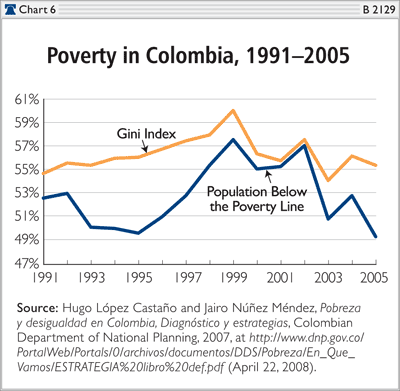
President Uribe already has made impressive strides against poverty in Colombia, as shown in Chart 6, which shows that poverty, as measured both by the Gini Coefficient and by a unique formula devised by an international study team (Mision para el diseno de una Estrategia para la Reduccion de la Pobreza y la Desigualdad— MERPD) that was funded by the United Nations Development Program, USAID, and other international development assistance agencies, has decreased substantially while President Uribe has been in power. The increased trade, investment, and job creation from the U.S.–Colombia FTA would only accelerate this laudable trend.
The FTA will spur additional economic development in
The U.S.–Colombia Trade Promotion Agreement is our single most effective tool to help bring economic and political security to
Colombia. Without this agreement and the investment security it provides, hundreds of thousands of Colombian jobs are in jeopardy of being lost. Each job opens an opportunity for a Colombian worker to enter the formal sector and to build individual economic prosperity—the alternative to narcotrafficking and the direct threat that poses to U.S. national security. Increased foreign investment and export market guarantees would further help to create the right economic conditions.[46]
If Congress were to reject such an agreement, it would be inflicting real pain on Colombian workers and the Colombian economy. As the Cato Institute recently reported:
A recent study by the
University of Antioquia shows that not approving the TPA would decrease investment by 4.5 percent in Colombia. Furthermore, it would increase unemployment by 1.8 percentage points, representing a net loss of 460,000 jobs. GDP would go down 4.5 percent, and the poverty level would rise by 1.4 points.[47]
More
Ninety-two percent of imports from
Colombia currently enter the United States completely duty free. It has been that way for 16 years, since Congress first passed the Andean Trade Preferences Act that gave Colombia access to our market as a way to reduce poverty and fight the drug trade.[48]
The FTA would then simply level the playing field and give
- [A] can of Colombian coffee comes into the
United States duty-free. But [a] bottle of Pepsi, made in the USA, pays a stiff 20% tax when sold in Colombia. - [B]eautiful Colombian flowers—a major Colombian export—come into our market and pay zero tariffs. But…U.S.-made fertilizer, which helps those flowers grow, is charged up to 15% when exported to
Colombia. - [A] bag of carrots comes into the
United States—and onto your dinner table—without paying any U.S. tariffs. But [a] tractor, made by Caterpillar in East Peoria, Illinois, faces a 10 percent duty when sold to a Colombian carrot farmer. - [A]
Pennsylvania apple pays a 15 percent tariff when sold in Colombia. Meanwhile, [a] Colombian banana enters the United States duty-free.[49]
Padilla summarizes that:
Colombian exporters pay tariffs on only 8% of the goods they send to the U.S. Meanwhile, U.S. exporters currently pay tariffs— some as high as 35%—on 97% of the products we sell Colombia….
The
U.S. exports more to Colombia than Russia, even though Russia has a population that is three times larger and an economy seven times that of Colombia.[50]
Demonstrating bipartisan support for the FTA, former White House Chiefs of Staff Ken Duberstein (Reagan Administration) and Mack McLarty (Clinton Administration), recently wrote in The Wall Street Journal:
[Under the FTA]
U.S. exports to Colombia, from cars to chemicals to consumer products, would grow by an estimated $1 billion per year—a direct benefit to U.S. workers and their families. From Colombia’s perspective, the FTA would add a welcome dimension of certainty to our trading relationship, encouraging investors to commit to Colombia and help create jobs there, too.[51]
As U.S. Secretary of Commerce Carlos Gutierrez reported earlier this year:
In 2007, trade contributed over half a percentage point to total GDP growth—the largest contribution in 16 years. We need to keep up the momentum. Trade agreements are critical to lowering barriers to American exports and creating better-paying American jobs.[52]
With specific regard to the effect of the housing/ subprime mortgage crisis on the
Partisan Politics and
The AFL–CIO says that
Congress Keeps Raising the Bar. On April 4, 2008, six Bush Cabinet secretaries sent Speaker of the House Nancy Pelosi (D–CA) a letter reminding her of the May 10, 2007, agreement between the White House and the congressional leadership. According to one account:
The letter opens with a reminder that Pelosi stood with [Treasury Secretary Henry M.] Paulson and U.S. Trade Representative Susan C. Schwab last May “to announce an agreement to restore a bipartisan consensus on trade,” and sets out a detailed case for how the Bush Administration has done to [sic] more than enough to hold up its end of the bargain.
“Over the past year, we have continued and intensified our efforts to work directly with you and other Members of Congress to identify a path forward for the
United State[s]– Colombia Trade Promotion Agreement,” the officials wrote. “In addition to the private conversations you have had with several members of the President’s cabinet, the Administration has made broad and comprehensive efforts to reach an agreement with House and Senate leadership on a package to consider and approve the Colombia free trade agreement.”[55]
Notwithstanding the May 10 agreement, and even though the Administration agreed to reopen the trade agreements, add onerous and vague new provisions to the labor and environment chapters, and weaken intellectual property rights protection for U.S. companies, the congressional leadership has since said consistently that it wants more from Colombia, but without specifying exactly how much or by when. The congressional leadership appears to have reneged on the May 10 agreement and to have been playing politics with the Colombia FTA, the most important of the three Latin American agreements.[56]
The timing of the opposition suggests that Big Labor is putting partisan politics ahead of national security. The left’s real agenda could be simply protectionism or a desire to deny a “legacy” victory to President Bush and the center-right government of
If Congress votes down the Colombia FTA, it will deliver a major psychological victory to Hugo Chávez, the FARC, and the narcotraffickers that the
A defeated FTA might also force
“Yes” to the
Famed Peruvian economist Hernando
In fact, Peruvian President Alain Garcia, a reformed leftist-populist, and Colombian President Uribe are both very capably leading their countries toward stronger, market-based democracies that will become members of the globalized community of trading partners. There is virtually no difference between the two countries, and both are friendly to the
Congress approved the Peru FTA because the congressional leadership is friendlier to center-leftist Garcia than to the center-right Uribe. The congressional leadership also wanted to use the
The Peru FTA requirement to adopt “fundamental labor rights” puts right-to-work, freedom of association and other major
U.S. labor provisions at significant risk. Article 17.2 of the Peru FTA requires both Peru and the United States to “adopt and maintain in its statutes and regulations, and practices there under, the following rights as stated in the International Labor Organization ILO Declaration on Fundamental Principles and Rights at Work and its Follow-up (1998) (ILO Declaration)”…. The Peru FTA does not provide any definition of these fundamental rights, leaving the interpretation…to a dispute settlement panel appointed by the
U.S. and Peruvian Governments. Given the agreement’s reference to the ILO declaration, it is widely expected that such a dispute settlement panel would in fact look at and rely at least partially on the standards of the relevant ILO core conventions associated with these rights.[59]
With their ILO concerns satisfied by approval of the
President Bush recently warned that failing to approve the Colombia FTA, especially given that Congress approved a nearly identical agreement with
Interestingly, Eric Farnsworth of the Council of the
A Long-standing, Good Friend of the
“Yes” to One-Way Trade; Why Not “Yes” to Two-Way Trade? Congress recently voted overwhelmingly to renew the Andean Trade Preference legislation that grants most Colombian products one-way access to the
If a majority of Members of Congress vote against the Colombia FTA (or refuse to vote on it), they will effectively be voting for Hugo Chávez.
A defeated FTA would be a tremendous loss of face for President Uribe and the entire Colombian nation. As with many smaller countries, Colombian and American perceptions of each other differ. Colombians imagine the
When asked recently about Congress’s possible failure to pass the Colombia FTA this year, President Uribe said that it would “be a serious setback” in an interview with The Wall Street Journal. “I wouldn’t know what to say. It would be very serious.”[63]
A failed FTA will lead
What the
Congress should promptly reverse itself and approve the U.S.–Colombia Free Trade Agreement so that it can come into force quickly.
The Bush Administration should continue to give high priority to passing and implementing the Colombia FTA. After the FTA is ratified, the Bush Administration and
Conclusion
In fighting against congressional approval of the FTA, far-left
Colombians deserve the support of all Americans, and Congress should promptly reverse itself and approve the U.S.–Colombia FTA to seal the alliance with this great ally and friend of the
If Congress listens to the AFL–CIO and votes down the U.S.–Colombia FTA, it will have delivered a potential knockout blow to President Uribe, the
American exporters would also lose, and significantly.
Ultimately, Congress would serve neither
[A]s the many Colombian unions that support the trade agreement know, rejecting the agreement will not save a single life— whereas passing it will be a powerful vote of confidence in the democracy Colombians have struggled so hard to protect.[65]
James M. Roberts is Research Fellow for Economic Freedom and Growth in the Center for International Trade and Economics at The Heritage Foundation.



