
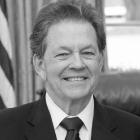
The following is Arthur Laffer's November 13 address to members of The Heritage Foundation's President's Club at the fall 2006 President's Club meeting, held at the Ronald Reagan International Trade Center in Washington, DC.
You know, one thing I always loved, Ed, was when I followed Milton Friedman to the podium I could actually raise the microphones.
Seriously, it's really a pleasure being here with all of you tonight. Ed, what you have done with Heritage, you and Phil, it just-it boggles the mind, the contribution you've made. It's a real honor to be here with all of you. [Applause.]
I'm going to follow the advice of one of my mentors, a professor of mine-and I was the chairman of his advisory board when he was senator from the state of California-a man named Sam Hayakawa. Do all of you remember him? He was great, but he gave me one piece of advice which I am going to follow this evening, which he said, "Arthur, never speak beyond the capacity of the audience's bladder. No matter how important your message, they just won't hear it." [Laughter.]
So I will keep these comments short this evening, but I do want you to know that I have been very fortunate all of my life. I've been truly blessed. I've been a fly on the wall of history. I've been just so many lucky places just by chance and serendipity and obviously a huge portion of that serendipity had to do with my relationship with the real president, Ronald Reagan.
My godfather was a man named Justin Dart. Some of you may remember Justin Dart. [Applause.] My younger son's name is Justin, named after Justin Dart. I was executor of his estate and he was my godfather. I first really got time to spend with Ronald Reagan with Justin Dart personally one-on-one.
I'm going to start off with one story, one Reagan story, which was at the Beverly Hills Hotel, and I think it was 1979, maybe early 1980. There were about 10 of us at the table and it was just a policy discussion, and Dick Allen was there-do you all remember Dick Allen? [Applause.] Phenomenal person. He was Reagan's first National Security Advisor. The Governor at the time said, "Dick, we've got a group here and we're just going to have a conversation, but what I'd like you to do is start that conversation. Would you mind sort of telling all of us what the thrust of U.S. policy has been in the post-World War II era?" And Dick, as all of you may remember, had a real pension for humor. He said, "Mr. Governor," he said, "I'd be glad to tell sort of a rendition of the history post World War II of the United States. Basically we did two things, Governor. We harassed our friends and we cajoled our enemies." [Laughter.] And with that Ronald Reagan looked up and said, "My goodness, what was that, Dick?" And he said, "Sir, we've cajoled our enemies, and we've harassed our friends." And he said, "My goodness, what have been the consequences of those policies?" And Dick Allen looked up with a smirk on his face and he said, "Sir, we have almost no friends left but we have lots of enemies." And Reagan couldn't hold the comment back and he said, and I'm going to quote it, and I think this is a direct quote, he said, "Well, Dick, I guess we're just going to have to reverse those policies, now aren't we? We're going to have to scare the bajeebers out of our enemies with Star Wars and we're going to have to make our friends stinking rich with supply-side economics."
At that moment, I knew that we had won the Third World War, period. It was a huge, huge change. If you look at the thrust that we're looking at tonight and the history, there were four basic areas of economics that Reagan pushed. All of you know these pushes, but I want to go through them because all four were the cornerstones of what we now know of Reaganomics.
Sound money. Sound money is the sine qua non of a prosperous society. Do any of you remember what the prime interest rate was when we came into office on January 20th, 1981? The prime interest rate was 21-and-a-half percent. Can any of you imagine what the U.S. would look like today with a 21-and-a-half percent? When you look at the long bond today, the long bond today is at four-and-a-half; that is the legacy of Ronald Reagan and Paul Volcker in seriatim.
We all know the taxes, what he did with taxes. When Reagan came into office, the highest federal marginal income tax rate was 70 percent on unearned income. By the way, some of you know it's a lot more difficult to earn unearned income than it is earned income. [Laughter.] Reagan dropped the highest federal marginal income tax rates from 70 percent to 28 percent. He cut the corporate tax rates, he indexed the personal tax codes, changing forever the taxes. Do you realize-I mean, it's just amazing that I'm going on 67 years old today and the taxes on the ownership of capital are the lowest they have been in my lifetime. [Applause.] And that is because of Ronald Reagan and the supply side move that he and others have done.
If you look at regulations, the third pillar of Reaganomics-supply side economics-what he did for regulations, not just taking that big stack of papers of the Federal Registers-do you remember that? Do you remember when he dropped it, the thump that went on the table? I mean, it was a phenomenally impressive thing, not only for him to have lifted it, but also for him to have reduced it. I don't know which one was the greater challenge, but both were Herculean.
Today, because of Ronald Reagan, the minimum wage in the United States-the minimum wage relative to the average wage in the United States is the lowest it's been in 50 years. It doesn't get any better.
But let me tell you that today, because of Ronald Reagan, the minimum wage in the United States-the minimum wage relative to the average wage in the United States is the lowest it's been in 50 years. It doesn't get any better. As all of you know, the minimum wage is the black teenage unemployment act. It is the guaranteed way of holding the poor, the minorities and the disenfranchised out of the mainstream is if you price their original services too high. Ronald Reagan recognized the deleterious affects of that and really did not allow that minimum wage to rise.
Another one that he did on regulations: do any of you remember the air traffic controllers? [Applause.] Do you remember what he did? He fired them. And he wouldn't let them work for government again. Since that time, union membership in the United States has gone from well above 30 percent to down around 12 to 14 percent. [Applause.] That is Ronald Reagan's legacy. The third pillar was regulations.
The fourth pillar, which I really want to talk to you tonight because it's a critical pillar of Reaganomics and supply side economics, and it is one of the issues that Ronald Reagan wanted to solve more than anything, and that has to do with the United States economy in the global economy. The United States is a nation located in the global economy and we get enormous, enormous benefits from dealing with foreigners.
Ronald Reagan wanted free trade more than anything. If you look at this issue today, in 1930, we passed-the United States passed with Herbert Hoover as President, and signed into law-something called the Smoot-Hawley Tariff. That tariff put tariff duties on imported products at the highest level they have virtually ever been. It was the precursor of the Great Depression. If you follow that legislation, it goes through the House Committees and the Senate Committees, you can see the stock market collapses. Those tariffs were the highest they've been. Since the Smoot-Hawley Tariff passed, in this country we have reduced tax rates on traded products and Ronald Reagan was a major reducer of those taxes on traded products. In fact, it was Ronald Reagan, as you all know, who sponsored NAFTA. We couldn't get it passed, but we sponsored NAFTA. It took Bill Clinton to switch and go against his own party, against the unions, to push that through. But Ronald Reagan pushed for NAFTA and pushed for lowering tariffs. Today in the United States, customs duties per dollar of import are the lowest they have been in a thousand years because of Ronald Reagan-literally the lowest.
You know, if you saw a store that sold you high quality products at low cost, is your first thought, "How can I boycott that store?" [Laughter.] I don't think so. You know, trade is an integral part of the U.S. prosperity and the U.S. position in the world economy is critical. You know, without China there is no Wal-Mart and without Wal-Mart there is no middle class and lower class prosperity in the United States. [Applause.]
In addition to free trade on products and free trade is essential for supply side economics and Reaganomics, in addition to trade on products, is outsourcing. There are some things we do better than Indians, and there are some things they do better than we do. We and they would be foolish in the extreme if we didn't do those things for them that we do better than they do, and they do those things for us that they do better than we do. We win and they win. It's a plus-plus for the world. [Applause.] And just remember, every dollar we spend on outsourcing is spent on U.S. goods or invested back in the U.S. market. That's accounting.
The third one I want to touch on, because I remember Ronald Reagan being so strong on this issue, and it also has to do with the U.S. and the global economy, and I'm going to say it in my style tonight and I hope I don't hurt anyone's feelings when I do, but it's immigration. Immigration is the life's blood of the U.S. economy. [Applause.]
I have on my desk in my office, I have a book, a set of books that was brought by my great-grandfather from Prussia to the United States. It was his cherished possession. It was the collected works of Frederic Schiller done in old German script, leather-bound. As you probably all know, I'm an ancestor worshiper. His name was Joseph Carl Kreisch, my great-grandfather, and he brought it over and I have it on my desk as a remembrance of my ancestors who came before. But I also have it there for another reason. If you open up the front page, it said, "Published in Philadelphia, 1852." [Laughter.]
Outsourcing is not new. Immigration is not new. Not only are these people the life's blood of America, they are, but let me just say to you tonight, on economic terms, the illegal immigrants are also the life's blood of this society. And I'm going to be hard core with you. They produce high quality labor at low cost and they cheat on their taxes. It doesn't get any better.
I'm having fun with you tonight as well, but let me just tell you that the California economy without immigrants would be a very different-you can't believe how much of what you buy and what you see and what you do is influenced by immigration in this wonderful, wonderful country of ours.
The last one I want to do on trade with you, and then I'll stop, is the trade deficit. You hear these mongers of fear tell you about the trade deficit and how it's ruining the world, it's the United States consuming way beyond its means with a credit card philosophy and literally putting into bondage our children in the future by the huge debt we're owing to foreigners. You all know this story, don't you? You've heard it from Warren Buffet and you've heard it from Pete Peterson, you've heard it from Bill Gates, you've heard it from everyone there that the trade deficit is a huge problem. Let me assure you it is not.
The United States today is the only developed growth country in the world. We are the only one. Living on the legacy of Ronald Reagan and those who have followed him, the United States is the only growth country in the world that is also a developed nation.
The United States today is the only developed growth country in the world. We are the only one. Living on the legacy of Ronald Reagan and those who have followed him, the United States is the only growth country in the world that is also a developed nation. It's just like a growth company. Do growth companies lend money or borrow money? They borrow money. Growth countries borrow money too. If you're a global investor for your own family, I don't care where you live, you want to have a large portion of your portfolio located in the United States.
How much do you want in Hugo Chavez's Venezuela, or in Argentina where you can get 30 cents on the dollar, or in the Middle East? Or how would you like to have it in Putin's Russia-you name it-or France, where they have a two percent wealth tax; that's a real attractive one. When you look at the world, everyone in the world who cares about his or her family wants to have a major portion of their assets in the United States because we are the growth country and the freedom loving country.
How do foreigners generate the dollar cash flow to buy U.S. located assets? There are only two ways they can do it. They've got to sell more goods to us and buy less goods from us. The U.S. trade deficit is one in the same as the U.S. capital surplus, and I want to put it to you seriously. Think of it in capital terms. Which would you rather have, capital lined up on your borders, trying to get into your country or trying to get out of your country? We are the capital magnet of this planet and we are the savior for not only people, for not only freedom, but also for capital.
The trade deficit is the capital surplus and don't ever think of having a capital surplus as being a bad thing for our country.
And if I can take you back-we have trade data that go back to the beginning of time. In fact, with Oliver Williamson's data, we have the trade balance of the U.S. going back to 1640. Let me tell you that from 1640 until 1870, that's how many years is it-is that 230 years-the U.S. ran a trade deficit, virtually each and every year for 230 years. We built our country on foreign capital and what did we do when we owed too much money to foreigners? We opened up immigration, we let them come here and then we didn't owe it to foreigners anymore. [Applause.]
The four pillars of Reaganomics are the grand territories of macroeconomics. You've got money, critical. You've got fiscal policy in taxes and governing spending, critical. You've got regulatory policy or what we call income policies in macroeconomics. And the fourth one, you have trade policy. These were the pillars of Reaganomics, these were the dreams that our president had, the real president had, and let me just say tonight, Mr. President, we all miss you very, very much. Thank you.
