
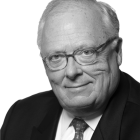
The extraordinary life of Professor Milton Friedman has been extolled in every major newspaper around the world. His contributions to economic theory and the free society merit a celebration of the life of this extraordinary individual.
Friedman was small in stature but a giant in the world of ideas. His passion and wisdom extended well beyond the field of economics and combined to make him one of the most compelling advocates of human freedom the world has known.
His ideas earned him the Nobel Prize. But more than that, his ideas have been translated into public policy in this nation and in countries around the world. And these ideas have empowered millions of people to pursue their destiny, opening for them new economic and educational opportunities that have made them more productive and more prosperous.
Over the last 30 years, Friedman enjoyed a close relationship with The Heritage Foundation. He was the featured speaker at the 1979 dedication of our headquarters building, our 1983 10th anniversary "Heritage 10" celebration, and other occasions. In 1998, I awarded Rose and Milton Friedman The Heritage Foundation's Clare Boothe Luce Award, our most distinguished honor. Friedman and Heritage have been closely linked in the policy arena for a very long time.
Even though he was formally affiliated with our sister institution, the Hoover Institution on War, Revolution and Peace at Stanford University, he never failed to lend his name, his credibility, and his energy to building other institutions committed to a free society in the United States and around the world.
He was one of the Philadelphia Society's four founding members, who organized the group in a New York City hotel in December 1964. His role with the Cato Institute, which awards the Milton Friedman Prize, the Institute of Economic Affairs in London, the Mont Pelerin Society, and a variety of other pro-freedom entities around the world testify to his willingness to promote the free society at every available opportunity.
With this short collection of comments about Milton Friedman, I join the legions who have praised his work.
Edwin J. Feulner, Ph.D.
President
The Heritage Foundation
On September 28, 1998 in San Francisco, The Heritage Foundation awarded the Clare Boothe Luce Award to Drs. Rose D. and Milton Friedman. Edwin Feulner offered these remarks:
The price of liberty, Thomas Jefferson reminded us, is eternal vigilance. You, Rose and Milton Friedman, have been second to none in your vigilant, tireless, and effective defense of liberty. At a time when it was intellectually fashionable to assert that collectivism was the wave of the future, you steadfastly championed the moral and practical superiority of free markets. At a time when "economic" freedom was widely held to be less important than "political" freedom, you demonstrated that they are, in fact, inseparable. And when others looked to the power of the state to accomplish their social objectives, you reshaped American politics through your advocacy of monetary restraint, deregulation, the volunteer army, school choice, and the flat tax.
Rose and Milton, for showing us how to advance the cause of freedom with academic rigor and prophetic zeal, and for strengthening the foundations of liberty in America and around the world, The Heritage Foundation is proud to salute you.
Yet this debating skill is leavened with wit, proving that the "dismal science" is anything but dismal in his hands. In reference to his height-five feet, two inches-he claims that he lost an inch from carrying the "weight of the world" on his shoulders. When Richard Nixon opined that "We are all Keynesians now," Friedman immediately wrote Galbraith a note: "You must be as chagrined as I am to have Nixon for your disciple."
Milton Friedman's defining attitude is an infectious confidence, which has given conservative (and classical liberal) economics its forward momentum. A student skit from the University of Chicago in the 1950s included the line: "Mr. Friedman, is it correct that you have discovered Truth, and that you are now simply verifying it empirically?" Once, when hiring an administrative assistant who lacked an economics background, Friedman reassured her: "You don't have to worry about not knowing anything about economics. There are many people who studied economics for years and don't know anything about economics. Stick with me and you'll learn the correct way."
Chairman of the Federal Reserve Alan Greenspan, who has called Friedman one of the most productive intellects of the century, comments: "As far as Milton Friedman is concerned, if something is true, it's true. He talks the same way to an eighteen-year-old college student as he does to the President of the United States." And he has regularly and persuasively talked with both.
Born in 1912, Milton Friedman is the product of America's hard, rich immigrant experience. His parents emigrated from a province of the Austro-Hungarian Empire in the late nineteenth century. From the age of fourteen, his mother worked as a seamstress in a New York sweat shop, an institution Friedman vigorously defends as a source of low-skill, low-paying jobs. "Sweatshops serve a very useful function. If present-day labor laws had been in effect in the 19th century, you never would have been able to have all the immigration you did."
As a child, Friedman showed a talent for mathematics, graduating from high school before his sixteenth birthday and dreaming of becoming an actuary for an insurance company. But at Rutgers College, where he was a student of Arthur Burns (later chairman of the Council of Economic Advisers and chairman of the Federal Reserve), Friedman fell in love with economics. Graduating in 1932, at the darkest moment of the Great Depression, he was offered a scholarship to the University of Chicago.
That university, he remembers, "exposed me to a cosmopolitan and vibrant intellectual atmosphere of a kind that I had never dreamed existed. I have never recovered." The University of Chicago's economics department was populated by free-market giants, including Frank Knight, Jacob Viner, and Henry Simons. Here Friedman also encountered another formative influence-a fellow graduate student in economics named Rose Director, who became his wife and frequent collaborator. Her husband, she recalls, was supremely studious, with little interest in things non-academic. Once, before they were married, she dragged him to the symphony in New York in a vain attempt to civilize him. "When I saw that he sat beside me reading a book while the music was on, I gave up."
After wartime work in Washington (where his efforts led to income tax withholding from paychecks to fund the war effort), Friedman returned to the University of Chicago, this time as a professor. Lindley Clark, editor and columnist at the Wall Street Journal, was one of Friedman's students in the late 1940s. He remembers him as "exciting, even exhilarating" teacher who, unlike some colleagues, "wasn't always canceling classes because his advice was wanted in Washington."
The University of Chicago, after World War II, was in the midst of a conservative golden age. Richard Weaver taught English and rhetoric. Friedrich von Hayek lectured on social philosophy. Leo Strauss attacked relativism and revisited Athens and Jerusalem in political philosophy. And Milton Friedman began a thirty-year run of scholarly achievements that changed the landscape of American economics. In 1950, he wrote a landmark piece on flexible exchange rates which has been called a "modern classic." In the early 1960s, he authored, with Anna Schwartz, the 860-page A Monetary History of the United States, reconstructing money supply data back to the Civil War from old bank records. Other works dealt with consumption theory, statistics and economic methodology. "People at MIT and Harvard didn't know what they were going to work on until Milton made a speech," says fellow University of Chicago Nobel Laureate, the late George Stigler. His influence transformed an academic department into a movement, the "Chicago School," of which Friedman was the spiritual leader. One professor at the time was led to conclude, "At most universities, people are either conservatives or liberals, but at Chicago, you are either a libertarian or an authoritarian."
Along the way, Friedman participated in the founding of the Mont Pelerin Society on April 1, 1947-an organization which has been called a "kind of Comintern for the free-market." Convened by Hayek in Switzerland, the meeting attracted thirty-nine prominent European and American scholars and connected Friedman to an international network of like-minded intellectuals. The tone of that first conference was somber. Its concluding declaration warned that "the position of the individual and the voluntary group are progressively undermined by extensions of arbitrary power." Yet the effect was encouraging. "The importance of that meeting," Friedman observes, "was that it showed us we were not alone." It was a "rallying point," he says, for outnumbered troops.
Friedman's rising star was quickly noticed in Washington. He turned down an invitation from President Eisenhower to serve on his Council of Economic Advisers. "I really thought I could be much more helpful and useful in the world at large as a maverick than I could be in Washington as a civil servant." But Washington kept insisting. In 1964, Friedman served as economic adviser to candidate Barry Goldwater.
But through it all, Friedman remained a maverick, unafraid to criticize slipshod economic thinking, whatever its source. When President Nixon imposed wage and price controls in 1971, Friedman wrote in the New York Times: "The controls are deeply and inherently immoral. By substituting the rule of men for the rule of law and for voluntary cooperation in the marketplace, the controls threaten the very foundations of a free society. By encouraging men to spy and report on one another, by making it in the private interest of large numbers of citizens to evade controls, and by making actions illegal that are in the public interest, the controls undermine individual morality."
In this period, one of Friedman's great achievements was the all-volunteer military. Beginning at a University of Chicago conference in December of 1966, Friedman debated vigorously against the draft. Eventually, he served on the presidential commission that voted to terminate it. And our experience since the summer of 1973, culminating in the Gulf War, has confirmed Friedman's faith in the ability and commitment of soldiers who give their service without compulsion.
In 1966-the same year that William Buckley started "Firing Line"-Friedman began his regular column in Newsweek, dueling with liberal economist Paul Samuelson, and spreading his ideas to a broader popular audience. In 1967, he was elected president of the American Economic Association. In 1969 he was featured on the cover of Time, in which he was called a "maverick messiah." Historian George Nash observes: "Here was a man of increasing prestige within his profession, a man whom even opponents respected as one of the very best American economists, who was articulating conservative viewpoints with a felicitous combination of learning and wit."
The Nobel Prize came in 1976, the two hundredth anniversary of Adam Smith's Wealth of Nations and Thomas Jefferson's Declaration of Independence, statements of economic and social freedom that Friedman has given new vigor and voice. In that same year, he left the University of Chicago. "I reached the age of 65 and had graded enough exam papers." But a broader exercise in teaching was just beginning. On January 11, 1980-a landmark date in American conservatism-the first episode of Friedman's "Free to Choose" aired on PBS, making a compelling case to millions of viewers on the essential connection between capitalism and human freedom. The ten-part series took Friedman from Hong Kong harbor, to the Glasgow classroom where Adam Smith lectured, to a Japanese electronics factory, to the ornate boardroom of the New York Federal Reserve. The book based on the series, and written with his wife Rose, was simultaneously on the bestseller list of every English-speaking nation in the world. One reviewer commented, "The Friedmans come out swinging on page one of the Preface and do not let up until the last page of Appendix B." Ronald Reagan called it "must reading for everyone."
In 1988, Milton Friedman was awarded the Presidential Medal of Freedom. He now lives in San Francisco and is a senior research fellow with the Hoover Institution. His overriding interest, he says, remains the same: "To try to understand as much as I can of the world around me-and to enjoy myself in the process. And no doubt, one has to confess, not only to understand, not only to enjoy-but to reform."
I first met Professor Milton Friedman in 1964 when he was a visiting professor of Economics at Columbia University. The late Don Lipsett arranged a meeting with Frank Meyer, William Buckley, Milton, Don, and me at the Sheraton-Atlantic Hotel in New York City. This was the organizing meeting of what would become the Philadelphia Society. Incidentally, this was also the first time that Friedman and Buckley had met each other. I was very much the junior man at the meeting, but plans were laid for a major American institution patterned after the international Mont Pelerin Society as an interdisciplinary organization of academics, businessmen, journalists, and others involved in studying and promoting the Free Society.
After our initial 1964 meeting, I came to know Milton and Rose as active participants in the public policy process, as well as participants in both Philadelphia Society and Mont Pelerin Society meetings. Milton's acuity was never sharper or more pithy than the time in 1968 at the Chicago meeting of the Philadelphia Society when he challenged me for my support of revenue sharing. Suffice it to say that in this case, like so many others before and since that meeting, Friedman was right and I was wrong, despite the seeming political attractiveness of the idea at the time.
The active involvement of both Milton and Rose in the Fiftieth Anniversary Special Gathering of the Mont Pelerin Society in Mont Pelerin, Switzerland, was a special occasion for all 120 of us who participated in it. To many of us, this was the capstone of his career as the leading intellectual light of the worldwide movement for liberty, especially since he was the only member of the Society who attended both the founding meeting and this golden anniversary celebration.
Milton Friedman carefully defines himself as a free market liberal, not as a conservative-a liberal in the classical sense, concerned primarily with the freedom of individuals. But it is impossible to deny that Friedman's greatest influence has been on, and come through, the American conservative movement, which has this same concern at its core.
In Free to Choose, he talks of "the importance of the intellectual climate of opinion, which determines the unthinking preconceptions of most people and their leaders, their conditioned reflexes to one course of action or another." Friedman's contribution to conservatism has been to influence that climate like the thaw after an ice age.
First, he has been able to thoroughly discredit the idea, common since the Great Depression, that capitalism is inherently flawed and requires the "fine-tuning" of government to avoid excess and disaster. This has been the central conceit of the Keynesian state, administered by educated elites, adjusting tax and spending policies to tame the business cycle. As late as December 1965, Time could run a cover story on John Maynard Keynes, concluding, "Today, some twenty years after his death, his theories are the prime influence on the world's free economies, especially on America's. Keynes and his ideas still make some people nervous, but they have been so widely accepted that they constitute both the new orthodoxy in the universities and the assumption of economic management in Washington."
Friedman attacked these beliefs at their root. He ambitiously argued that the Great Depression was not caused by the "defects" of capitalism but by government incompetence. Going back to the 1930s, he demonstrated that the one-third fall in GNP was due to a one-third cut in the money supply from 1929 to 1933. "The Great Depression in the United States, far from being a sign of the inherent instability of the private enterprise system, is a testament to how much harm can be done by mistakes on the part of a few men when they wield vast power over the monetary system of the country."
This astonishing revision of the conventional wisdom changed the entire context of economic policy. Keynesians argued that an unstable private sector must be stabilized by the public sector. Friedman showed that an essentially stable private sector has been the victim of irrational shocks by government. In the process, he made it academically and intellectually respectable to believe there was life left in Adam Smith, even after the soup lines of the 1930s.
Second, Milton Friedman has shown, in case after case, that government interventions in free markets are not only ineffective, but result in the exact opposite of their intended purpose. He has called this the "invisible foot"-the unseen force that makes things go terribly and perversely wrong with social programs. The minimum wage, instead of helping poor people, eliminates low-paying, entry-level jobs. Price controls on energy actually resulted in the energy shortage and crisis of the 1970s. Public housing has led to inhuman living conditions. "The government solution to a problem," Friedman concludes, "is usually as bad as the problem."
Yet, on the other side of this ledger, when free markets are allowed and encouraged to work, they often prove an unsuspected, constructive power to solve social problems-in education and the protection of workers, consumers, and the environment. Freedom leads, not just to economic efficiency, but to social justice. And this has led Friedman beyond the realm of economic theory to draw the hopeful policy implications of his ideas. Above any conservative economist of his time, he understands the inadequacy of a vision without a task. He has not only criticized current social and economic arrangements, he has proposed specific, free-market alternatives like school vouchers, the flat tax and deregulation. His brainstorms have provided conservatives with a positive agenda. Friedman is a realist with a passion for the possible, who sees his role not only in the demolition of bad ideas, but the construction of better ones. And this has helped turn free market economics into a force of hopeful reform.
Third, and most important, Friedman has made a case with passion and power that economic, social, and political freedom are inseparable-part of the same yearning of the human spirit. He has defended "the fundamental proposition that freedom is one whole, that anything that reduces freedom on one part of our lives is likely to affect freedom in the other parts." "It is widely believed that politics and economics are separate and largely unconnected; that individual freedom is a political problem and material welfare is an economic problem.… Such a view is a delusion," wrote Friedman in 1962. "On one hand, freedom in economic arrangements is itself a component of freedom broadly understood, so economic freedom is an end in itself. In the second place, economic freedom is also an indispensable means toward achievement of political freedom."
This is perhaps the most revolutionary idea of the twentieth century, with more dramatic promise than anything claimed by Marx, and it is a profoundly conservative concept. What Jefferson called the "disease of liberty" cannot be quarantined; it is bound to spread rapidly, as a number of the world's tyrants have discovered to their discomfort. Economic freedom is connected not only to the liberation of men and women from poverty, but their liberation from tyranny and torture, and from the oppression of conscience and information. Friedman argues that the finest achievement of capitalism is not the accumulation of wealth and property but "the opportunities it offers to men and women to extend and develop and improve their capacities." And Friedman's unquestioned success in making this case is the primary reason William Buckley refers to him, simply, as "my hero."
This essay is one of the classic statements of the philosophy of freedom. Capitalism and Freedom-dubbed by some followers as "Capitalism and Friedman"-is described by George Nash as "one of the most significant works of conservative scholarship of the 1960s." It has been in print for thirty-five years, sold over half a million copies and been translated into Spanish, French, Swedish, Italian, German, Japanese, Hebrew, Icelandic, Arabic, Russian, and Portuguese.
With typical iconoclasm, Milton Friedman launches his defense of liberty with an attack on John Kennedy's call to ask what "we can do for our country." In place of this concept, Friedman elevates another objective: "We take freedom of the individual, or perhaps of the family, as our ultimate goal in judging social arrangements." His reasons are practical, noble, and compelling: because social progress-in art, ideas, and the relief of misery-results from a social climate of variety and diversity; because free markets are a necessary condition for political freedom (though not a sufficient one); because "democratic socialism" can never be democratic; and, most important, because freedom and justice head in the same direction, rewarding merit and allowing for coordination without coercion. Opposing free markets is a serious matter, because "underlying most arguments against the free market is a lack of belief in freedom itself."
This essay is a bold assault on the core convictions of modern liberalism by a classical liberal in the tradition of Adam Smith. And it reveals a conviction at the heart of modern conservatism: that justice, opportunity, and even social morality depend on personal liberty and limited government-on structures of freedom that honor accomplishment and cherish human dignity.
There is no more articulate voice in defense of freedom than Milton Friedman. But he is careful to note that, while freedom is the highest goal of society, it cannot be the highest goal of individuals. "In a society, freedom has nothing to say about what an individual does with his freedom; it is not an all-embracing ethic. Indeed, a major aim of the liberal is to leave the ethical problem for the individual to wrestle with. The really important ethical problems are those that face an individual in a free society-what he should do with his freedom."
In mid-1998, Milton and Rose Friedman's joint autobiography will be published by the University of Chicago Press. At that time, the same publisher will release a new edition of Capitalism and Freedom. We hope that this excerpt from that seminal work will pique the interest of the new generation to reflect on the timeless principles of liberty as expounded by Milton Friedman a generation ago.
Economic and social freedom, Friedman reminds us, is not a state of nature, but it is also not a state of grace. It creates the space where souls can make their own choices, informed by bishops and rabbis, poets and philosophers. "The central and supreme object of liberty," said Lord Acton, "is the reign of conscience." And in the end they are inseparable.
Edwin J. Feulner, Ph.D.,is president of The Heritage Foundation (heritage.org), a Washington-based public policy research institute and co-author of the new book Getting America Right.



