

Statement on immigration Research
(Update: On Tuesday, May 16, the Senate passed Sen. Jeff Bingaman's (D-NM) amendment to S. 2611 that significantly reduced the number of legal immigrants who could enter under the bill's "guest worker" program. As a result of this change, our estimate of the number of legal immigrants who would enter the country or would gain legal status under S. 2611 falls from 103 million to around 66 million over the next 20 years.)
If enacted, the Comprehensive immigration Reform Act (CIRA, S.2611) would be the most dramatic change in immigration law in 80 years, allowing an estimated 103 million persons to legally immigrate to the U.S. over the next 20 years-fully one-third of the current population of the United States.
Much attention has been given to the fact that the bill grants amnesty to some 10 million illegal immigrants. Little or no attention has been given to the fact that the bill would quintuple the rate of legal immigration into the United States, raising, over time, the inflow of legal immigrants from around one million per year to over five million per year. The impact of this increase in legal immigration dwarfs the magnitude of the amnesty provisions.
In contrast to the 103 million immigrants permitted under CIRA, current law allows 19 million legal immigrants over the next twenty years. Relative to current law, then, CIRA would add an extra 84 million legal immigrants to the nation's population.
The figure of 103 million legal immigrants is a reasonable estimate of the actual immigration inflow under the bill and not the maximum number that would be legally permitted to enter. The maximum number that could legally enter would be almost 200 million over twenty years-over 180 million more legal immigrants than current law permits.
immigration Status
To understand the provisions of CIRA, largely based on a compromise by Senators Chuck Hagel (R-Nebraska) and Mel Martinez (R-Florida), it is useful to distinguish between the three legal statuses that a legal immigrant might hold:
- Temporary Status: Persons in this category enter the U.S. temporarily and are required to leave after a period of time.
- Near-Permanent, Convertible Status: Persons in this category enter the U.S. and are given the opportunity to "adjust" or convert to legal permanent residence after a few years.
- legal Permanent Residence (LPR): Persons in this category have the right to remain in the United States for their entire lives. After five years, they have the right to naturalize and become citizens. As naturalized citizens, they have the constitutional rights to vote and to receive any government benefits given to native-born citizens.
A key feature of CIRA is that most immigrants identified as "temporary" are, in fact, given convertible status with a virtually unrestricted opportunity to become legal permanent residents and then citizens.
Another important feature of both CIRA and existing immigration law is that immigrants in convertible or LPR status have the right to bring spouses and minor children into the country. Spouses and dependent children will be granted permanent residence along with the primary immigrant and may also become citizens. In addition, after naturalizing, an immigrant has the right to bring his parents into the U.S. as permanent residents with the opportunity for citizenship. There are no numeric limits on the number of spouses, dependent children, and parents of naturalized citizens that may be brought into the country. Additionally, the siblings and adult children (along with their families) of naturalized citizens and the adult children (and their families) of legal permanent residents are given preference in future admission but are subject to numeric caps.
Key Provisions of CIRA
Four key provisions of CIRA would result in an explosive increase in legal immigration.
amnesty for Current Illegal Immigrants: CIRA offers amnesty and citizenship to 85 percent of the nation's current 11.9 million illegal immigrants. Under the plan, illegal immigrants who have been in the U.S. for five years or more (60 percent of illegals) would be granted immediate amnesty. Illegal immigrants who have been in the country between two and five years (25 percent of illegals) could travel to one of 16 "ports of entry," where they would receive amnesty and lawful work permits.[1] In total, the bill would grant amnesty to 85 percent of the current illegal immigrant population, or some 10 million individuals.
After receiving amnesty, illegal immigrants would spend six years in a provisional status before attaining LPR status. After five years in LPR status, they would have the opportunity to become naturalized citizens and vote in U.S. elections. As well, the spouses and dependent children of current illegal immigrants would have the right to enter the U.S. and become citizens.[2] There would be no numeric limit on the number of illegal immigrants, spouses, and dependents receiving LPR status; under the amnesty provision, such individuals would not be counted against any other cap or limit in immigration law.[3]
The New "Temporary Guest Worker" Program: CIRA creates an entirely new "temporary guest worker" (H-2C) program. There is nothing temporary about this program; nearly all "guest workers" would have the right to become permanent residents and then citizens.
Foreign workers could enter the U.S. as guest workers if they have a job offer from a U.S. employer. In practical terms, U.S. companies would recruit foreign workers to enter the guest worker program and immigrate to the U.S. Most likely, intermediate employment firms would specialize in recruiting foreign labor for U.S. employers.
Guest workers would be allowed to remain in the U.S. for six years.[4] However, in the fourth year, the guest worker could ask for LPR status and would receive it if he has learned English or is enrolled in an English class.[5] There are no numeric limits on the number of guest workers who could receive LPR status. Upon receiving LPR status, the guest worker could remain in the country permanently. He could become a U.S. citizen and vote in U.S. elections after just five more years.
The spouses and minor children of guest workers would also be permitted to immigrate to the U.S.[6] When guest workers petition for LPR status, their spouses and children would receive it as well. Five years after obtaining LPR status, these spouses could become naturalized citizens. The bill sets no limit on the number of spouses and children who could immigrate under the guest worker program. After workers and their spouses have obtained citizenship, they would be able to bring in their parents as legal permanent residents.
The bill does provide numeric limits on the number of guest workers who can enter the country each year, but the number starts high and then grows exponentially. In the first year, 325,000 H-2C visas would be given out, but if employer demand for guest workers is high, that number could be boosted by an extra 65,000 in the next year. If employer demand for H-2C workers continues to be high, the number of H-2C visas could be raised by up to 20 percent in each subsequent year.
The 20 percent exponential escalator provision allows the number of H-2C immigrants to climb steeply in future years. If the H-2C cap were increased by 20 percent each year, within twenty years the annual inflow of workers would reach 12 million. At this 20 percent growth rate, a total of 70 million guest workers would enter the U.S. over the next two decades and none would be required to leave. While it is unlikely that so many workers would enter, the program does have the potential to bring ten of millions of immigrants to the U.S.
The "guest worker" program, then, is an open door program, based on the demands of U.S. business, that would allow an almost unlimited number of workers and dependents to enter the U.S. from anywhere in world and become citizens. It is essentially an "open border" provision.
Additional Permanent Visas for Siblings, Adult Children, and their Families: The permanent entry of non-immediate relatives-such as brothers, sisters, and adult children-is currently subject to a cap of 480,000 per year minus the number of immediate relatives (the parents, spouses, and minor children of U.S. citizens) admitted in the prior year. CIRA eliminates the deduction for immediate relatives from the cap.[7] This effectively increases the number of non-immediate relatives who could attain LPR status by 254,000 per year.
Additional Permanent Employment Visas: The U.S. currently issues around 140,000 employment-based visas each year. Under CIRA, the U.S. would issue 450,000 employment-based green cards per year between 2007 and 2016.[8] After 2016, the number would fall to 290,000 per year.[9] Under current law, LPR visas going to the spouses and children of workers with employment-based visas are counted against the cap. Under CIRA, these spouses and children would be removed from the cap and given legal permanent residence without numeric limits.[10] Historically, 1.2 dependent relatives have entered the U.S. for each worker under employment-based immigration programs.[11] This means that some 990,000 persons per year would be granted LPR status until 2016 and, after that, 638,000 per year.
Estimating Future immigration Under CIRA
Most provisions of CIRA are straightforward; in many categories, the number of future immigrants allowed is either directly stated or can be easily calculated from the law's provisions. In some areas, however, the law's impact is uncertain. To estimate future legal immigration under the bill, three assumptions have been used in this paper:
- Spouses and children of workers: Dependent spouses and children represent a major component of current immigration. In the current employment-based visa program, 1.2 dependents enter for each incoming worker.[12] This paper assumes this ratio will continue in the employment-based program and will also apply to those entering under the new guest worker program. This is a conservative assumption: guest workers are likely to have lower education levels and thus to have larger families. Finally, many current illegal immigrants who would receive amnesty under the bill already have families in the U.S.; therefore the ratio of incoming spouses and children to amnesty recipients is assumed to be only 0.6, or half the ratio of the employment-based program.
- Parents of naturalized citizens: Parents of naturalized citizens currently make up eight percent of all new legal immigrants. This paper assumes that half of all adult immigrants will naturalize after five years of LPR status and that 30 percent of the parents of these naturalized citizens will immigrate in the three years after their children's naturalization.
- Growth in the guest worker program: The number of immigrants in the guest worker program will be driven by employer demand. The bill allows the number of H-2C visas to increase by 20 percent per year; this level of growth would result in an extraordinary 60 million guest workers in the U.S. over the next twenty years. This paper assumes that the number of immigrants in the guest worker program would increase at a more moderate rate of 10 percent per year. Alternative estimates for 20 percent growth and zero growth in the program are also presented.[13]
A Flood of legal Immigrants
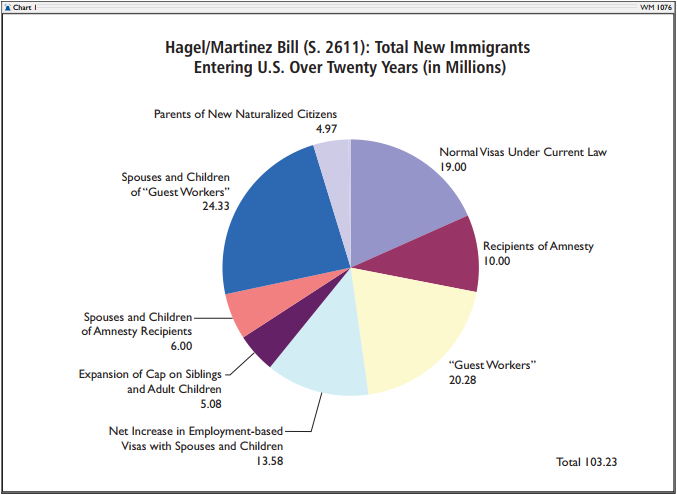
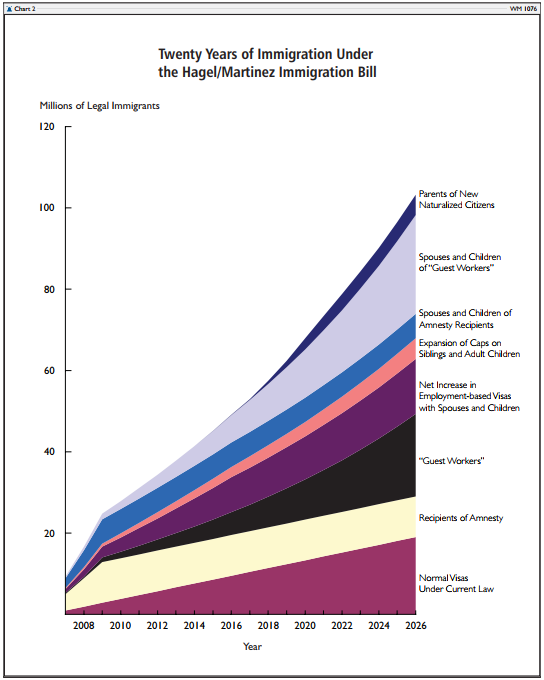
Under CIRA, immigrants could enter the country or attain lawful status within the country through eight channels. In each channel, immigrants would be granted permanent residence and the right to become citizens. The first channel represents immigrants who would have entered under current law; the second channel represents illegal immigrants who are currently in the country and would be given legal permanent residence under the bill. The other six channels represent new inflows of legal immigrants that would occur as a result of the bill. The total number of new legal immigrants over a twenty year period would be as follows: (See Charts 1 and 2.)
- Visas under current law: Roughly 950,000 persons receive permanent residence visas under current law each year. Over 20 years, the inflow of immigrants through this channel would be 19 million. This represents the status quo under existing law.
- amnesty: The bill would grant amnesty to roughly 10 million illegal immigrants. These individuals are currently living in the U.S.; amnesty would allow them to remain legally and to become U.S. citizens.
- Expanded family chain migration: The number of family-sponsored visas for secondary family members, such as adult brothers and sisters, is currently limited to 480,000 per year minus the number of visas given to immediate family members (spouses, minor children, and parents of U.S. citizens). The bill changes the law so that the total quota on secondary family members would be 480,000 without deductions for immediate family members. The net increase in the number of immigrants under this provision would be around 254,000 per year, or 5.1 million over 20 years.[14]
- Employment-based green cards: The bill would increase the number of employment-based visas from 140,000 to 450,000 per year. For the first time, it would also exempt the spouses and children of workers from the cap. Total annual immigration under this provision is likely to be 450,000 workers plus 540,000 family members annually. The net increase above current law over 20 years would be around 13.5 million persons.[15]
- The guest worker (H-2C) program: CIRA would allow 325,000 persons to participate in the guest worker program in the first year. This number could rise by 65,000 in the next year and then by 20 percent per year. Assuming 10 percent annual growth in the annual number of guest workers entering the country (well below the bill's maximum), the total inflow of workers under this program would be 20 million over 20 years.
- Spouses and children of guest workers: Guest workers could bring their spouses and children to the U.S. as permanent residents; the added number of entrants would be 24 million over 20 years.
- Spouses and children of illegal immigrants given amnesty: Illegal immigrants who received amnesty could bring their spouses and children into the U.S. as legal permanent residents with the opportunity for full citizenship. The number of spouses and children who would enter the U.S. as a result of amnesty would be at least six million.
- Parents of naturalized citizens. The bill would substantially increase the number of naturalized citizens. Naturalized citizens would have an unlimited right to bring their parents into the U.S. as legal permanent residents. Over twenty years, the number of parents who would enter the U.S. as permanent legal residents as a result of CIRA would be around five million.
Overall, the bill would allow some 103 million persons to legally immigrate over the next twenty years. This is roughly one-third of the current population of the United States. All of these new entrants would be permanent residents and would have the right to become citizens. This would be a 84 million person net increase over current law.
legal Flow Compared to Illegal immigration
All of the immigration discussed to this point would be legal immigration. If illegal immigration continued after enactment of S.2611, the inflow of immigrants would be even greater. Although illegal immigration is considered a major problem, the proposed legal immigration under CIRA would dwarf it numerically. The net inflow of illegal immigrants into the U.S. population is around 700,000 per year.[16] legal immigration under CIRA would exceed five million per year, seven times the rate of the current illegal immigration flow. Annual legal and illegal immigration together now equals about 1.7 million; future legal immigration alone under CIRA would be three times this amount.
Range of Estimates
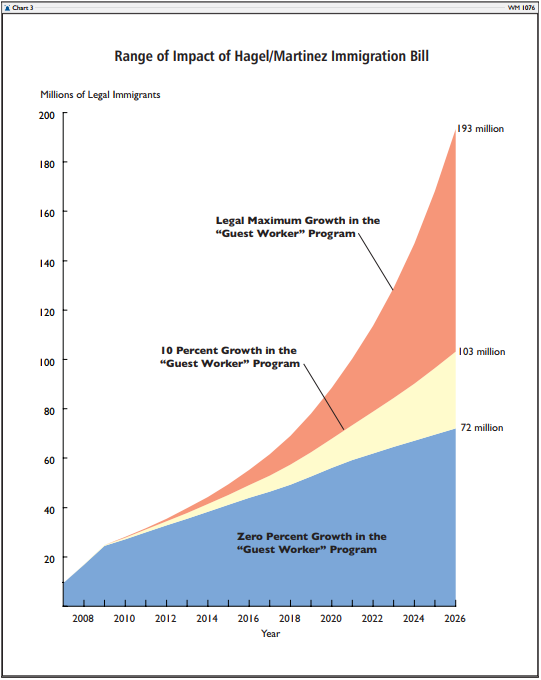
The figure of 103 million new legal immigrants is based on the assumption that immigration under the guest worker program would grow at 10 percent per year. If guest-worker immigration grows at the maximum rate permitted by the bill, 20 percent per year, the total number of new immigrants coming to the U.S. over the next twenty years would be 193 million. On the other hand, if immigration under the H-2C program did not increase at all for two decades but remained fixed at the initial level of 325,000 per year, total legal immigration under CIRA would be 72 million over twenty years, or more than three times the level that would occur under current law. (See Chart 3.)
The tables in the Appendix show annual inflows of total legal immigrants in each of the eight channels mentioned above over the next twenty years. The tables show the estimated yearly rate of immigration under three scenarios for the H-2C program: zero growth, ten percent growth, and twenty percent growth.
Dwarfing the Great Migration
Between 1870 and 1920, the U.S. experienced a massive flow of immigration known as the "great migration". During this period, foreign born persons hovered between 13 and 15 percent of the population.[17]In 1924, Congress passed major legislation greatly reducing future immigration. By 1970, foreign born persons had fallen to 5 percent of the population.
In the last three decades, immigration has increased sharply. The foreign born now comprise around 12 percent of the population, approaching the levels of the early 1900's. However, if CIRA were enacted, and 100 million new immigrants entered the country over the next twenty years, foreign born persons would rise to over one quarter of the U.S. population.[18] There is no precedent for that level of immigration at any time in U.S. history.
Conclusion
If enacted, CIRA would be the most dramatic change in immigration law in 80 years. In its overall impact on the nation, the bill would rival other historic milestones, such as the creation of Social Security or Medicare.
The bill would give amnesty to 10 million illegal immigrants and quintuple the rate of legal immigration into the U.S. Under the bill, the annual inflow of immigrants with the option of becoming legal permanent residents would rise from the current level of one million per year to more than five million per year. Within a few years, the annual inflow of new immigrants would exceed one percent of the current U.S. population. This would be the highest immigration rate in U.S. history.
Within 20 years, some 103 million new immigrants would enter the U.S. This number is about one-third of the current U.S. population. All of these immigrants would be permanent residents with the right to become citizens and vote in U.S. elections. CIRA would transform the United States socially, economically, and politically. Within two decades, the character of the nation would differ dramatically from what exists today.
Robert Rector is Senior Research Fellow in Domestic Policy Studies at The Heritage Foundation.




;)
;)
;)