(Archived document, may contain errors)
Adolescents who take a virginity pledge have substantially lower levels of sexual activity and better life outcomes when compared with similar adolescents who do not make such a pledge, according to recently released data from the National Longitudinal Study of Adolescent Health (Add Health survey). Specifically, adolescents who make a virginity pledge:
-
Are less likely to experience teen pregnancy;
-
Are less likely to be sexually active while in high school and as young adults;
-
Are less likely to give birth as teens or young adults;
-
Are less likely to give birth out of wedlock;
-
Are less likely to engage in risky unprotected sex; and
-
Will have fewer sexual partners.
In addition, making a virginity pledge is not associated with any long-term negative outcomes. For example, teen pledgers who do become sexually active are not less likely to use contraception.
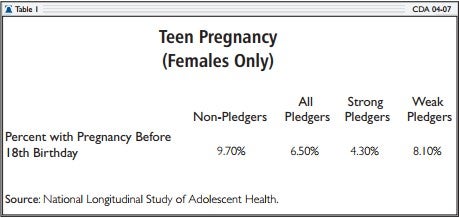
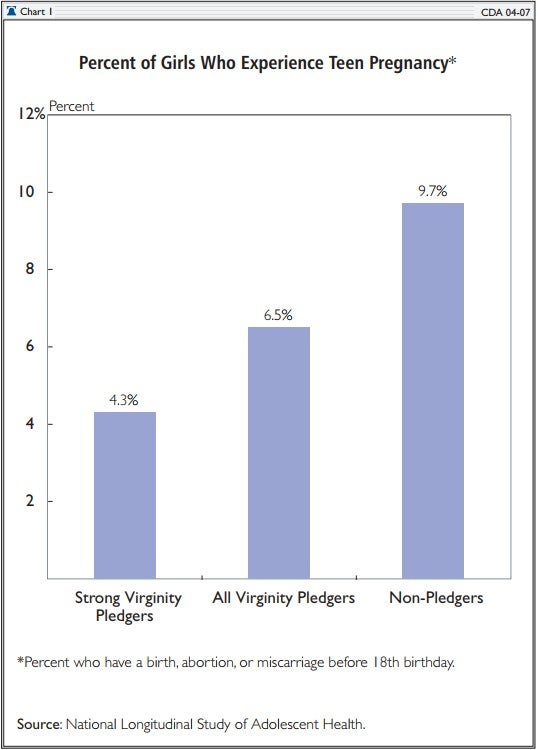
Data from the National Longitudinal Study of Adolescent Health, which is funded by more than 17 federal agencies,[1] show that the behavior of adolescents who have made a virginity pledge is significantly different from that of peers who have not made a pledge. Teenage girls who have taken a virginity pledge are one-third less likely to experience a pregnancy before age 18. Girls who are strong pledgers (defined as those who are consistent in reporting a virginity pledge in the succeeding waves of the Add Health survey) are more than 50 percent less likely to have a teen pregnancy than are non-pledgers.
Teens who make a virginity pledge are far less likely to be sexually active during high school years. Nearly two-thirds of teens who have never taken a pledge are sexually active before age 18; by contrast, only 30 percent of teens who consistently report having made a pledge become sexually active before age 18.
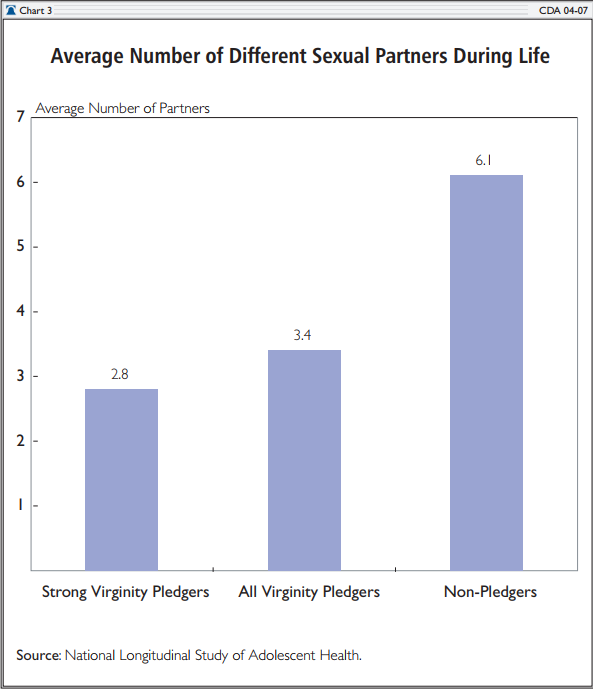
Teens who have made a virginity pledge have almost half as many lifetime sexual partners as non-pledgers have. By the time they reach their early twenties, non-pledgers have had, on average, six different sex partners; pledgers, by contrast, have had three.
Girls who have taken a virginity pledge are one-third less likely to have an out-of-wedlock birth when compared with those who have never taken a pledge. Girls who are strong pledgers (those who are consistent in reporting a virginity pledge in the succeeding waves of the Add Health survey) are half as likely to have an out-of-wedlock birth as are non-pledgers.
Girls who make a virginity pledge also have fewer births overall (both marital and nonmarital) as teens and young adults than do girls who do not make pledges. By the time they reach their early twenties, some 27.2 percent of the young women who have never made a virginity pledge have given birth. By contrast, the overall birth rate of peers who have made a pledge is nearly one-third lower, at 19.8 percent.
Because they are less likely to be sexually active, pledging teens are less likely to engage in unprotected sex, especially unprotected nonmarital sex. For example, 28 percent of non-pledging youth reported engaging in unprotected nonmarital sex during the past year, compared with 22 percent of all pledgers and 17 percent of strong pledgers.
One possible explanation for the differences in behavior between pledgers and non-pledgers is that the two groups differ in important social background factors such as socioeconomic status, race, religiosity, and school performance. It is possible that these background factors-rather than the pledge per se-account for the differences in sexual behavior and birth rates.
To investigate this possibility, the authors performed multivariate regression analyses that compared individuals who were identical in relevant background factors. These analyses show that, although the magnitude of the differences was reduced somewhat, differences in the behavior of pledging and non-pledging teens persisted even when background factors such as socioeconomic status, race, religiosity, and other relevant variables were held constant.
Overall, making a virginity pledge is strongly associated with a wide array of positive behaviors and outcomes while having no negative effects.[2] The findings presented in this paper strongly suggest that virginity pledge and similar abstinence education programs have the potential to substantially reduce teen sexual activity, teen pregnancy, and out-of-wedlock childbearing.
Background
For more than a decade, organizations such as True Love Waits[3] have encouraged young people to abstain from sexual activity. As part of these programs, young people are encouraged to take a verbal or written pledge to abstain from sex until marriage. In recent years, increased public policy attention has been focused on adolescents who take these "virginity pledges" as policymakers seek to assess the social and behavioral outcomes of such abstinence programs.
One major source of data on teens who have made virginity pledges is the National Longitudinal Study of Adolescent Health, funded by the Department of Health and Human Services and other federal agencies. The Add Health survey started with interviews of junior-high and high-school-aged students in 1994. In that year, and in subsequent interviews, adolescents were asked whether they had ever taken a virginity pledge. The students were tracked through high school and into early adulthood. By 2001, most of the youth in the survey were between the ages of 19 and 25-old enough to evaluate the relationship between pledging as teens and a variety of social outcomes.
As noted, the Add Health survey is longitudinal, which means that it surveys the same group of adolescents repeatedly over time. Interviews were conducted in three succeeding years: Wave I in 1994, Wave II in 1995, and Wave III in 2001. In each of these years, individuals were asked the question: "Have you ever signed a pledge to abstain from sex until marriage?" We have grouped the Add Health youth into four categories based on their responses to this repeated question.[4]
- Non-pledgers. These individuals answered that they had not taken a virginity pledge in each of the three waves of the survey.[5]
- Pledgers.These individuals responded in at least one wave of the survey that they had made a virginity pledge.
- Strong pledgers. These individuals form a subset of the general pledger group; they affirmed in at least one wave of the survey that they had made a pledge and did not provide contradictory data in any subsequent wave. For example, they may have reported that they had "ever taken a virginity pledge" in Waves I, II, and III; in Waves II and III; or only in Wave III. The deciding factor for placement in this category was that the respondents' answers were consistent; once they had reported that they had "ever taken a pledge," they did not subsequently report that they had not taken a pledge.
- Weak pledgers. These individuals form a second subset of the pledger group. These respondents reported in at least one wave of the survey that they had "ever taken a virginity pledge," but their responses were inconsistent; on a subsequent wave, they reported that they had not taken a pledge. Either these individuals ignored or forgot their previous response that they had made a pledge, or they interpreted the question differently in later years.
All adolescents were first placed in either the non-pledger or pledger category. All pledgers were subsequently placed in the weak or strong pledge categories. The four pledge categories are used throughout this paper to measure the behavioral correlates of pledging.
Virginity Pledgers Are Less Likely to Experience Teen Pregnancy
The Add Health survey data show that girls who have made a virginity pledge are substantially less likely to experience teen pregnancy (to become pregnant before their 18th birthday) when compared with girls who have not made a pledge.[6] As Table 1 and Chart 1 show, some 6.5 percent of girls who had made a pledge became pregnant before age 18. The figure for girls who had not made a pledge was about 50 percent higher, at 9.7 percent. Among girls who were strong pledgers, the pregnancy rate was lower still: 4.3 percent became pregnant before their 18th birthday-less than half the number among non-pledgers.
Virginity Pledgers Substantially Delay Sexual Activity and Have Fewer Sex Partners
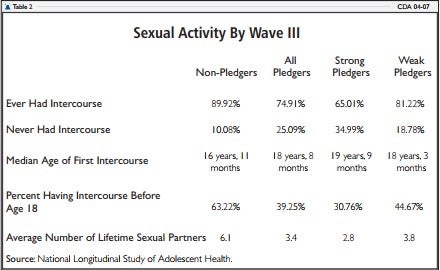
The Add Health survey data show that teens who have made a virginity pledge are likely to delay substantially the onset of sexual activity, compared with those who have not made a pledge. As Table 2 shows, among non-pledgers, the median age for beginning sexual intercourse was 16 years and 11 months. By contrast, the median age for the onset of sexual activity among all pledging teens was 21 months later, at 18 years and 8 months. The delay in the onset of sexual activity was even more pronounced in the strong pledger group; the median age of initial sexual activity among these teens was 19 years and 9 months, or nearly three years later than the non-pledgers.
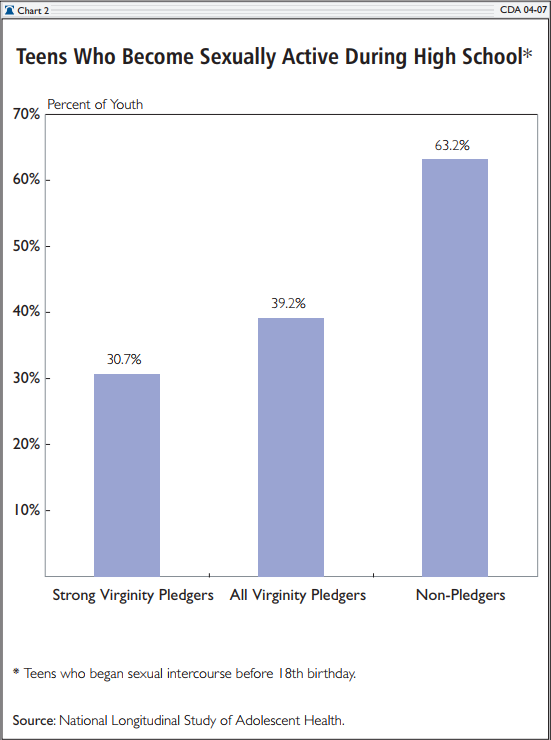
Polls show that over 90 percent of parents want students taught that they should abstain from sexual activity until they have, at least, finished high school.[7] Thus, sexual abstinence throughout high school appears to be a minimal value embraced by nearly all parents. The Add Health data presented in Table 2 show that a strong majority of pledgers do abstain through their high-school years, while an equally large majority of non-pledgers fail to achieve that goal. As Chart 2 shows, more than 60 percent of all teen pledgers and nearly 70 percent of strong pledgers abstain from sexual intercourse until at least their 18th birthday. By contrast, only 37 percent of non-pledgers abstain until that age. Pledging is clearly linked to reduced sexual activity during the high-school years.
Delay in initial sexual activity is linked to a number of other positive outcomes, particularly to a reduction in the number of sex partners during one's lifetime. Table 2 and Chart 3 show that teens who have made a virginity pledge report significantly fewer sex partners. Non-pledgers reported having, on average, 6.1 sex partners by the time they reached Wave III of the survey. Among pledgers, the average number of sexual partners was cut roughly in half: 3.4 for all pledgers and 2.8 for strong pledgers.[8]
Other surveys confirm the long-term linkage between early onset of sexual activity and high numbers of sex partners over a lifetime. This linkage persists into adulthood; for example, women who become sexually active in their early teen years are less likely to have stable marriages in their thirties when compared with women who wait.[9] Thus, the relative differences in numbers of sexual partners between pledgers and non-pledgers at the present time are likely to continue through the individuals' adult lives.