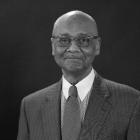
A dam Meyerson, Vice President for Educational Affairs:
We gather today to honor Dr. Martin Luther King, Jr., who did so much to bring America closer to the ideal of our Pledge of Allegiance: One nation under God, with liberty and justice for all. We thank Dr. King for his love of country, his love of peace and non-violence, his love of his fellow man. We thank Dr. King for the healing he brought to the wound of racial hatred in our national soul. We thank him for his righteous indignation, his insistence that all Americans be allowed to enjoy the rights secured by our Declaration of Independence -- the rights to life, liberty, and the pursuit of happiness. We thank Dr. King for his dream that some day our children will be judged not by the color of their skin, but by the content of their character.
Conservatives did not, and do not, agree with all of Dr. King's political positions. In particular, we think Dr. King looked too much to government, too much to the welfare state, and not sufficiently to entrepreneurial capitalism, to win economic opportunity for African-Americans. But there was a deeply conservative message throughout Dr. King's life and work, and we are fortunate today to have with us two distinguished speakers who will talk about the conservative virtues of Dr. King.
Both of our speakers were active in the civil rights movement in the 1960s. Both are active today in the next stage of the civil rights revolution -- the rebuilding of America's families and communities.
Our first speaker, Robert Woodson, was Vice President of the NAACP in West Chester, Pennsylvania when Dr. King was assassinated. As riots were breaking out all over the country, Mr. Woodson worked with the police, the National Guard, and community leaders to help stop a riot in West Chester and make sure the protest was structured and non-violent. During the 1970s Mr. Woodson headed the Administration of Justice Division of the National Urban League. In 1981, he founded the National Center for Neighborhood Enterprise, and has been its president ever since.
The National Center for Neighborhood Enterprise is one of the most inspiring organizations in America today. It does more than any other organization I know of to help successful grass-roots organizations that are stopping crime and drug abuse, keeping families together, fostering ownership of property, building small businesses, and otherwise making a difference in low-income communities.
Our second speaker, William Bennett, was teaching philosophy at the University of Southern Mississippi when Dr. King was killed. Mr. Bennett, in front of his colleagues, held a teach-in in honor of Dr. King that night, and he expressed the views that he has consistently held to this day -- America should be a color-blind society in which we do not discriminate or give preference based on race. Bill Bennett was beaten up for holding these views in Mississippi in 1968. Today, when he expresses the same views, he is sharply criticized by race-conscious liberals from the Northeast and Midwest. Meanwhile black and white conservatives in Mississippi are now joining forces on issues such as prayer in the schools.
Bill Bennett has gone on to a distinguished career in the political, as well as academic, worlds. He was Chairman of the National Endowment for the Humanities, Secretary of Education under President Reagan, and Director of the Office of National Drug Control Policy under President Bush. He is now a Distinguished Fellow in Cultural Policy Studies at The Heritage Foundation, as well as founder and Co-Director of Empower America. A revised version of the study he did for The Heritage Foundation, "The Index of Leading Cultural Indicators," will be published as a book by Simon & Schuster in a few weeks. And I am happy to report that his most recent book, The Book of Virtues, has this week surpassed Howard Stern's Private Parts as the number one best seller in the nation. That is at least one cultural indicator that is going in the right direction.
Ladies and gentlemen, please join me in greeting Mr. Robert Woodson to talk about the conservative virtues of Dr. Martin Luther King.
Robert Woodson:
It is a pleasure to be here, particularly to share this podium with Bill Bennett. Bill Bennett was the only Reagan appointee to ever take the time to come over to our office and sit and listen to what we had to say about empowerment, what we were doing to help grass-roots people to overcome the legacy of dependency in America.
Before coming over here, I was questioned by a producer of the "Today Show," who is considering a story on Martin Luther King's life. He asked me why young blacks are not embracing Dr. King or do not understand him. I said because it has been convenient for many advocates of civil rights to emphasize the Dr. King of the "I Have a Dream" speech. So he is presented to many as this wimpish figure who has a dream out here somewhere without really connecting to the realities confronting these young people today. I told him that when I think of Dr. King, I think of the Dr. King who, in the spirit of Jesus, went into the temple and threw out the money changers, I think of the aggressive Dr. King. Dr. King was a man who never was content to conform to the consensus of the majority or to reflect popular opinion. He was a man who was willing to challenge assumptions, and even his own peers.
When everybody quotes the "I Have a Dream" speech, I reflect on his "Letter from Birmingham City Jail," in which he said that the greatest stumbling block to black progress is not the Ku Klux Klan or the White Citizens' Council, it is the white moderate. He said that lukewarm acceptance from those of good will is more difficult to tolerate than outright rejection of those of ill will. He was counseled against releasing that letter because some feared it would alienate the liberal, white leadership and maybe jeopardize the money. But Dr. King released it anyway and stood by it. Again, when Dr. King tried to bring the civil rights movement together with the peace movement, it was Carl Rowan who characterized Dr. King as a communist, not Ronald Reagan. I remember being on the dais of the NAACP banquet in Darby, Pennsylvania, when Roy Wilkens soundly castigated Dr. King for this position. I remember almost storming off the platform, because I supported King in that position.
So, this is the Dr. King who was morally consistent on social issues. Dr. King spoke out against the violence of the Ku Klux Klan, but he also spoke out with equal vigor against the retaliatory violence of the Black Panther Party. Dr. King also used as the basis of his message the gospel of Jesus Christ. When he sought to remove the barriers confronting black America, he did not seek to then describe us as victims. There are two ways that you can prevent someone from competing. One is to deny them the opportunity to compete by law, which laws of segregation and discrimination did. The second way to deny them the opportunity to compete is to tell them they do not have to compete, that they can just sit back and government will do it for them.
As a consequence, when Dr. King also confronted conventional wisdom, he realized in the early 1960s that race-specific solutions alone are not going to deliver for all blacks. He realized that the civil rights movement was basically a middle-class movement in that for many of them who were locked out of the doors of opportunity, race was not the barrier, that economic opportunity had to follow. And Dr. King died fighting for economic rights. That is because anyone who is in a position of leadership has to possess the ability to dream bad dreams in good times, and good dreams in bad times.
The good pharaoh in Genesis, remember, even though Egypt was enjoying prosperity, had some troubling dreams that he did not understand. None of his advisors could answer the challenges that his dreams presented to him. Pharaoh looked into the prison and saw Joseph, a Hebrew boy from a dysfunctional family, who lacked education, had no experience in foreign policy or as Secretary of Agriculture, but he brought him up and sought his counsel. When Joseph interpreted Pharaoh's dreams, he put him in charge. Dr. King was that kind of person, someone who was willing to look beyond all of the conventions and to seek information and insight and guidance from the best source. His source happened to be the gospel of Jesus Christ.
Dr. King believed that everybody was capable of enjoying God's redemptive powers. He did not attack his enemies. Like Abraham Lincoln, he believed that the best way to destroy your enemy is to make him your friend. And Dr. King was motivated by the best traditions of the black community, in that he believed that personal conduct was important. But we saw the decline of the black community occur precisely at a time when we had the greatest opportunity. When the doors were opening up, instead of saying to black America, "Open the doors now and initiate self-help efforts to propel you further than you were," we told our young people, "Because of past discriminatory practices, you are society's victim and you have a right to restitution. You have not only a right to a level playing field and a right to opportunities, but you have a right to ten percent of the trophies." And as a consequence, this whole idea of victimization began to occur.
Remember, up until 1959, only nine percent of black families had illegitimate children, and 13 percent of white families in 1959 had children where the mother never married the father. When poverty programs began to unleash their evil message, we saw a dramatic decline and the nine percent went to 60 percent. I happened to be teaching at Crozer Theological Seminary at that time, and a lot of the young, black pastors there and at other liberal seminaries were embracing the social gospel. And what the social gospel did was separate righteousness from right. Suddenly we were telling young people that as long as you were confronting difficult circumstances of discrimination, until those circumstances were changed, you could not be expected to change. This is the opposite of what our predecessors had been teaching our people. Black America has a rich tradition of moral rectitude and personal responsibility.
Dr. King understood this and he tried to bring that message forward. For instance, in 1787 the black community established our first welfare system at Mother Bethel's Church in Philadelphia, when we had our own Free Society of Blacks. And our own welfare system would not give welfare to those who were poor because of their own thoughtlessness and irresponsibility. You could not become a member of the Free Society of Blacks if your own personal conduct was not proper. And in 1855, in Washington, D.C., 22 blacks were arrested on suspicion of rebellion. They were carrying two books on ethics and one of the gospel of Jesus Christ. The third item they were carrying was the plans to buy the freedom of a black slave in North Carolina.
It is Dr. King's attempt to bring forward this message that I remember most. Many of the civil rights leaders who have followed him no longer refer to the gospel of Jesus Christ as the basis of their message. Instead, they have embraced poverty programs. Instead, they have secularized the movement. They have told young people that they should be exempt from responsibility: It is OK to become fathers and mothers before you become women and men, because you have been a victim of discrimination. It is OK for you to kill and maim one another -- after all, you are a victim of society. As a consequence of this drumbeat of despair -- this drumbeat of victimization -- we have the kind of decline and despair that exists today.
If Dr. King were alive today, he would stand here and in pulpits throughout this country and give a message of redemption to young people. He would say to them that the victimizer might have knocked you down, but it is the victim that has to get up. And the most successful programs around this country are not what people on the right would lead you to believe; that is, all we have to do is have the right set of economic policies and proper economic incentives, because this is going to heal families. This is not the case. I do not know of anybody who sacrifices his life on foreign soil for reduction in the capital gains tax rate. No one. That is not the primary basis that motivates people. Nor do I know of anybody who has sacrificed his life so that he can get another government welfare check.
Remember the old adage: When bull elephants fight, the grass always loses. We need to understand that the fundamental basis upon which we will deliver this nation is to confront this cultural challenge -- the crisis in values which Bill Bennett talks so eloquently about. This is the next battlefield upon which we must fight. That is the legacy of Dr. King. If he were alive today, he, too, would have had a best-selling book on virtues.
William J. Bennett:
That was great. Let me add to what Adam said about Howard Stern and give you even better news. I read that Howard Stern does not allow his children to listen to his show. And he would not allow them to read his book. This is the reverse of the Washington phenomenon. In Washington you are very familiar with people's private lives being a good deal worse than their public persona. But good for Howard Stern. This is the classic definition of hypocrisy. He understands. He knows what is important, because he knows what he will let his kids see and what he will not. So we congratulate him on that score.
On my getting beaten up in Mississippi, you may wonder how many guys it took to beat me up. I wish I could tell you it was a lot. Here is what happened. Not after the Martin Luther King teach-in, at which I read from King's works, I found a note on my door from one of my students saying, "Go back to Moscow, you big radial." And I wondered why this guy was calling me a tire. He meant radical; he just couldn't spell. I think that was the last time anybody called me a radical -- from the left anyway. But there is a point to that: If you said in 1968 that you should judge people by the content of their character, not the color of their skin, that you should be color-blind, you were a liberal. If you say it now, you are a conservative. It is in that sense that Martin Luther King today is a conservative.
But my getting beaten up wasn't about Martin Luther King, it was about Bob Gibson. Bob Gibson was a great pitcher in baseball. The year I was in Mississippi, the Cardinals went to the series and Gibson was pitching. I was watching the game in a redneck bar in Hattiesburg when this guy said, "Gibson will choke, that *#$&$*#" (He used a racial epithet). Gibson then proceeded to strike out fourteen people in a row. I said, "Great choke, huh?" And he said, "It will come, it will come. These guys just don't have the character, you know." I said, "You are an idiot." He said, "You are some kind of yankee boy aren't you?" And I said, "Yes." And he said, "Why don't you call me a redneck?" I said, "All right, you are a redneck idiot." The guy I was saying it to didn't hit me, but his friend who was standing nearby took a round, a full body blow right into the chin. It knocked me right off my chair. That was it. I had maybe a beer and a half already, so I had a head start and that put me out. They hit me a couple more times and that was it. And then they were very polite. They threw water in my face, picked me up, and said, "You know we don't agree with you, but we admire a guy who stands up for what he believes in."
I was in Baton Rouge yesterday and Biloxi the day before, and in Jackson, Mississippi. That society is essentially transformed on these issues. It is remarkable. King himself said he was much more fearful in Illinois then he was in Alabama. And he had good reason to be. In my view, this society has changed dramatically. Whenever I go back to Hattiesburg, it is a much better and more integrated society than most of our northern cities. It is remarkable.
There are two bigotries remaining in American life. One is the bigotry against religious people. The second is the bigotry of some people in the North and Los Angeles and other places toward the South. You need to go there and see that in many ways the South is far beyond those northern enclaves where they have a sense of moral superiority.
Lots of people will be invoking the memory of Dr. King this weekend and Monday. And they will be invoking him as a kind of saint. He is a saint, but one wants him to be more than a saint. And that is, to take him seriously. He will be talked about in the next three days as a source of inspiration, but my guess is, by many who say they speak for him, he will be regarded as a source of inspiration rather than a source of wisdom. And they will talk about the figure of Dr. King, and what he meant and started, but they won't take his words seriously today. I think that he still has a lot to teach us. That is why I put two of his major speeches in my book.
I think people should continue to read what he has to say on three issues -- race, education and the Western tradition, and the spiritual in life. On race, Dr. King said, "I have a dream that my four little children will one day live in a nation where they will not be judged by the color of their skin but by the content of their character." A color-blind society.
Well, Dr. King, we're not going to make it with your children, maybe your grandchildren, maybe your great-grandchildren. We are further away from being color-blind today than we were when Dr. King said these words, because race-norming, counting by race, reverse discrimination, racial identification, talking about oneself and one's identity in terms of race is much more popular and much more a part of the intellectual and political mainstream than it ever was. But to remind people of what King said I think is still a moral obligation. I took it seriously. I taught it to my students in Mississippi, and I continue to quote it.
But it is interesting how the so-called civil rights establishment reacts when you quote it. Just two quick examples. A few years ago, during a television discussion with Eleanor Holmes Norton, I quoted this line from King about the content of character not the color of skin. She angrily banged the desk and said, "Stop quoting dead saints." And I said, "What kind of saint should I quote?" What is the objection here, the sainthood or the dead? If we are limited to living saints we have a real problem. What is the objection? These words somehow rankle much of our leadership.
And then I used King's quote during a discussion with the Reverend Jesse Jackson and he accused me of "intellectual terrorism" for using those words. And I said, "I don't understand." He said, "Let me explain. King was a context theologian." This made a murkier comment murkier yet. I didn't understand the explanation of the explanation.
Again, this wasn't supposed to be said. What is objectionable about it? Is it wrong? Is it wrong for a white person to say it? It would be odd if it were true that we should be judged by the content of our character rather than the color of our skin, but it is somehow improper for a white person to say it. That would be sort of self-refuting, wouldn't it?
If King's statement is true, it doesn't matter who says it. If it is true, it is true. Indeed, everyone should say it. Everyone of all races should say it.
But today the modern agenda is one that insists on counting by race, skin pigmentation, quotas, racial gerrymandering, set-asides, and race-norming. We are moving further from Dr. King's vision on this issue.
A second issue that is very much in the news and in discussion is about education, particularly about the role of Western culture and Western civilization, and the citizenship of black Americans in the culture and tradition of the West. Here is a quote you will not see very often. Who said this? "The Negro is an American. We know nothing of Africa." That was the Reverend Martin Luther King, Jr. Martin Luther King, as a student, immersed himself in the intellectual tradition of the West. No pusher of Afrocentric studies was Martin Luther King.
According to Arthur Schlesinger, a distinguished historian, "Martin Luther King did pretty well with Thoreau, Gandhi, and Reinhold Niebuhr as models. And remember, after all, whom King and his father were named for. The record hardly shows that Eurocentric education had such a terribly damaging effect on the psyche of black Americans. Why deny it to black children today?" Martin Luther King embraced the West, the philosophical tradition of the West, the universalism of Western philosophy, and believed that that tradition was the tradition that led to the liberation of black men and white men and black women and white women.
From Morehouse to Crozer Theological Seminary, where King studied, King immersed himself in the writings of the great philosophers, "from Plato and Aristotle," I see he wrote later, "down to Rousseau, Hobbes, Bentham, Mill and Locke." Here, with these teachers, was planted the seed not of a contemplative life, but of a life of action, a life of thoughtful devotion to political reform, to the pursuit of justice -- in the broader sense, equality, liberty and dignity of all people.
King turned to the great philosophers because he needed to know the answers to certain questions: What is justice? What should be loved? What deserves to be defended? What can I know? What should I do? What is man? As a result of the way in which King answered those questions, out of and through the Western tradition, Jim Crow was destroyed and American history was transformed. I have no objection, in case anybody is interested, to students studying cultures that are not Western. I think that is fine. But they should not be denied access to the best and greatest philosophical tradition in the world, the one that has transformed society around the world, the one that is the intellectual and moral and political currency not only of the world that developed in the West, but for all people. And students, black or white, would all be better to imitate what Martin Luther King did, rather than this trend coming out of some curriculum boards.
As the Secretary of Education of the United States, I was invited to go to Stanford University, theoretically one of the best universities in America, to defend Western civilization. Did you need me to fly across the country to defend Western civilization? What in God's name is going on out there? Can't anybody out there do it? Well, we are not sure; we are having a faculty meeting.
So I went, because a group of students and faculty had gathered and paraded up and down saying, "Hey, hey, ho, ho, Western Civ. has got to go." And many found that a convincing argument. So we went out to make the case.
The irony was that two years earlier, as Chairman of the National Endowment for the Humanities, I had given grants to Stanford, which involved a course in non-Western civilization for students in their sophomore year, once they had taken Western Civ. in their freshman year. Again, Martin Luther King would be a great source of wisdom.
If you were the Grand Dragon of the Ku Klux Klan and wanted to keep black children down in America -- 50 percent are dropping out of school already -- the best thing to do is to keep the best of our tradition -- intellectual, moral, literary tradition -- from them (let the white kids study that). Instead, make believe with the black kids that they are all going to live in Africa, and that what is most important to them is to become experts in obscure African history rather than experts in the society in which they are going to live. Talk to black children in America and ask them what they want to be; talk to white children in America and ask them what they want to be -- they will tell you the same thing. These are our children; they are American children. They are entitled to the best we have to offer -- Western, Eastern, black, white, whatever. We should give all of our children the best we have to offer.
Finally, when reviewing the textbooks in history and how they treated Dr. King, I find, more often than not, King is described in the history books as a social activist. He is not described as a minister of the Christian faith. But if you asked Martin Luther King what was the most important thing in his life, he would never hesitate to tell you. And if you read the collected works of Martin Luther King, you will see him primarily and overwhelmingly a minister of the Christian faith. He said, "I still believe that standing up for the truth of God is the greatest thing in the world. This is the end of life. The end of life is not to be happy. The end of life is not to achieve pleasure and avoid pain. The end of life is to do the will of God, come what may." He said this over and over and over again. He was not primarily a social activist, he was primarily a minister of the Christian faith, whose faith informed and directed his political beliefs.
I had the opportunity to go the King Center two years in a row when I was in government. Coretta Scott King invited me down and I made this point both times, and both times she said, "Thank you for making this point. This is somehow an embarrassment for a lot of people -- that Martin was a minister." This, ladies and gentlemen, is what Stephen Carter was talking about in his book The Culture of Disbelief -- the hesitation or even discomfort of many liberals with religion and with people who take religion seriously. This is a very, very serious matter. Martin Luther King, there again, is not just a source of inspiration, but a source of wisdom. There is that other bigotry in American life, bigotry against religious people.
Let me conclude. If you are interested in visiting historic sites in America, I urge you to visit the Lorraine Motel in Memphis. It is not much of a place, the place where Martin Luther King was shot, but there is a little place where you can go to now and look at the balcony. It is just a little balcony off of a motel room. The last time I went there it was under construction and I had to walk through a lot of scaffolding and stuff to go up. It is a very modest place, but there it is.
There is on the site a plaque. The plaque reads from the Book of Genesis. It says, "And they said one to another, behold, this dreamer cometh. Come now therefore, and let us slay him... and we shall see what will become of his dreams." Well, the dreamer was slain, and now we shall see what becomes of his dreams. His dream was a large dream, a large vision, a comprehensive one, one full of wisdom. The dream, it seems to me, since he has died, has become smaller, less noble, less enriching, less valuable. Martin Luther King is not just a source of inspiration, he is a source of wisdom.
Wordsworth says, "What we have loved, others will love, but we must teach them how." In the same way, I think we have to take this new generation in our schools and teach them what King said and believed, not just for the sake of inspiration, but for the sake of truth.
Note: Nothing written here is to be construed as necessarily reflecting the views of The Heritage Foundation or as an attempt to hinder the passage of any bill before Congress.
Some Heritage studies contain tables and graphs which may not be included in this system.
If you would like to purchase a complete copy of the following document, contact The Heritage Foundation's publications department at (202) 546-4400.