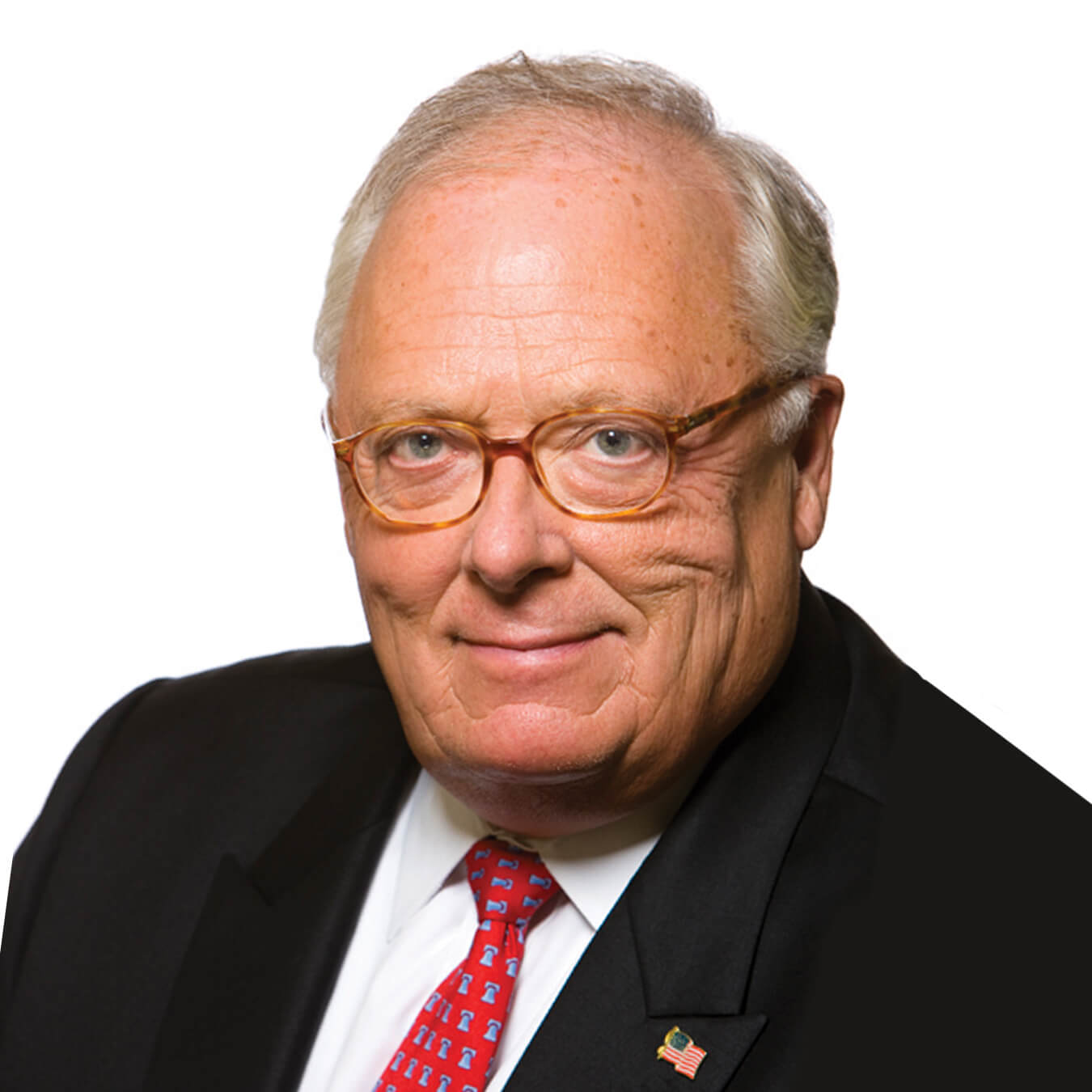
Heritage Expert

Edwin Feulner, Ph.D.

Edwin J. Feulner’s leadership as President of The Heritage Foundation has transformed the think tank from a small policy shop into America’s powerhouse of conservative ideas and what the New York Times calls “the Parthenon of the conservative metropolis.”

Under Feulner, Heritage’s presence in Washington grew from a nine-member staff working out of a rented office on Capitol Hill in 1977 to a 275-person organization occupying three office buildings near the U.S. Capitol today.

“This has been a conscious goal of The Heritage Foundation—to be a permanent Washington presence,” Feulner wrote in the introduction to one of his books, The March of Freedom. “We have set out to make conservative ideas not just respectable but mainstream. To set the terms of national policy debate. To offer not a lament for a lost America, but positive, practical, free market alternatives to the failed liberal policies of the old order.”

Feulner’s work in the conservative movement throughout his life has earned him praise from a range of individuals from Heritage donors to U.S. Presidents.

“By building an organization dedicated to ideas and their consequences, he has helped to shape the policy of our Government. His has been a voice of reason and values in service to his country and the cause of freedom around the world,” read the citation of the Presidential Citizens Medal, given to Feulner on Jan. 18, 1989, by President Ronald Reagan.

Feulner’s leadership has been internationally recognized. The Daily Telegraph (UK) named him one of the 100 most influential conservatives in America in 2007 and 2010. In a 2009 Forbes magazine article, Karl Rove ranked Feulner the 6th most powerful conservative in Washington. That same year, he was featured by the Fox News Channel on Fox News Sunday as host Chris Wallace’s “Power Player of the Week.” In July 2010, he was included in Townhall magazine’s list of “the 100 Americans the Left hates most.”

In April 2009, the Intercollegiate Studies Institute (ISI) conferred upon Feulner the Charles Hoeflich Lifetime Achievement Award.

Feulner first joined The Heritage Foundation as a founding Trustee in 1973. He later became President in 1977, Heritage’s fourth in four years. After accepting the job, Feulner was determined to chart a new course for the struggling think tank.

He did not want to lead a group of academics that would write studies, place them on a shelf and hope someone important would read them. Instead, Feulner decided that Heritage would operate like a business that expected progress from its analysts and results from their policy studies. Heritage would achieve these results by creating timely, concise studies and aggressively marketing them to Congress, policymakers and the media.

This “briefcase test” concept became a model for other think tanks to follow. In fact, Heritage’s success has led many liberals to try to create a “liberal Heritage Foundation” to counter the think tank’s influence. “[Conservatives] worked on it for 30 years and they’ve got it,” former President Bill Clinton complained in a 2003 appearance on NBC’s Today show. “They’ve got everything from The Heritage Foundation, the sympathetic newspapers, to sympathetic cable programs …”

This didn’t happen by accident. Feulner works tirelessly. He travels more than 150,000 miles a year, crisscrossing the United States and the globe to meet with leaders and help spread the ideals of individual liberty, economic freedom, rule of law, and family values.

“Although his ways are entirely unassuming, one pauses … to wonder how Ed Feulner manages as he does,” wrote National Review founder William F. Buckley Jr. in an introduction to The Power of Ideas, a 1997 book on Heritage’s history. “It helps that he disposes of the requisite biological and temperamental attributes—the capacity to go many hours without sleep, to travel endlessly attending to caseloads of work, to endure a day of meetings that begin at breakfast and end at midnight.”

Feulner’s schedule is often full because of the many hats he has worn over the years: He is the former President and current Treasurer of the Mont Pelerin Society; he has served as a Trustee and former Chairman of the Board of ISI; a Board Member of the National Chamber Foundation; a Board Member of the Institut d’ Etudes Politiques; a member of the Board of Trustees of Regis University in Denver; and President of the Philadelphia Society, of which he is a Distinguished Member.

Feulner is a member of the Advisory Board of the Public Diplomacy Collaborative at Harvard University’s Kennedy School of Government. He is past Director of the Sequoia Bank, the Council for National Policy, the Acton Institute, the International Republican Institute, the American Council on Germany, the Lehrman Institute, and George Mason University.

He is a longtime officer and director of three grant-making foundations: the Sarah Scaife Foundation, the Aequus Institute, and the Thomas A. Roe Foundation.

Feulner formerly served as a member of the Gingrich-Mitchell Congressional U.N. Reform Task Force (2005) and on the Congressional Commission on International Financial Institutions (“Meltzer Commission”) from 1999-2000. He was the Vice Chairman of the National Commission on Economic Growth and Tax Reform (“Kemp Commission”) from 1995-1996. As Chairman of the U.S. Advisory Commission on Public Diplomacy (1982-91), he was confirmed by the U.S. Senate on three occasions.

He served as the Public Member (Ambassador) of the U.S. Delegation to the United Nations Second Special Session on Disarmament in New York, as a consultant for domestic policy to President Reagan, and as an adviser to several government departments and agencies.

Feulner speaks frequently both in the United States and abroad, and has been awarded honorary degrees from 15 colleges and universities. He has been declared a Benefactor of the University of Edinburgh, and has received honors from the governments of Taiwan and South Korea.

But his heart belongs to Heritage – and to the thousands of colleagues and supporters he has worked with over the decades. “I can’t stress it enough,” Feulner said in 2002 on his 25th anniversary as president. “If you don’t have the right people, you won’t have the success Heritage has had over the years.”

Edwin John Feulner Jr. was born Aug. 12, 1941, in Chicago to Helen Joan Feulner and Edwin J. Feulner Sr., who owned a real estate firm. After growing up in Elmhurst, Ill., Feulner attended Regis University in Denver. There he read Arizona Sen. Barry Goldwater’s best-selling manifesto, The Conscience of a Conservative and Russell Kirk’s The Conservative Mind, which influenced his thinking and the direction of his life.

He graduated from Regis University with a bachelor’s degree in English, and received an MBA from the University of Pennsylvania’s Wharton School of Business in 1964. He later attended Georgetown University and the London School of Economics, and then earned a doctorate degree at the University of Edinburgh in 1981.

Feulner began his Washington career as Public Affairs Fellow for the Center for Strategic Studies (now the Center for Strategic and International Studies) and at the Hoover Institution at Stanford University, where he wrote on subjects such as trade with the Soviet Union. He later became a confidential assistant to Rep. and later Defense Secretary Melvin R. Laird (R-WI). Afterward, Feulner became Chief of Staff to Rep. Philip M. Crane (R-IL). Before joining Heritage as its President, Feulner was Executive Director of the Republican Study Committee.

Feulner is the author of seven books: Getting America Right (2006), Leadership for America (2000), Intellectual Pilgrims (1999), The March of Freedom (1998), Conservatives Stalk the House (1983), Looking Back (1981) and Trading with the Communists (1968).

He was the editor of U.S. – Japan Mutual Security: The Next Twenty Years, China – The Turning Point, and a contributor to 10 other books and numerous journals, reviews and magazines. Feulner also was publisher of Heritage’s Policy Review magazine from 1977 until 2001, when Heritage transferred the publication to the Hoover Institution. He was the co-founder and Chairman of the Web site Townhall.com, which was established to coordinate online activities of dozens of conservative organizations and columnists.

Feulner also pens a weekly column that appears regularly in dozens of newspapers and Web sites across the country.

He and his wife, Linda, have two grown children, Edwin J. Feulner III and Emily V. Lown, and three grandchildren. They live in Alexandria, Va.

All Publications by Edwin Feulner, Ph.D.
  • Report posted August 17, 2010 by Edwin Feulner, Ph.D. Introduction and Highlights

    America has reached a tipping point. The federal government has grown exponentially, not just in spending (up from approximately $20,000 per household in 2000 to…

  • WebMemo posted December 10, 2009 by Helle Dale, Edwin Feulner, Ph.D. Strategic Listening: How to Build Research Capacity Within the U.S. Government

    High on the to-do list of Undersecretary of State for Public Diplomacy Judith McHale is the creation of a national communications strategy. While McHale acknowledged as much in her confirmation testimony last May, she also has the benefit of a congressional mandate to hold her feet to the fire.…

  • Special Report posted July 20, 2009 by Edwin Feulner, Ph.D. Spending Spree and Cutting Defense Don't Add Up

    During the Administration of John Adams, Americans were offered a chance to bribe their way out of a war. Most responded by chanting, "Millions for defense, not a penny for tribute." That was then. These days, our political leaders might well go for the tribute. Spending money is easy--when it's somebody else's money. Political leaders are…

  • First Principles Series Report posted July 9, 2008 by Edwin Feulner, Ph.D. The Roots of Modern Conservative Thought from Burke to Kirk

    America is the most successful and enduring experiment in democracy in human history. It has survived foreign invasion and terrorist attacks, world wars and a civil war, a great depression and not so small recessions, presidential assassinations and scandals, an adversary culture and even the mass media. It is the most powerful, prosperous, and envied…

  • WebMemo posted April 12, 2007 by Edwin Feulner, Ph.D. President Must Veto Unconstitutional, Irresponsible War FundingLegislation

    After two months of delay, Congress may soon send President George W. Bush an emergency spending bill that would supply needed funds to U.S. soldiers in Iraq and Afghanistan, but the bills already passed by the House and Senate-which have yet to be reconciled into final form-are unacceptable. The bills would tie the President's…

  • WebMemo posted November 29, 2006 by Edwin Feulner, Ph.D. Feulner on Friedman: A Tribute

    The extraordinary life of Professor Milton Friedman has been extolled in every major newspaper around the world. His contributions to economic theory and the free society merit a celebration of the life of this extraordinary individual.   Friedman was small in stature but a giant in the world of ideas. His passion and wisdom extended…

  • WebMemo posted October 6, 2005 by Edwin Feulner, Ph.D., Alison Acosta Fraser A Line in the Sand for Fiscally Responsible Lawmakers

    The nation is at a crucial crossroads for conservative governance. Hurricanes Katrina and Rita will test whether Congress and the President can respond to such disasters responsibly by prioritizing the federal government's obligations. The President is to be commended for his call to cut other spending in order to pay for the hurricanes. He should…

  • Backgrounder posted August 10, 2004 by Edwin Feulner, Ph.D., John Hulsman, Brett Schaefer Free Trade by Any Means: How the Global Free Trade Alliance Enhances America's Overall Trading Strategy

    America's economy thrives on trade. The United States has seen its economy and per capita income grow strongly as trade has become an ever greater portion of the country's gross domestic product (GDP). It is in America's economic interest to continue to expand trade by lowering barriers to goods and services in…

  • Executive Memorandum posted November 2, 2001 by Edwin Feulner, Ph.D. Time to Give President Bush Trade Promotion Authority

    A cornerstone of President Bush's trade agenda is securing Trade Promotion Authority (TPA). Formerly known as fast-track authority, TPA would limit Congress to a straight up-or-down vote on any trade agreements negotiated by the Administration. This would accelerate the implementation of trade agreements and enhance U.S. credibility by assuring foreign countries that there will not…

  • Executive Memorandum posted January 23, 2001 by Edwin Feulner, Ph.D. Pressing Concerns on the Korean Peninsula Call for an EarlyBush-Kim Summit

    While most Americans are anxious to see the new Bush Administration achieve forward movement on such domestic issues as tax reform and education, significant foreign policy issues already confront the United States. One area that requires early attention is the U.S.-Republic of Korea alliance. New developments in relations between democratic South Korea and communist North…