
Economic theory does not necessarily tell us the proper size of government. Instead, economic theory tells us to examine costs and benefits in order to determine whether resources are allocated in a manner that increases or decreases economic growth.
Economists are fond of stating that there is no such thing as a free lunch. For purposes of fiscal policy, this means that a dollar that is spent by the government is a dollar that no longer is available to the private sector of the economy. This is an unavoidable cost. The key question is whether there are offsetting benefits.
Not all government spending is created equal. Some forms of spending on "public goods" facilitate the operation of a market economy. A well-functioning legal system, for instance, is necessary to facilitate private contracts. There will be an economic cost when resources are taken from the private sector to finance outlays for a court system, but the benefits presumably will exceed those costs - meaning that the net effect on economic performance is positive.
Other forms of government spending have a less desirable impact on economic activity. If a program does not facilitate or encourage economic activity, or has only a small positive effect, then the aggregate impact on the economy will be negative because there are limited benefits - if any - to outweigh the costs. And if the program actually undermines work, saving, and investment or encourages misallocation of resources, then the overall adverse impact on economic growth will be particularly pronounced. A good example from recent events is federal flood insurance. Not only does the program require resources to be taxed or borrowed from the productive sector of the economy - with all the associated economic costs, but it also encourages over-building in flood zones, which leads to the destruction of wealth during natural disasters.
There are two macroeconomic reasons why government spending can undermine economic performance. The first reason, mentioned above, is "resource displacement." Every time government spends money, it is using labor and/or capital and those resources no longer are available for private sector uses.
The second macroeconomic issue associated with government spending is the "financing cost." When government taxes, it not only takes money from the productive sector, but it also raises revenue by means of a tax system that generally reduces incentives to work, save, and invest. And if it finances spending with debt, it siphons money out of private credit markets.
The microeconomic costs of government spending involve the impact of various forms of budget outlays. The two most important of these effects are the "subsidy for sub-optimal behavior" and the "penalty for pro-growth behavior." In the first instance, some government programs are directly linked to choices that reduce economic performance. Prior to welfare reform, for instance, income transfer programs frequently rewarded people for choosing not to work or for having children out of wedlock.
In the second instance, specific government programs discourage behaviors that are good for the economy. A large number of government programs, for example, reduce incentives to save by subsidizing health care, retirement, education, and housing. Other programs reduce incentives to work.
Other forms of microeconomic damage are associated with outlays - such as budgets for regulatory agencies - that result in the imposition of costs on private sector activity. A recent example is the Sarbanes-Oxley legislation. The actual budget costs for the Securities and Exchange Commission is only a fraction of the economic costs associated with the regulatory burden generated by that single piece of legislation.
Another form of microeconomic damage involves the misallocation of resources. Education is widely considered a public good, yet there is considerable evidence that the means of delivering that public good is very inefficient because government school monopolies provide a very low amount of educational achievement per dollar spent.
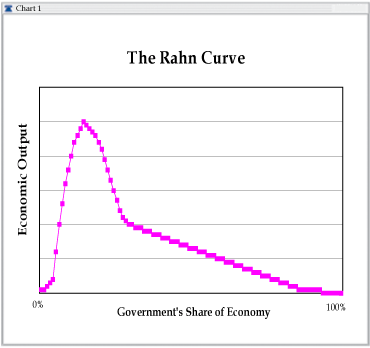
The economic impact of government spending can be presented in graphical form. The so-called Rahn Curve in Figure 1 (attached) shows that economic output or growth is very low when government is non-existent. In this anarchical world, workers, savers, investors, and entrepreneurs do not have an environment conducive to productive behavior.
As certain public goods are provided, however, economic growth and/or output rises. There is a growth-maximizing level of government spending. But once outlays exceed that point, economic performance begins to slip. And as government becomes bigger and bigger, the economy suffers larger losses of output and/or growth.
This theoretical construct is the spending equivalent of the Laffer Curve. In both cases, the extreme points on the curve show adverse consequences. The more challenging question, of course, is figuring out whether government is too big or too small. In other words, where is America on the Rahn Curve?
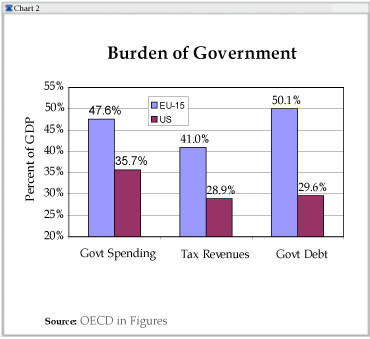
This is a difficult question, but empirical data and academic research indicate that excessive government has a negative impact on economic performance. A comparison of US and European fiscal and economic outcomes can be very instructive. As seen in Figure 2 (attached), the average burden of government in the European Union is much larger than it is in the United States. What has this meant for economic performance?
· Per capita economic output in the U.S. is more than 40 percent higher than the average for EU-15 nations.
· Real economic growth in the U.S. has been more than 50 percent faster than EU-15 growth during the past 10 years.
· The U.S. unemployment rate is significantly lower than the EU-15 unemployment rate, and there is a stunning gap in figures for long-term unemployment.
These cross-country comparisons are instructive, but the academic research is even more conclusive. In the past 20 years, a wealth of scholarly research has found a negative link between government spending and economic output. To cite just a few examples:
· A Public Choice study reported: "[A]n increase in GTOT [total government spending] by 10 percentage points would decrease the growth rate of TFP [total factor productivity] by 0.92 percent [per annum]. A commensurate increase of GC [government consumption spending] would lower the TFP growth rate by 1.4 percent [per annum]."
· A National Bureau of Economic Research paper stated: "A reduction by one percentage point in the ratio of primary spending over GDP leads to an increase in investment by 0.16 percentage points of GDP on impact, and a cumulative increase by 0.50 after two years and 0.80 percentage points of GDP after five years. The effect is particularly strong when the spending cut falls on government wages: in response to a cut in the public wage bill by 1 percent of GDP, the figures above become 0.51, 1.83 and 2.77 per cent respectively."
· A study from the Journal of Monetary Economics stated: "We also find a strong negative effect of the growth of government consumption as a fraction of GDP. The coefficient of -0.32 is highly significant and, taken literally, it implies that a one standard deviation increase in government growth reduces average GDP growth by 0.39 percentage points."
· A National Bureau of Economic Research paper stated: "[A] 10 percent balanced budget increase in government spending and taxation is predicted to reduce output growth by 1.4 percentage points per annum, a number comparable in magnitude to results from the one-sector theoretical models in King and Robello."
· A Journal of Macroeconomics study discovered: "[T]he coefficient of the additive terms of the government-size variable indicates that a 1% increase in government size decreases the rate of economic growth by 0.143%."
· A study in Public Choice reported: "[A] one percent increase in government spending as a percent of GDP (from, say, 30 to 31%) would raise the unemployment rate by approximately .36 of one percent (from, say, 8 to 8.36 percent)."
· A study in the European Economic Review reported: "The estimated effects of GEXP [government expenditure variable] are also somewhat larger, implying that an increase in the expenditure ratio by 10 percent of GDP is associated with an annual growth rate that is 0.7-0.8 percentage points lower."
Finally, it is worth commenting on specific examples of nations that have prospered by reducing the burden of government. Ireland is best know for sweeping tax rate reductions, but government spending also was reduced from more than 50 percent of GDP to about 35 percent of GDP. The former "sick man of Europe" is now known as the Celtic Tiger. Unemployment has dropped from 17 percent to 5 percent, and Ireland is now the second-richest nation in the European Union.
New Zealand enjoyed similar success, reducing burden of government by an equally dramatic amount. The economy has turned around and is now rated as one of the most competitive in the world. Slovakia is an example from the former Soviet Bloc. In a remarkably short period of time, government spending has been reduced by about 20 percentage points of GDP according to OECD data. Combined with other economic reforms, Slovakia now leads the world in foreign direct investment per capita.
This testimony provides just a brief glance at some of the theoretical, empirical, and academic evidence that excessive government hinders economic performance. This is a critically important issue for the future of American competitiveness. In recent years, policy makers have allowed a record increase in government spending. In all likelihood, this spending is causing the economy to grow slower than would otherwise be the case.
But this short-term spending increase is a drop in the bucket compared to long-terms threats. Demographic changes - combined with misguided decisions such as the creation of a new entitlement for prescription drugs - mean that government will consume a growing share of America's economic output.
If government is allowed to expand to levels found in Europe's welfare states, it is unavoidable that America will suffer the economic weakness now plaguing nations such as France and Germany.
Economic theory does not necessarily tell us the proper size of government. Instead, economic theory tells us to examine costs and benefits in order to determine whether resources are allocated in a manner that increases or decreases economic growth.
Economists are fond of stating that there is no such thing as a free lunch. For purposes of fiscal policy, this means that a dollar that is spent by the government is a dollar that no longer is available to the private sector of the economy. This is an unavoidable cost. The key question is whether there are offsetting benefits.
Not all government spending is created equal. Some forms of spending on "public goods" facilitate the operation of a market economy. A well-functioning legal system, for instance, is necessary to facilitate private contracts. There will be an economic cost when resources are taken from the private sector to finance outlays for a court system, but the benefits presumably will exceed those costs - meaning that the net effect on economic performance is positive.
Other forms of government spending have a less desirable impact on economic activity. If a program does not facilitate or encourage economic activity, or has only a small positive effect, then the aggregate impact on the economy will be negative because there are limited benefits - if any - to outweigh the costs. And if the program actually undermines work, saving, and investment or encourages misallocation of resources, then the overall adverse impact on economic growth will be particularly pronounced. A good example from recent events is federal flood insurance. Not only does the program require resources to be taxed or borrowed from the productive sector of the economy - with all the associated economic costs, but it also encourages over-building in flood zones, which leads to the destruction of wealth during natural disasters.
There are two macroeconomic reasons why government spending can undermine economic performance. The first reason, mentioned above, is "resource displacement." Every time government spends money, it is using labor and/or capital and those resources no longer are available for private sector uses.
The second macroeconomic issue associated with government spending is the "financing cost." When government taxes, it not only takes money from the productive sector, but it also raises revenue by means of a tax system that generally reduces incentives to work, save, and invest. And if it finances spending with debt, it siphons money out of private credit markets.
The microeconomic costs of government spending involve the impact of various forms of budget outlays. The two most important of these effects are the "subsidy for sub-optimal behavior" and the "penalty for pro-growth behavior." In the first instance, some government programs are directly linked to choices that reduce economic performance. Prior to welfare reform, for instance, income transfer programs frequently rewarded people for choosing not to work or for having children out of wedlock.
In the second instance, specific government programs discourage behaviors that are good for the economy. A large number of government programs, for example, reduce incentives to save by subsidizing health care, retirement, education, and housing. Other programs reduce incentives to work.
Other forms of microeconomic damage are associated with outlays - such as budgets for regulatory agencies - that result in the imposition of costs on private sector activity. A recent example is the Sarbanes-Oxley legislation. The actual budget costs for the Securities and Exchange Commission is only a fraction of the economic costs associated with the regulatory burden generated by that single piece of legislation.
Another form of microeconomic damage involves the misallocation of resources. Education is widely considered a public good, yet there is considerable evidence that the means of delivering that public good is very inefficient because government school monopolies provide a very low amount of educational achievement per dollar spent.
The economic impact of government spending can be presented in graphical form. The so-called Rahn Curve in Figure 1 (attached) shows that economic output or growth is very low when government is non-existent. In this anarchical world, workers, savers, investors, and entrepreneurs do not have an environment conducive to productive behavior.
As certain public goods are provided, however, economic growth and/or output rises. There is a growth-maximizing level of government spending. But once outlays exceed that point, economic performance begins to slip. And as government becomes bigger and bigger, the economy suffers larger losses of output and/or growth.
This theoretical construct is the spending equivalent of the Laffer Curve. In both cases, the extreme points on the curve show adverse consequences. The more challenging question, of course, is figuring out whether government is too big or too small. In other words, where is America on the Rahn Curve?
This is a difficult question, but empirical data and academic research indicate that excessive government has a negative impact on economic performance. A comparison of US and European fiscal and economic outcomes can be very instructive. As seen in Figure 2 (attached), the average burden of government in the European Union is much larger than it is in the United States. What has this meant for economic performance?
· Per capita economic output in the U.S. is more than 40 percent higher than the average for EU-15 nations.
· Real economic growth in the U.S. has been more than 50 percent faster than EU-15 growth during the past 10 years.
· The U.S. unemployment rate is significantly lower than the EU-15 unemployment rate, and there is a stunning gap in figures for long-term unemployment.
These cross-country comparisons are instructive, but the academic research is even more conclusive. In the past 20 years, a wealth of scholarly research has found a negative link between government spending and economic output. To cite just a few examples:
· A Public Choice study reported: "[A]n increase in GTOT [total government spending] by 10 percentage points would decrease the growth rate of TFP [total factor productivity] by 0.92 percent [per annum]. A commensurate increase of GC [government consumption spending] would lower the TFP growth rate by 1.4 percent [per annum]."
· A National Bureau of Economic Research paper stated: "A reduction by one percentage point in the ratio of primary spending over GDP leads to an increase in investment by 0.16 percentage points of GDP on impact, and a cumulative increase by 0.50 after two years and 0.80 percentage points of GDP after five years. The effect is particularly strong when the spending cut falls on government wages: in response to a cut in the public wage bill by 1 percent of GDP, the figures above become 0.51, 1.83 and 2.77 per cent respectively."
· A study from the Journal of Monetary Economics stated: "We also find a strong negative effect of the growth of government consumption as a fraction of GDP. The coefficient of -0.32 is highly significant and, taken literally, it implies that a one standard deviation increase in government growth reduces average GDP growth by 0.39 percentage points."
· A National Bureau of Economic Research paper stated: "[A] 10 percent balanced budget increase in government spending and taxation is predicted to reduce output growth by 1.4 percentage points per annum, a number comparable in magnitude to results from the one-sector theoretical models in King and Robello."
· A Journal of Macroeconomics study discovered: "[T]he coefficient of the additive terms of the government-size variable indicates that a 1% increase in government size decreases the rate of economic growth by 0.143%."
· A study in Public Choice reported: "[A] one percent increase in government spending as a percent of GDP (from, say, 30 to 31%) would raise the unemployment rate by approximately .36 of one percent (from, say, 8 to 8.36 percent)."
· A study in the European Economic Review reported: "The estimated effects of GEXP [government expenditure variable] are also somewhat larger, implying that an increase in the expenditure ratio by 10 percent of GDP is associated with an annual growth rate that is 0.7-0.8 percentage points lower."
Finally, it is worth commenting on specific examples of nations that have prospered by reducing the burden of government. Ireland is best know for sweeping tax rate reductions, but government spending also was reduced from more than 50 percent of GDP to about 35 percent of GDP. The former "sick man of Europe" is now known as the Celtic Tiger. Unemployment has dropped from 17 percent to 5 percent, and Ireland is now the second-richest nation in the European Union.
New Zealand enjoyed similar success, reducing burden of government by an equally dramatic amount. The economy has turned around and is now rated as one of the most competitive in the world. Slovakia is an example from the former Soviet Bloc. In a remarkably short period of time, government spending has been reduced by about 20 percentage points of GDP according to OECD data. Combined with other economic reforms, Slovakia now leads the world in foreign direct investment per capita.
This testimony provides just a brief glance at some of the theoretical, empirical, and academic evidence that excessive government hinders economic performance. This is a critically important issue for the future of American competitiveness. In recent years, policy makers have allowed a record increase in government spending. In all likelihood, this spending is causing the economy to grow slower than would otherwise be the case.
But this short-term spending increase is a drop in the bucket compared to long-terms threats. Demographic changes - combined with misguided decisions such as the creation of a new entitlement for prescription drugs - mean that government will consume a growing share of America's economic output.
If government is allowed to expand to levels found in Europe's welfare states, it is unavoidable that America will suffer the economic weakness now plaguing nations such as France and Germany.
