
President George W. Bush, holding firmly to his campaign commitment, has proposed a tax reform package that will strengthen America's economy. The across-the-board reductions in personal income tax rates he is seeking will increase incentives to work, save, and invest; and repealing the death tax will eliminate a pernicious form of double taxation while encouraging entrepreneurs and small-business owners to make decisions based on economic value instead of tax considerations.
These commonsense tax reforms are being criticized, however, by opponents of tax relief who claim that "only the rich" will benefit. Policymakers should ignore this class-warfare rhetoric. Unlike European welfare states crippled by redistributionist policies, the United States has prospered because success is admired rather than envied. But more needs to be done to redesign America's tax code so that barriers to upward mobility that remain are reduced. In other words, cutting taxes is not a policy for the rich, but a strategy that will help everyone else become rich or at least rise as far and as fast as their talent, ability, and willingness to work will take them.
The debate over tax "fairness" is not just an ethical battle between those who support a free-market economy and those who desire a welfare state. It is also an empirical battle based on numbers that often can be verified or disqualified. Not surprisingly, it turns out that many of the claims made by opponents of tax cuts do not withstand close scrutiny. For instance:
Myth: The rich do not pay their fair share of taxes and therefore should not get a significant share of a tax cut.
Reality: According to data from the Internal Revenue Service,1 the top 1 percent of income earners pay nearly 35 percent of the income tax burden; the top 10 percent pay 65 percent; and the top 25 percent pay nearly 83 percent. The bottom 50 percent of income earners, on the other hand, pay barely 4 percent of income taxes. By definition, then, it is impossible to cut taxes without the so-called rich receiving a share of the benefits.;)
Myth: Lower tax rates will mean that the rich pay less.
Reality: This outcome depends on how much tax rates are reduced. History indicates that the revenue-maximizing rate is less than 30 percent.2 In other words, when marginal rates are higher than 30 percent, the rich probably will pay more taxes if rates are lowered. The reason? There is less incentive to hide, shelter, or underreport income.
Consider what happened in the years following each of the three times Americans enjoyed significant tax rate reductions.
-
The 1920s: The top tax rate fell from 73 percent to 25 percent, yet the rich (in those days, individuals earning $50,000 or more) went from paying 44.2 percent of the tax burden in 1921 to paying more than 78 percent in 1928.3
-
The 1960s: After President John F. Kennedy slashed the top tax rate from 91 percent to 70 percent, those making more than $50,000 annually saw their tax payments rise during the next three years by 57 percent and their share of the tax burden climb from 11.6 percent to 15.1 percent.4
- The 1980s: The top tax rate fell from 70 percent in 1980 to 28 percent in 1988 during the Reagan years. What happened to the "rich"? The top 1 percent went from shouldering 17.6 percent of the income tax burden in 1981 to paying 27.5 percent of the total in 1988. The top 10 percent saw their share of the burden climb from 48 percent in 1981 to 57.2 percent in 1988.5
;)
Myth: Reducing income tax rates will not help the poor.
Reality: It is true that the poor will not receive a tax cut when tax rates are reduced, but the reason is that they do not pay income taxes. This does not mean, however, that they will receive no benefits from a tax cut. Indeed, because they are on the lowest rungs of the economic ladder, they will be the biggest beneficiaries of the faster growth that follows a tax cut.
Myth: The payroll tax is the biggest imposition on low-income workers, so reducing income taxes will have little effect on their tax burden.
Reality: This actually is true, but it is not an argument against reducing income tax rates. Instead, it is a reason to reform the Social Security system so that lower-income workers can build wealth and enjoy a more comfortable retirement.
Myth: Only millionaires are concerned about the tax-the-rich issue.
Reality: Like fairness, "rich" is a subjective term, but the most common definition of "rich" in Washington is someone in the top 20 percent (or quintile) of income. Many Americans in this quintile hardly would qualify as rich, though, since the cutoff in 1999 for the top 20 percent of tax returns is $79,375 of household income. This quintile also includes many businesses -- such as partnerships, sole proprietorships, and Subchapter S corporations -- that use the personal income tax instead of the corporate income tax to file their returns. Most of these small-business owners do not satisfy the conventional definitions of wealthy, but most of them care greatly about tax reform and lowering tax rates. So do millions of middle-class families that are mischaracterized as rich by proponents of class warfare.
Myth: Lower tax rates mean the rich will get richer while the poor get poorer.
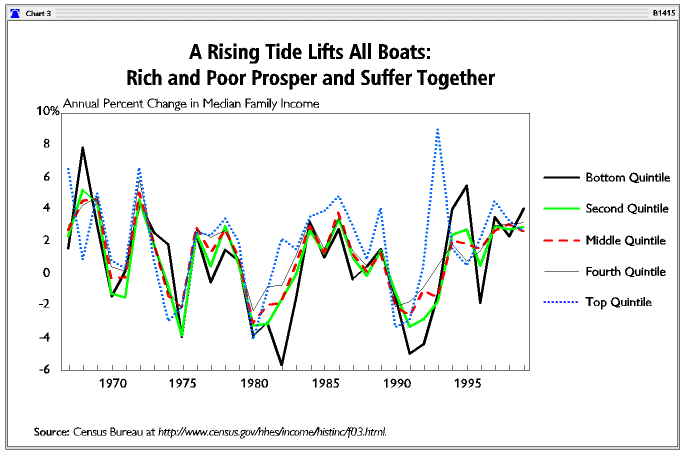
Reality: President Kennedy was right: A rising tide lifts all boats. Census Bureau data show that earnings for all income classes tend to rise and fall in unison.6 In other words, economic policy either generates positive results, in which case all income classes benefit, or causes stagnation and decline, in which case all groups suffer. As Chart 3 illustrates, the high tax policies of the late 1970s and early 1990s are associated with weak economic performance, while the low tax rates of the 1980s are correlated with rising incomes for all quintiles. Likewise, all income groups enjoyed increases in income after the 1997 capital gains tax cut.
Myth: Lower tax rates will lead to a repeat of the failed policies of the 1980s.
Reality: In the 1980s, tax revenues climbed by 99.4 percent, much faster than was needed to keep pace with inflation. More important, the economy rebounded from the malaise of the 1970s. Indeed, the prosperity Americans enjoy today is a continuing legacy of the economic renaissance triggered by President Reagan's tax rate reductions.7
Myth: Eliminating capital gains taxes, death taxes, the double taxation of dividends, or the double taxation of savings will merely create loopholes for the rich to exploit.
Reality: Existing provisions of the tax code dealing with capital have the effect of taxing income more than once. More specifically, they impose multiple layers of taxation on savings and investment. Defenders of the status quo can argue that these provisions are desirable. They can claim that the goal of income redistribution necessitates double taxation. They can even say that there is nothing morally wrong or economically destructive about discriminating against taxpayers who save and invest. They cannot argue legitimately, however, that elimination of double taxation
creates loopholes. Double taxation is a bias; adopting policies that tax income only once will institute fairness in the code.
Myth: Lower taxes on capital -- savings and investment -- represent "trickle down" economics.
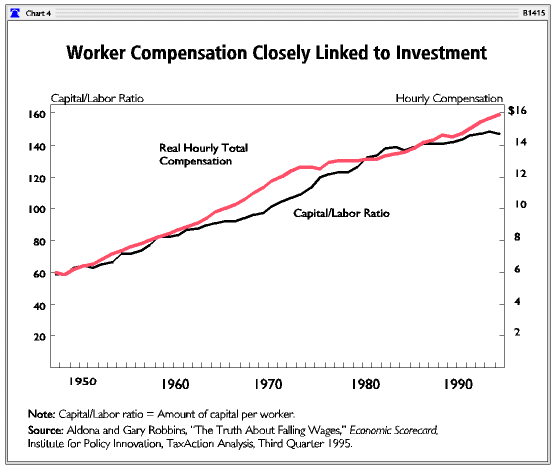
Reality: Every economic theory, including Marxism, agrees that capital formation is the key to faster growth and higher standards of living. Increases in real wages over time are closely correlated with the average amount of capital available per worker. (See Chart 4.) In other words, if workers are paid on the basis of what they produce, it makes sense to adopt tax policies that encourage investment in the tools, equipment, machinery, and technology that help them produce more.
Myth: The death tax affects only the very rich.
Reality: Only 2 percent of deaths may result in an estate tax liability, but many more families are forced to engage in costly and inefficient tax planning in order to avoid the tax. The burden of the tax, however, extends beyond those who either face the tax or take steps to avoid it. The death tax affects every family that lives in a community where a family-owned business must be liquidated to pay the tax. The death tax affects every worker when investments are sent offshore as families seek to protect their assets from this unfair form of double taxation. And the death tax affects everyone who loses income because a significant amount of money is invested for tax-minimization and tax-avoidance purposes instead of wealth-creation purposes.
When politicians pit one group against another, the only winners are those who believe that more power should be concentrated in the federal government. The economic evidence clearly demonstrates that the U.S. economy will produce significant income gains for all Americans as long as appropriate policies are followed.
Marginal tax rate reductions and death tax repeal are examples of those policies. Yes, taxpayers will benefit, including some upper-income taxpayers, but the real winners will be Americans on the lower rungs of the economic ladder.
Daniel J. Mitchell, Ph.D. , is McKenna Senior Fellow in Political Economy in the Thomas A. Roe Institute for Economic Policy Studies at The Heritage Foundation.




;)
;)