
Social Security ran a $71 billion deficit in 2013, closing out four years of consecutive cash-flow deficits as the program’s unfunded obligations continue to grow.[1] According to the 2014 annual report from the programs’ trustees, the combined 75-year unfunded obligation of the Social Security and Disability Insurance Trust Funds (referred to collectively as the OASDI Trust Fund) is $13.4 trillion, a $1.1 trillion increase from last year’s unfunded obligation of $12.3 trillion.[2]
The combined Social Security and Disability Insurance programs, known as OASDI, are projected to remain solvent—that is, they are expected to have enough revenue from payroll taxes, interest on the Trust Fund balance, and repayment of borrowed Trust Fund dollars to pay out scheduled benefits—through 2033.[3] This is the same date as projected in last year’s report.
Separately, the Disability Insurance (DI) Trust Fund is projected to remain solvent for only two more years, until 2016, and the Social Security (OASI) Trust Fund is projected to remain solvent through 2034.
If no action is taken to improve Social Security’s solvency before its Trust Fund runs dry, benefits will be reduced across the board by 23 percent.
Social Security Is Already Adding to the Deficit
In 2033, the combined OASDI Trust Fund will be exhausted, and the programs will be able to pay only three-fourths of scheduled benefits. While the programs are considered solvent until that year, this is true only on paper. Social Security and Disability already add to budget deficits.
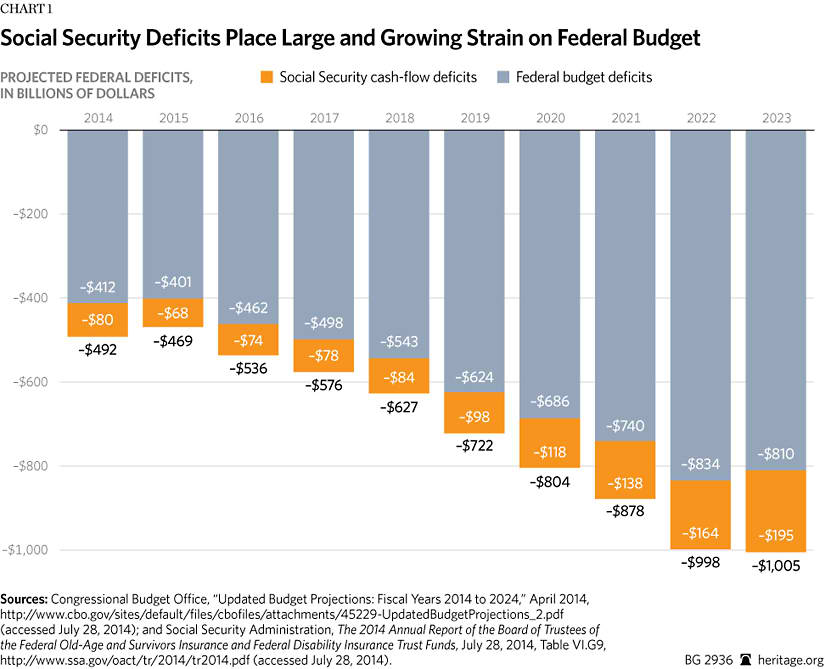
Since 2010, OASDI has taken in less money through payroll tax revenues than it pays out in benefits, generating cash-flow deficits. The 2013 cash-flow deficit was $71 billion. Over the next 10 years, the OASDI cash-flow deficit will amount to $1.1 trillion, according to the trustees’ intermediate assumptions. This $1.1 trillion would be matched dollar-for-dollar by an increase in the publicly held debt.
Social Security’s cash-flow deficits add to the public debt because those deficits are covered by drawing down interest payments from the U.S. Treasury on previous Trust Fund borrowing. Cash-flow deficits mean the Treasury can no longer cover interest payments to the OASDI Trust Fund by issuing additional IOUs; instead, it must produce actual cash from taxes or borrowing. Thus, Social Security and Disability are adding to today’s deficits on a cash-flow basis.
What About the Trust Fund?
In the past, when Social Security ran cash-flow surpluses, the federal government spent those surpluses on other federal spending, and in return, the Treasury credited Social Security’s Trust Fund with special-issue government securities. Although this $2.8 trillion in securities is not counted in the total amount of debt held by the public, it represents real debt that will have to be repaid over the coming decades, according to current law.[4]
The Social Security Trust Fund represents legitimate repayments plus interest, but this distinction has no bearing on the federal budget’s bottom line. Imagine a family that sets aside money for a child’s college education but then borrows all of that money for other spending. Once the time for college arrives, the family will have to scramble to pay tuition because the IOUs in the college account represent money the family must pay itself.
So it is with Social Security’s Trust Fund. Congress spent all the excess revenues when Social Security was running surpluses, and now repaying those revenues is adding to deficits.
As Chart 1 shows, Social Security repayments represent a considerable portion of current and future deficits.
How Accurate Is the 2033 Prediction?
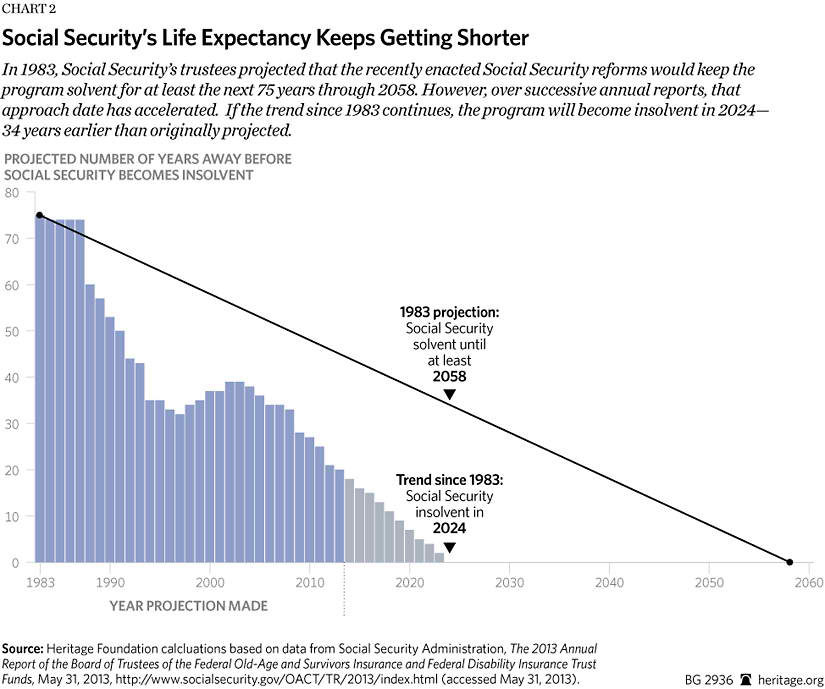
According to the 2014 trustees’ report, the combined Social Security and Disability Insurance Trust Fund will remain solvent through 2033, but if history is any indicator, insolvency could come much sooner. As recently as 1983, the Social Security trustees projected, “On the basis of all but the most pessimistic of the four sets of assumptions used, the program is now estimated to be financially sound over the next 75 years.”[5] That would have been 2058 or later. Three decades later, the projected insolvency date is now 25 years sooner. As a Heritage Foundation report shows, if that trend continues, the Social Security Trust Fund would be insolvent nine years sooner than currently projected—in 2024 rather than 2033.[6]
Negative Returns Make Social Security a Bad Deal for Current and Future Retirees
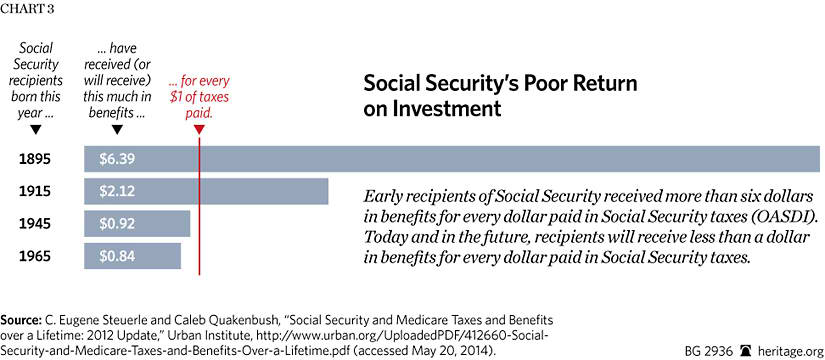
For decades, Social Security retirees received more in benefits than they paid into the system, but that will not be the case for recent and future retirees. An analysis by the Urban Institute revealed that an average-earning male who reached age 65 in 1960 received $6.39 in Social Security benefits for every dollar he paid in Social Security taxes. This ratio has declined over time to $2.12 for workers who reached age 65 in 1980. For recent and future retirees, Social Security will provide a negative rate of return: Workers who reached age 65 in 2010 will receive 92 cents for every dollar paid in taxes, and workers who reach age 65 in 2030 will receive only 84 cents for every dollar in payroll tax contributions.[7]
As Social Security has shifted from a program to protect the elderly from poverty to a potential decades-long income subsidy, current workers and younger generations will inevitably bear the burden of Social Security’s drain on the federal budget. Raising payroll taxes on today’s and tomorrow’s workers to cover Social Security’s funding shortfall would only add to their burden.
Three Social Security Reforms
The sooner lawmakers act to address Social Security’s massive and growing cash-flow deficits, the lower the burden will be on current and future workers. Three important reforms could help solve Social Security’s financial shortfall and shift the program back toward its original purpose of protecting seniors against poverty:
- Fix Social Security’s cost-of-living adjustment. Social Security’s cost-of-living adjustment (COLA) is based on an outdated measure of changes in the cost of living that fails to account for how people react to changes in prices. Lawmakers should index Social Security’s COLA to the chained Consumer Price Index (CPI), which acknowledges that people choose less expensive and different goods and services in response to changes in prices. This would more accurately protect the value of benefits while improving Social Security’s finances.[8]
- Increase the early and full retirement ages. Since Social Security’s inception, life expectancy at birth in the United States has increased by more than 20 years, while life expectancy at age 65 has increased by about seven years.[9] At the same time, jobs in the United States have become less physically demanding and individuals have become healthier.[10] Yet, Social Security’s full retirement age has increased by only two years, and the early retirement age has not increased at all. Social Security’s retirement age serves as an implicit guideline for actual retirement, as nearly two-thirds of eligible workers choose to take Social Security benefits between the early and full retirement age. For Social Security, this means greater financial strain, and for the economy, it means a smaller workforce, lower economic growth, less retirement security, and lower revenue. Lawmakers should gradually and predictably increase the early and full retirement ages, and then index both to increases in life expectancy.
- Focus Social Security benefits on those who need them most. Social Security was designed as a program to protect the elderly from poverty, yet it pays benefits to more than 47,000 millionaires and leaves many low-income recipients in need of additional welfare benefits.[11] Lawmakers should phase out benefits for retirees with high levels of non–Social Security income and provide a true system of social insurance that focuses on seniors who need it most. Lawmakers should also consider a minimum flat benefit level to protect all seniors from poverty in retirement.
Social Security Needs Reform Today
Despite being solvent for about two more decades, the Social Security and Disability Insurance programs are already contributing to annual deficits. Absent reform, Social Security benefits will be cut across the board by 23 percent in 2033. Action should be taken today to protect Social Security’s most vulnerable beneficiaries from such drastic cuts without burdening younger generations through tax increases.
Lawmakers should immediately replace the current COLA with the more accurate chained CPI, raise the early and full retirement ages gradually and predictably, focus Social Security benefits on those who need them most, and alleviate poverty in old age with a minimum flat benefit.
—Rachel Greszler is Senior Policy Analyst in Economics and Entitlements in the Center for Data Analysis, of the Institute for Economic Freedom and Opportunity, at The Heritage Foundation. Romina Boccia is Grover M. Hermann Fellow in Federal Budgetary Affairs in the Thomas A. Roe Institute for Economic Policy Studies of the Institute for Economic Freedom and Opportunity.


