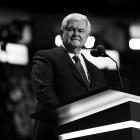
EDWIN J. FEULNER, Ph.D.:
Just as Ronald Reagan made conservative ideas popular at the presidential level, so too did Newt Gingrich popularize them for the Congress and for a change in the Congress. In introducing Newt Gingrich again to a Heritage audience, I would only make three points.
The first point: When he was named Man of the Year by Time magazine in 1995, they said "Leaders make things possible; exceptional leaders make them inevitable." Newt Gingrich belongs to the category of exceptional. Time magazine got it right that time.
Number two: Newt Gingrich is a man of vision and forward thinking. Several of us here in the room remember a brown bag lunch we had with him in 1978, before he was elected to Congress, while he was still a professor of history. It was over at our old headquarters building, and he talked to us about his vision of a future where stay-at-home moms--a term none of us had ever heard before at that point--would be working from computer terminals in their home. This before the invention of the Apple PC: a man of vision.
A man who, if you skip ahead 23 years to the night of September 10, five weeks ago, I ended up sitting next to, coming back from Frankfurt Airport to Dulles, rather serendipitously. We had a long discussion on the way across the Atlantic about national security issues, about the need for ballistic missile defense, and at one point he said to me, "You know, you really ought to have your people over there take a closer look at homeland defense; we need to be doing a lot more in that area."
The next morning, he and I were on the phone after the incredible tragedies across the river here at the Pentagon, in New York City, and in that field in western Pennsylvania. Within a couple of hours, we had both, in our own separate ways but more or less in concert, called for a declaration of war on terrorism.
That brings me to the third point: Newt Gingrich is a man with whom not everyone agrees, but to whom everyone in the policy arena listens.
Ladies and gentlemen, it's my very great pleasure to welcome back to the Heritage Foundation our good friend, Newt Gingrich.
NEWT GINGRICH:
Let me start by saying that I think it's very important to understand that a state of war has in many ways existed since 1983. If you look at the list of the 22 Most Wanted, it includes somebody whose first activity killing Americans was the Marine barracks in Lebanon.
That person is still active. According to the summary that was released, they believe he was also responsible for kidnapping and killing the head of American CIA activities in Lebanon, that he was also active in and responsible for kidnapping an American officer serving with the United Nations and killing him, and that he's had other activities since then.
So here you have a man who has now spent a period of 18 years being at war with America. And in his mind, he's been actively trying to figure out how to hurt Americans for 18 years.
If you don't want to go back that far, you could go back no further than 1993 and the first bombing of the World Trade Center. You then had the bombing of the Khobar Towers barracks in Saudi Arabia; you then had the bombing of two American embassies in Africa; you then had the bombing of the United States warship, the USS Cole , in Yemen. These were acts of war carried out on a continuous basis by people who have, I think, legitimate reasons for not liking us.
Let me be clear about this. I think all of the efforts to understand why they don't like us come down to a very simple model. We are a free society with a liberated role for women, with a very complex, open advertising system that creates a range of lifestyle opportunities, all of which are abhorrent if you are a fanatic who believes in a medieval version of Islam.
Two Waves of Opponents
It's important to understand that we have two waves of opponents in the Islamic world. We have the modernists, led by Saddam Hussein, who is relatively secular and relatively modern. The Ba'ath party was originally in many ways anti-traditional Islam. And you have the medievalists. I think it's better to describe them as medieval than as fundamental, because "fundamental" implies a whole range of connectivity in the United States that has no parallel.
Afghanistan's Taliban seeks to create a medieval world in which women are totally repressed. It's been astonishing to me for the last few years that the feminist movement in America has not been more offended by the people who are our opponents.
We need to understand: This is not about appeasing them. You can't appease them over Israel; you can't appease them over Saudi Arabia. The core objective reality is that our very existence functions as an act of war, because our very existence offers to their young a desirable alternative to the closed society they intend to create. You have to start with that.
I also think it's important to regard September 11 as an opportunity to come to grips with reality, comparable to 1941 at Pearl Harbor and to 1947 with the fall of Czechoslovakia. On those two occasions, the American nation responded to a general state of affairs. That is, after Pearl Harbor, we didn't just say, "Let's go sink the Japanese fleet." We said, "We're now at war with the Axis." We took on Japan, Italy, and Germany simultaneously, and we said, "Our goal is to win a global war."
After 1947, we didn't just say, "Gee, our problem is, how do you deal with the Soviet Union in the middle of Europe?" We said, "This is clearly a general threat, and we have to create a worldwide coalition, and we have to contain the Soviet empire until they break," which we successfully did in the 45-year campaign.
The Lesson of September 11
I would argue that the biggest lesson of September 11 is not that there are terrorists who hate us. The biggest lesson of September 11 is that in the 21st century, our cities are vulnerable to a variety of attacks.
I helped create, with President Bill Clinton, the Hart-Rudman Commission back in 1997, and we had 14 senior people from both parties, plus retired military, who worked for three years, looking out to 2025. When we reported in March, we said that the number one threat to the United States is a weapon of mass destruction going off in an American city. I want to repeat that. It wasn't commercial airliners hitting a building; it was a weapon of mass destruction: chemical, biological, or nuclear.
Our estimates were that you had to be prepared in a homeland security agency for as many as four cities being hit simultaneously with weapons of mass destruction, and that unless you had a robust enough system to contain and respond to a disaster of that scale, you were underestimating the danger.
There wasn't a great deal of interest back in March, although I will say that Congress was more interested than the news media. People were complaining that they weren't aware of it, and "Gee, nobody thought of these things." It's just plain not true. Tom Clancy wrote a novel in which a Boeing 747 hits the Capitol, and in that novel, he describes the impact of aviation fuel on a building.
My ground rule is simple: Those who knew worried, and those who didn't worry didn't know. Now, on September 11, you have an intersection where for a brief period, people can worry. The question is, coming out of that worry, when we're done with this particular period, will we be, in fact, profoundly different?
I want to start with the question of what can happen to our cities? Because there are essentially three very different kinds of threats.
- First of all, international terrorism in the Osama bin Laden/al-Qaeda tradition.
- Second, dictatorships with weapons of mass destruction, in which I would list Iraq and North Korea as the two greatest dangers.
- Third, nations that are relatively stable but that are acquiring weapons that can directly threaten us. Even in this period of comity, there is considerable effort underway, for example, in China and Russia to develop weapons that could defeat American forces at the theater level. These are very sophisticated efforts by very intelligent people, and I have great respect for them.
So when you start talking about our future at a defense level, I think you've got to be capable of dealing with all three of these threats, and you've got to recognize that we literally are always threatened in our cities. We're threatened by terrorists; we're threatened by missiles; we're threatened by clever ways of delivering violence.
Need for a Homeland Security Agency
We said at the time that on the defensive side, you had to have a homeland security agency. Let me say that the President took the correct first step, but if it is the only step, it will be a failure. It is impossible for Tom Ridge's job in its current form to work beyond the immediate crisis. Impossible.
It's also constitutionally wrong. A presidential appointee parallel to the National Security Adviser is not accountable to the legislative branch. On something as important as the survival of American cities, the legislative branch ought to insist on accountability. So it ought to be a legislated office and an office which has to report to the Congress, and an office which ultimately has to be approved by the Senate. Anything short of that is an inadequate level of accountability for future crises.
In addition, we argued passionately that you had to have an agency with budgetary power, and it had to be a Cabinet-level department, not a White House office. Anybody who has worked with the drug czar's office knows that the power of jawboning inside the federal bureaucracy is a stunningly limited power. If you don't have control over the money, if you can't promote people or fire people, you don't have real power.
The parallel with Condoleezza Rice's job as National Security Adviser is a false parallel. The National Security Adviser mediates the relationship between the President of the United States and other foreign powers, and mediates the relationship between the President of the United States, the Secretary of State, the Secretary of Defense, and the Director of Central Intelligence. As a consequence, the National Security Adviser briefs the President every day, is in meetings with the President every day, and has a level of personal involvement that is absolutely unlike what will happen after you get past the current crisis.
Will Tom Ridge have a lot of access for 90 days? Yes. Will he have a lot of access for three years? It is impossible. No presidency could stand that unless we were under constant attack. So that will become an office comparable to the drug czar, not comparable to the National Security Adviser, which is why, to be effective, he has to have line-item power and he has to have a budget.
We strongly felt that that office ought to be built around FEMA, because the Federal Emergency Management Agency is the logical day-to-day interactor. Notice that almost all the people who respond are civilians. They're not military. They're police; they're emergency people; they're fire departments. So you want FEMA, which on a normal basis is constantly working with these people for floods, for hurricanes, for tornadoes, for earthquakes: FEMA is the logical base around which to build response for a domestic crisis.
In addition, you want to allocate and dedicate parts of the National Guard. We need far more robust construction capability, far more robust medical capability, so that if you did have an outbreak of smallpox, if you had an outbreak of an engineered anthrax that was communicable or something else that was truly dangerous, you'd have a massive capacity to respond with mobile hospitals and with mobile quarantining. We currently have none of those capabilities.
You want the homeland security agency to be able to focus on reconstruction and minimizing casualties, because you could well be in the middle of a war overseas when the event occurs in the United States, and you can't expect the Secretary of Defense to simultaneously be managing an offensive campaign overseas and a defensive campaign at home. It's not a doable job. There's too much involved. That's why I would argue that you have to go to some kind of homeland security agency.
Domestic Security
Let me talk briefly about domestic security. Having nine incompetent people do what three incompetent people used to do does not necessarily dramatically increase the capacity for security.
Let me start with a simple analysis. To the best of my knowledge, we do not know of anything we are now doing in airport security that would have stopped September 11. There seems to be some indication that the weapons were actually put on board by people who were working on the airfields; they weren't smuggled through security. So we are now engaged in a massive increase in the complexity of airline travel for no known consequence.
I would also point out that since we're now dealing with suicide bombers, the current questions are totally insane: "Did you pack your bag personally?" "Absolutely. I made sure the bomb was in there." What is the point of this?
I want to draw two distinctions here that are central to how we ought to think about the next five or 10 years.
Frantic vs. Effective
There's a big difference between being frantic and being effective. Frantic is the first-wave response of a bureaucracy that you knew was incompetent before the crisis but you want to pretend the next day has been modified radically. Why would you think the people you complained about the day before the crisis are dramatically better the day after the crisis because you're now giving them more power? They're not.
We have to really be careful, because you can engage in a lot of frantic behavior that absorbs a lot of energy. The current plan to make the Capitol a fortress is one that, as Speaker, I blocked because the security people have for a decade wanted to make the Capitol a fortress. The notion that you can't invent a Pennsylvania Avenue that's safe is just a tribute to the Secret Service's lifetime desire to block Pennsylvania--and they want to block 17th Street if they can figure out how to do it--which is nonsense. It would have had no impact on September 11 because the airplanes weren't coming down Pennsylvania Avenue.
You have to stop and say to yourself, "Tell me the threat you're trying to stop." Then, when you do, you find out that if you put a bridge across Pennsylvania Avenue that blocks anything larger than seven feet, you have a pedestrian bridge that guarantees that no truck is going to pull up. You could move Pennsylvania Avenue across Lafayette Square, as has been suggested. There are many things you could do.
The attitude of security forces when there's a brief period of panic is to grab as much space, hang tight, and hope that a bulldog-like determination will give them the maximum space. That's what we're going through right now. We closed the one airport no airplane came out of while opening the airport that produced the airplane that hit the Pentagon. Think about that. There was zero connectivity between closing National and opening Dulles in terms of the events of September 11.
For normal terrorist attacks, what we had been doing was perfectly good. We have not had a major terrorist incident in the air for many years because against a random, untrained terrorist, the security system worked fine. It wasn't particularly brilliant, but it was fine.
Comfortable vs. Serious
So let me talk for a minute about, first of all, the difference between being frantic and being effective, and, second, the difference between being serious and being comfortable, and let me explain the difference.
A comfortable organization looks at a new problem and accepts any strategy which does not require a structural change. You're seeing this at the Pentagon now. Many modernization programs are now "transformational" because they've heard both the President and the Secretary of Defense say the words "transformation of." They took exactly the same program that last year was not transformational, put "transformation" on top, and have now resubmitted it. They can show you the list of transformational programs they have underway, which is remarkable because they were, in fact, the programs that they had underway last year before they were transformational.
A serious organization looks at the problem it has to deal with, and then adopts the strategy that will win, and then changes its structure to implement the strategy. For example, the U.S. Navy concluded around 1918 that airplanes could fly off of ships. They began buying aircraft carriers. The Langley was the first one in 1919. They eventually built an entire fleet doctrine around aircraft carriers, which was a very big change if you were used to guns that fired bullets or large shells for 20 miles. It was a very profound change.
Armor was a very profound change, because it moved at a pace infantry couldn't keep up with, and it required very substantial rethinking of the structure. Those are real changes.
Getting Serious About Airport Security
The American model of security is a capital-intensive, high-technology model. We don't do well when we have poorly paid people with limited equipment, designed at a minimum-cost basis. Other countries do that well; we don't. It's not our national style.
The two best places for invisible security, Las Vegas and Disney World, have very high levels of security, but you don't notice them because you won't come back if you're scared. They're the model for airports.
Principle number one: Everybody who works at an airport on a regular basis should have a biometric check, probably retinal. You walk through; you're an airline pilot; we've registered who you are. A camera looks at you, and in less than a second, the computer says you're who you say you are. The retinas have 256 points of reference. Thumb prints have 36. It is very hard to deceive a retinal scan. It could be done, but when you get to that level of terrorism, you have a whole different set of problems. It's way beyond al-Qaeda.
You automatically change the entire security system, and it's faster. It's exactly like those of you that have a sticker on your car so you can drive through the toll gate at five miles above the speed limit or whatever you think you can get away with--which, again, is the American model.
This does not require a national databank. It requires a two-track system. Everybody who is a frequent traveler, who wants to be convenient, who would like to not be slowed down, you walk through Lane A. We know who you are. We record you instantaneously. It's very efficient.
Everybody who doesn't want to do that, which is your right as an American in peacetime, there's a line over here. It may take awhile, but they'll get around to you, and you'll get through eventually.
You will find that about 95 percent of the frequent flyers in this country will migrate instantly to registering. You look in a camera one time; they register your retina; you put it in a national base so that wherever you walk through, they can record who you are. Similar biometrics which come off facial characteristics ought to be a standard part of walking through every immigration line.
People say to me, "Does this mean the era of big government is back?" I say to them that if a government can't buy a computer to allow the CIA watch list to get through the FBI to the FAA in six weeks, which is how long they were looking for the two guys who got on the plane in Boston under their own names--this was not a false identity card, which at least half of you used as kids; they got on the plane under their own name because they were so confident the American system wouldn't catch them--that's not a very sophisticated model.
If we're serious about security, we can be much more secure. Part of that is to get companies like GE to build MRI systems for container cargo. We have 3.5 million containers a year that come across our borders. We don't want to slow that down, and we don't want to inspect them. We want to have some kind of electronic device that scans them at very, very high speed, and we want to be able to seal them in after the scan, so you could actually scan them in Thailand before they're shipped and have an electronic seal that, if it's broken, would send off a signal.
We can do that, but it requires a capital-intensive, DARPA-style investment rather than the FAA models. I think that's a very different future.
How to Win the War on Terrorism
Let me talk briefly about winning the war, and then about what we do beyond the current campaign. I would just make 10 quick points.
Second, in wars, your enemies are allowed to be clever, courageous, and determined. In the first couple of days, we talked about how cowardly they were. These people are not cowards. They are smart, dedicated fanatics, willing to die to kill Americans, and we need to assume that our enemies are at least as smart as we are.
Principle three: In war, the vision of success is decisive for the rest of what you're trying to accomplish. I cannot overstate this. Our vision has to be--and, generally, the President has been right on this, although there has been some tension between State and Defense on it--that we are against terrorism internationally; that Afghanistan is the first campaign; it is not the campaign.
It's very important for us to come back to this again and again. We are in the business of making American cities safe. We're not just in the business of catching Osama bin Laden. Nothing would be more dangerous for us than to have bin Laden get turned over, announce victory, and then allow new martyrs to grow up, prepared to pursue bin Laden's career, and wait for the next wave of attacks. It's important to take the energy we have now and apply it to winning a war against the threats to our cities.
Principle four: The stakes are enormous. As I said earlier, I cannot overstate this. You live in a country which has to assume that at some point in your lifetime, there will be a series of weapons of mass destruction used against us. They exist. They are possible. We have people who hate us. If we do not take advantage of this opportunity, of this revulsion by the world against these attacks, and use this period to dramatically change the balance of terror on the planet, we should expect future problems.
The model is simple. Piracy was relatively common in the early 18th century. By the end of the century, it had been totally wiped out because it became unacceptable behavior, and people gradually came to the agreement that we won't tolerate it anymore. We have that same model here. We have to say supporting and sustaining terrorists is intolerable.
My fifth principle is--and the President has been very good at this so far--that means a series of ultimatums. Currently, we're involved in ultimatums with the Taliban. I would hope that, next, we would go toward Syria or Iraq. Iraq is the more important target, but I think we have to go through a revolving cycle of ultimatums where we basically say, "Pick which side you're on, and if you're on the side of terrorists, you have to be replaced."
Which is my sixth principle: To achieve victory, you have to plan for a coercive, not a consensual, result. The difference is powerful. Consensual is, how far can we push the Syrians? Coercive is, X has to happen. We'd like them to do it voluntarily. If not, what are we going to do to raise the ante until they have to do it? And raising the ante may well mean, in a number of cases, replacing the government.
Principle seven is that the campaign has to be comprehensive. We need a massive, ongoing public diplomacy campaign, and it has to be more than government officials talking. It's very revealing that Nelson Rockefeller recruited Disney to help do cartoons for Brazil in the Second World War, which actually became stunningly popular. His goal was to have a variety of mechanisms to communicate with people.
So whether it's in song, whether it's on MTV, whether it's on whatever the Middle Eastern version is of MTV, you want a continuing pattern of messages that reach people; that say everybody that wants to have a secure life, everybody that wants to have a prosperous life, everybody that wants to live without being afraid of terrorists, you're on our side; that we are the allies of 99 percent of the Islamic world. And that message has to come from a lot more than just government officials.
In addition, when we win, we have to be generous. I would argue that the other part of the comprehensiveness is, if we win in Afghanistan, which I believe we will, the following week, aid and reconstruction, new irrigation, new health care, new food. People around the Islamic world have to see vividly that being on the American side pays off.
We did this before. In 1945, we rebuilt Germany, Italy, and Japan. In 1953, we rebuilt South Korea. The fact is, it has paid off for us in overwhelming returns, and we should take the same attitude toward dealing with the challenge country-by-country, starting with Afghanistan.
Eight: I think the coalition has to start with what we're trying to do and has to be as large as will agree to do what we want to do. We cannot reshape our aims to build the coalition. In some places, we may literally go it alone. Technically, we have the power to go it alone against any plausible country that is harboring terrorists; and in a lot of places where we couldn't go it alone, none of them harbor terrorists. There are no countries that currently harbor terrorists that the United States could not defeat on its own.
This notion that we are limited by our allies is exactly backwards. We have to define the goals. We have in Afghanistan so far. It's working reasonably well. I think that in the next phase of the campaign, we have to do it.
My ninth principle is, you're going to have to sustain freedom every day. We've now entered a 21st century in which we are bound to the rest of the planet. There will always be potential terrorists. The trick is to keep them as disorganized and as weak as possible. There will always be potential enemies. The trick is to understand them and prepare for them. But we will never be able to back off from the challenge of sustaining freedom.
I believe that we're clearly paying some of the price for having grossly underfunded defense and intelligence. For the first time since Pearl Harbor, we got below 3 percent of our gross national product last year in terms of defense and intelligence combined. I believe, as a general goal, we should be at 4 percent of our GDP for defense and intelligence. I don't think it is possible technically to do everything we need to do around the world, to sustain the force and to transform the force, and to have the intelligence we need.
I'll give you just one example. People say, "We need more spies and fewer satellites." No, we need every satellite we have--and we actually have about 25 percent too few satellites--and we need human intelligence. We need to decide, as a serious country, that we're going to do what it takes to be secure, and that means more intelligence; it means more comprehensive defense capabilities; and I suspect it means, in the end, a larger force with more modern systems in order to be able to accomplish what we want to be able to do.
The fact is, we are trapped on the planet. None of the terrorists we have identified so far are Afghan, but we're fighting in Afghanistan. Just think about the complexity of a world in which, in fact, we end up in a country we have no particular reason to be in, chasing people who are largely Saudi Arabian and then other various nationalities. It's a very complex future, and we can't get by with it on the cheap, except at great expense.
Finally, we have to develop a method of reminding the American people again and again what we're doing. We built after World War II an amazing consensus on managing the Cold War. It lasted a very long time, and I think that it's the kind of system we need to go back to.
The Problem of Iraq
When we finish in Afghanistan, which I suspect will happen when the Taliban crumbles and when there is a new post-Taliban government that's probably a broad coalition and that makes it much easier to go after the various terrorists, I believe the next stage has to be Iraq. It has to be Iraq for a couple of simple reasons, if your goal is defending America's cities, not merely getting even for September 11.
I recently talked with the defector who headed the Iraqi nuclear program. When he left in 1994, there were 7,000 people working on nuclear weapons in Iraq. Richard Butler, the Australian who was the head of the U.N. inspection program in Iraq, says flatly that Saddam Hussein's government is working on biological, chemical, and nuclear weapons. He doesn't think it's debatable.
Saddam is a man who proved, both by using chemical weapons against the Iranians and by using them against a city in his own country, that he's very prepared to use chemical weapons. Saddam has proven that he will accept 100,000 dead Iraqis, which was the cost of the 1991 war. And he will accept 10 years of sanctions in order to keep building weapons of mass destruction.
Any reasonable person would have to come to the conclusion that this is a man who intends to use them the first chance he gets. This is Hitler in 1935. And it would be an act of extraordinary folly for us to back down after the Afghan campaign and not do whatever is necessary.
I thought the President took the first step the other night when he described Saddam as evil and said he had better let the inspectors back in. But if Saddam is still in power and there are no inspectors three years from now, then we will have lost this war, even if we do well in Afghanistan, because Iraq is a vastly greater threat to our cities than is Afghanistan.
The Honorable Newt Gingrich is former Speaker of the U.S. House of Representatives and author of Lessons Learned the Hard Way. Edwin J. Feulner, Ph.D., is President of The Heritage Foundation.


