
My name is Stuart Butler. I am Vice President for Domestic and Economic Policy Studies at The Heritage Foundation. The views I express in this testimony are my own, and should not be construed as representing any official position of The Heritage Foundation.
The new Congressional Budget Office (CBO) baseline once again underscores the scale of the entitlement spending problem:
- Medicare spending (including offsetting receipts) expanded 12 percent in 2006 and will grow 13 percent more in 2007. Combined Medicare and Medicaid spending now exceeds Social Security spending.
- The Medicare drug entitlement is now projected to cost $822 billion through 2017. It will cost $60 billion per year by 2012 and $119 billion per year by 2017. Its annual expense will continue to increase thereafter.
- Over the next decade, Medicare and Medicaid costs will surge by nearly 8 percent per year, and Social Security costs by 6 percent annually. These programs will rise from 8.5 percent to 10.7 percent of GDP as the baby boomers begin to retire.
- Meanwhile, notes the CBO, the federal government is not suffering from a dearth of revenues. Revenues are projected to grow from today's above-average level of 18.6 percent to almost 20 percent in 2012 and then continue at record levels as a percent of GDP.
But these 10-year figures actually only hint at the far more serious budget problem - the tsunami wave of entitlement spending that will hit the budget when the Baby Boom generation begins to retire in large numbers. As the CBO's long-term forecast indicates:
- The combination of the "big three" entitlements - Medicare and Social Security and Medicaid - will double from the current 8 percent of GDP to 15 percent when today's newborn graduates college, and reach nearly 20 percent of GDP when today's college graduate reaches retirement in 2050.
- With conservative assumptions, CBO projects that under current law the federal deficit will increase from today's 3.3 percent of GDP to about 20 percent in 2050.
As Comptroller General David Walker has pointed out, this entitlement-driven unfunded growth in spending will impose staggering financial burdens on our children and grandchildren:
- The total present value of unfunded federal obligations of the federal government, or fiscal exposure, is now $50.5 trillion ($38.8 trillion of which is due to Medicare and Social Security).
- This exposure translates into a financial burden of $440,000 for every household or, put differently, a mortgage of $170,000 placed in the crib of each and every baby born in America.
Why Raising Taxes Is Not the Answer
Given the scale of future entitlement spending, and the enormous unfunded obligations, it may be tempting to say that the prudent step would be to raise taxes to keep pace with the mounting obligations. But there are at least three reasons why this would be folly:
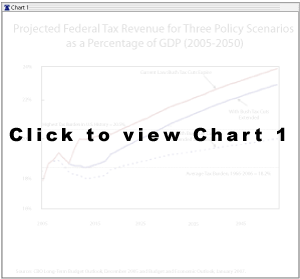
- Falling tax levels are not the cause of the long-term problem. Federal tax revenues currently are 18.6 percent, just above the historical level of 18.2 percent - a reasonable level of taxation that has helped the US economy perform consistently better than other major countries. Moreover, as Chart 1 indicates, CBO's long-run forecast projects that federal taxes under current law will exceed their highest-ever level (20.5 percent in 1944 and 2000) by 2022 and rise to almost 24 per cent by 2050. That unprecedented level means taxes as a percent of GDP would be one-third higher than the burden today. Even if the Bush tax changes were made permanent that would shave only about one percentage point off this rising tax burden.
America does not face a long-term decline in the level of federal revenues as a percent of GDP. In fact, we face a worrying increase in the burden of taxation.
- Raising taxes further would be damaging. Any increase in taxes would be on top of this already record rise in the projected tax burden. If we were to balance the budget without tackling entitlements, and maintained discretionary spending at the same proportion of GDP as today, federal taxes would have to rise to almost 30 percent of GDP by 2050 - two-thirds higher than today. Add in state and local taxes of approximately 10 percent, and our children and grandchildren will face total taxes similar to low-growth, high-unemployment Europe.
- Raising taxes on future generations would be immoral. Raising taxes to address the long-term spending situation means increasing tax burdens on future generations to fund the huge future benefits this generation has voted itself. We in this generation have voted to pay for these benefits by handing steadily increasing credit-card bills to future generations. That is wrong, and should be corrected. But the way to reduce borrowing money from our children and grandchildren is not to take their money in new taxes instead. Every dollar of new taxes imposed on younger Americans to "fix" the long-term spending and deficit problem simply takes the place of a dollar we would otherwise borrow from the same people. If borrowing money from our children and grandchildren to pay for our excessive spending is immoral, then taking their money is even more immoral.
How Should We Address This Long-Term Problem?
When a family has bought a house that is too big, and it cannot pay the mortgage, the answer is not to send its youngest members out to get jobs and for the parents to take second jobs. It is for the family to admit that it is overextended and to move to a more modest house with a lower mortgage. That is what we must do with entitlements - admit that we have overextended ourselves and overcommitted our children and seek fair and reasonable ways of reducing future spending. That means looking hard at the promises we made to ourselves and making reasonable and prudent changes - changes that still provide necessary resources to those who need them but reduce the burden on future generations.
To do that fairly and efficiently, Congress should take the following steps:
Replace the drug benefit provision of the Medicare Modernization Act with a targeted benefit
The 2003 Medicare drug bill was a huge and unaffordable new entitlement. Instead of providing help only to those seniors who needed help to afford their prescriptions, it provided a heavily subsidized drug benefit to all retirees on Medicare, including millions of retirees quite able to pay for their prescriptions. The new Part D program has increased unfunded obligations on future generations by a present value of $7.9 trillion - larger than the entire publicly held debt in 2000.
It is hard to imagine how the burden of future generations can be addressed without revisiting this unaffordable credit-card legislation. Congress should repeal the general subsidized benefit it enacted and replace it with a limited benefit targeted to only needy seniors.
Introduce full income testing of Medicare parts B and D
Parts B and D are not social insurance programs. Unlike Social Security and Medicare Part A these are not benefits that retirees "paid for" in payroll taxes during their working life. They are heavily subsidized voluntary insurance programs.
Today the Part B premium charged to seniors, even to millionaires, is just 25 percent of the true cost. For the Part D drug benefit, the premium charged for basic coverage is also approximately 25 percent of the total cost. Given the excessive spending level and future borrowing required to subsidize these voluntary programs, it is time to say that the subsidy should be based on need. Richer seniors should have a smaller, or no, subsidy for their Part B and D premiums.
The best step, as already noted, would be to repeal the new Part D drug program and replace it with a far smaller subsidy restricted to those who need. If that cannot be achieved, then the Part D and Part B premiums should be fully income adjusted, with Congress raising these premiums to 100 percent of their real cost for affluent seniors. At the very least, as an interim measure, Congress should make the subsidy in Parts B and D taxable for those with moderate and higher incomes, thereby recouping some of the subsidy for upper-income retirees.
Make all Social Security benefits fully taxable for higher-income seniors
Recognizing the unfunded obligations of retiree benefits, Congress has already accepted the principle of taxing Social Security benefits in order to recoup some of the benefit costs. The tax applies to single seniors with annual incomes greater than $25,000 ($32,000 for couples). Above these incomes, seniors must pay tax on a rising proportion of their benefits (starting with 50% of benefits included in taxable income, rising to 85 percent).
With the principle of recouping unaffordable benefits in this way, it is time for Congress to phase in 100% taxation of benefits for all single seniors with incomes above $25,000 and married couples above $32,000. The full 100% taxation should apply on single incomes of $35,000 and married couples with $45,000.
Eliminate Disincentives that Discourage Workers from Working Longer
As Urban Institute economist Eugene Steuerle pointed out almost a decade ago, today's workers are likely to have a longer lifespan, are healthier, and are less likely to work at physically demanding jobs than was the case for workers fifty years ago. A male American today who reaches 65 can expect to live about another 17 years, while a female can expect to live almost 20 more years. Yet, since the 1980s, over half of workers retire at 62, with less than 20 percent saying that they retired because of ill health. We are approaching the point where typical Americans can plan on spending one-third of their adult life in retirement, with financial support guaranteed from other working Americans. This is not sustainable. Retirement programs should not begin at age 62. Workers can and should be encouraged to work longer.
Part of increasing working life will require cultural changes. Workers need to expect to work until later in life, and employers to value older workers for the experience they bring. But in addition, existing disincentives in the tax system need to be eliminated to make it more attractive to spend a more reasonable and sustainable proportion of adulthood at the workplace. A major disincentive today is that Social Security benefits are calculated on a worker's highest 35 years of earnings. So for an individual who works beyond today's normal retirement, the only way that working longer can increase benefits is if the worker's pay, indexed for wage growth, is higher at, say, age 68 than it was in his or her 30s. As an incentive to work longer, therefore, Social Security taxes should not be imposed on those who are employed after their normal retirement age. Since half of payroll taxes are paid by employers, they would also have an economic reason to retain older workers longer.
Gradually Increase the Social Security Retirement Age to 70
In the last major reform of Social Security, Congress recognized that increasing longevity required a gradual increase in the normal retirement age (NRA) - the age at which a worker can receive his or her full Social Security benefits - from 65 until 67. In the nearly quarter century since then, the average lifespan has continued to go up, and so it is time for Congress to again raise the normal retirement age to adjust for that increase in longevity. Today the NRA is 66, with a scheduled increase to 67 set to begin in 2020. This is too long to wait for an overdue adjustment. Congress should at least begin phasing towards 67 in 2010 at the rate of 2 months per year until NRA reaches 70 in about 2034. At the same time, Congress should gradually raise the early retirement age - the age at which a worker can receive a reduced Social Security benefit - from today's 62 to at least 65.
Future increases in longevity should lead to additional increases in these thresholds. Moreover, periodic changes to these thresholds for Social Security, and the eligibility age for Medicare, should be a regular part of the five-year re-examination of entitlement programs mentioned later in my testimony.
Focus Social Security Benefits on those who need them the most
The way to give additional meaning to Social Security's promise to insure workers against retirement poverty is to focus the system's resources on those who face the greatest hardship.The best way to accomplish this would be change the Social Security benefit formula so that the benefits of lower income workers grow at a faster rate than those for upper income workers. Under this "progressive indexation" proposal the benefits of upper-income workers (those who earn over $100,000 today) would increase only at the rate of inflation, instead of at the rate of wage growth as they do today. Benefits for lower-income workers (those who earn less than $25,000 today) who retire in the future would continue to grow as they would under today's benefit formula. This is only fair, because lower-income workers are less likely than other workers to have any other retirement savings and more likely depend on Social Security benefits for almost all of their retirement income. Meanwhile, middle- and upper-income workers, who are typically able to put aside money for retirement, would receive smaller increases in traditional benefits.
Progressive indexation preserves the principle of social insurance for workers of every income level, but it also recognizes that in an era of limited resources, benefits should be concentrated on those who need them the most. Depending on how this change is implemented, it could reduce Social Security's unfunded liability by about 60 percent. However, for it to be successful without reducing retirement income, Congress must also act to ensure that every worker has a retirement saving program that they are strongly encouraged to participate in from when they first go to work until the day they retire.
Change the budget status of retirement entitlements
The current budget treatment of entitlements has two major shortcomings, which frustrate attempts to put reasonable constraints on spending and thwart efforts to balance national priorities.
The first shortcoming is that the federal budget works on a pay-as-you-go system with a limited "look forward" period, with Congress using arbitrary five-year and ten-year budget windows. So the long-term cost of existing entitlements is ignored in the annual budget cycle, and the potentially huge cost of proposed new legislation is also ignored - which is why the multi-trillion unfunded long term cost of the Medicare drug legislation did not even have to be debated. Steps must be taken to require Congress to address long-term entitlement costs and unfunded obligations during the annual budget cycle by including a measure of these obligations in the budget process.
In addition, entitlements have first claim on spending whether or not benefits for specific groups of individuals really should have top priority. For example, this means that Part B subsidies for retired millionaires preempt help for the homeless, or most education spending, in the struggle for federal funds. A key element of the solution to the entitlement spending problem is to enable Congress to make more rational trade-offs between the alternate uses of constrained future federal spending.
A two-step reform is needed to achieve these goals:
- Step 1: Include long-term entitlement obligations in the annual federal budget. A critical first step would be to amend the budget process to include a present-value measure of long-term entitlement obligations and special tax preferences in the annual budget process and to specify changes in the present value in the annual budget resolution.
The annual federal budget thus should prominently include a measure of the long-term budgetary situation implications. In addition, the long term budgetary implications of proposals to expand or reduce entitlement programs should be included in the budget, with a requirement that Congress go on record each year with a vote agreeing to an increase or decline in that long-term measure.
Last October the Federal Accounting Standards Advisory Board issued a report calling for changes in financial reporting for social insurance programs that might form the basis of such a budget process change. As the FASAB emphasized, the nation must have better financial information that will force Congress and the President to address the mounting unfunded long-term costs of entitlement programs.
- Step 2: Convert retirement entitlements into 30-year budgeted discretionary programs. Building on the first step, Congress also should begin to change the preferred status of entitlement programs, especially retiree programs, so that spending on some Americans is no longer mandatory while spending on other, more needy individuals is discretionary.Today, retired millionaires automatically preempt the homeless and our soldiers in Iraq in the struggle for federal funds.
To be sure, while one group of Americans should not automatically have first call on spending, it is true that even a more affluent American planning for retirement requires a high degree of certainty about such programs as Social Security and Medicare. But this does not mean that we should continue to wall off these programs from a fair and balanced consideration of the needs of future retirees compared with other needs - including the financial security of younger Americans.
A way to achieve balanced consideration and priority for the needy with a reasonable level of future certainty would be to convert all retirement spending entitlements into 30-year budgeted programs that must be reviewed and re-authorized by Congress every five years. This long-term spending and financing plan could be explicitly and openly adjusted regularly every five years in light of such things as changes in technology, demographics, and national priorities.
To keep the programs within the approved long-term budget, Congress would apply "triggers" to each program. Such triggers would require default and automatic adjustments to features of the program if the trend of current and future spending were projected to move above or below the budgeted amount. The eligibility age for Medicare benefits or payments to providers, for instance, could be adjusted. Congress would always be able to maintain the agreed budget glide path in another way. Indeed, Congress might utilize the National Entitlement Adjustment Commission, proposed by Senator Feinstein, to recommend ways in which Congress might deal with departures from the 30-year budget.
The Heritage Foundation is a public policy, research, and educational organization recognized as exempt under section 501(c)(3) of the Internal Revenue Code. It is privately supported and receives no funds from any government at any level, nor does it perform any government or other contract work.
The Heritage Foundation is the most broadly supported think tank in the United States. During 2013, it had nearly 600,000 individual, foundation, and corporate supporters representing every state in the U.S. Its 2013 income came from the following sources:
Individuals 80%
Foundations 17%
Corporations 3%
The top five corporate givers provided The Heritage Foundation with 2% of its 2013 income. The Heritage Foundation’s books are audited annually by the national accounting firm of McGladrey, LLP.
Members of The Heritage Foundation staff testify as individuals discussing their own independent research. The views expressed are their own and do not reflect an institutional position for The Heritage Foundation or its board of trustees.
